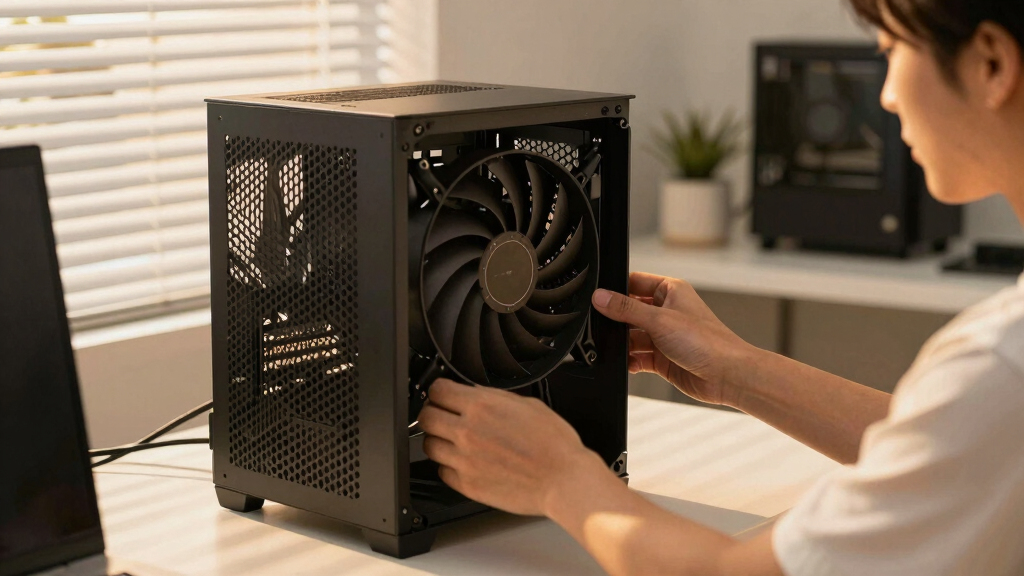

📊 Full opportunity report: Best Quiet Case Fans + the Airflow Setup That Actually Works on ThorstenMeyerAI.com — validation score, market gap, and execution plan.

Turn your quiet moments into listening time
- Thousands of audiobooks, podcasts and originals
- Listen on your phone, tablet or Echo — also offline
- Cancel anytime
TL;DR
This article identifies the best quiet case fans for 2026, emphasizing large, slow-moving fans like Noctua’s NF-A12x25 and Arctic P12 Pro. It also explains airflow setups that maximize cooling while minimizing noise, crucial for silent, high-powered workstations.
New data and testing confirm that large, slow-moving case fans such as the Noctua NF-A12x25 and Arctic P12 Pro offer the best combination of quiet operation and effective airflow for high-performance workstations in 2026.
Recent testing and expert consensus highlight that larger fans, like 140mm models, moving air at lower RPMs produce significantly less noise while maintaining excellent cooling capacity. The Noctua NF-A12x25, widely regarded as the best-engineered 120mm fan, moves over 100 CFM at below 1000 RPM with a noise level around 16 dB, making it ideal for continuous operation in quiet work environments.
For budget-conscious builders, Arctic’s P12 Pro and P14 fans provide nearly comparable airflow and static pressure performance at a fraction of the cost, around $8.50 each, with near-silent operation below 1000 RPM. These fans are recommended for filling cases with high-quality airflow without breaking the bank.
When silence is paramount, the be quiet! Silent Wings 4 fans deliver around 17 dB noise levels, maintaining quiet operation even at higher RPMs. For radiator setups, static-pressure fans like the Arctic P12 Pro and Noctua NF-F12 are preferred to push air through dense heatsinks or radiators effectively while remaining quiet.
Best quiet case fans
+ the airflow that works.
The best fan won’t help if it’s pointed the wrong way. The whole recipe: big fans, running slowly, in a clean front-to-back path, with slightly more intake than exhaust. Build a config in Part 2 and watch the pressure balance respond.
Why Choosing the Right Fans and Setup Matters in 2026
Selecting the appropriate case fans and airflow configuration directly impacts the thermal performance and noise levels of high-performance workstations. Using larger, slower fans reduces noise significantly without compromising cooling, which is crucial for quiet office environments and long-term reliability. Proper airflow setup ensures sustained cooling efficiency, preventing thermal throttling and hardware degradation, especially during intensive AI workloads.
As high-power components generate more heat, the right combination of fans and airflow design becomes essential for maintaining system stability and user comfort. This knowledge helps builders optimize their setups for both silence and performance, reducing the need for expensive cooling solutions or noise mitigation measures.
As an affiliate, we earn on qualifying purchases.
Latest Trends in Quiet PC Cooling for 2026
Over the past few years, the focus on quiet PC builds has shifted toward larger fans moving air at lower RPMs, driven by advances in fan engineering and a better understanding of airflow dynamics. The 2026 recommendations build on this trend, emphasizing the importance of matching fan size and type to specific roles within the case—intake, exhaust, or radiator cooling.
Recent reviews and tests from industry experts, including Thorsten Meyer, confirm that the combination of high-quality, large fans and optimized airflow curves can deliver both low noise and effective cooling. This approach counters the misconception that quiet systems must sacrifice thermal performance.
Prior developments include the release of refined fan models like Noctua's NF-A12x25 and Arctic's P12 Pro, which have set new standards for noise and airflow efficiency, influencing current best practices for workstation cooling setups.
"Big and slow beats small and fast—larger fans moving at lower RPMs deliver both quiet operation and excellent cooling, which is vital for high-performance AI workstations."
— Thorsten Meyer, cooling expert
As an affiliate, we earn on qualifying purchases.
Remaining Questions About Long-Term Fan Reliability and Setup
While current testing confirms the performance of these fans, long-term durability and performance consistency over years of continuous operation are still being monitored. Additionally, specific airflow configurations may vary based on case design and individual component placement, which can influence effectiveness. Further real-world testing in diverse setups is ongoing to validate these recommendations.
As an affiliate, we earn on qualifying purchases.
Next Steps for Builders and Manufacturers in 2026
Manufacturers are expected to release updated fan models with even lower noise profiles and higher airflow efficiencies. Builders should focus on implementing the recommended larger, slower fans with carefully tuned airflow curves to maximize silence and cooling. Future research may refine airflow strategies further, especially as new case designs and cooling technologies emerge.
static pressure fans for radiators
As an affiliate, we earn on qualifying purchases.
As an affiliate, we earn on qualifying purchases.
Key Questions
Why are larger fans better for quiet PC builds?
Larger fans move the same amount of air at lower RPMs, which produces less noise and reduces mechanical wear, making them ideal for quiet, high-performance systems.
Can I use smaller fans if I tune the airflow properly?
While possible, smaller fans typically need to run at higher RPMs to match airflow, which increases noise. Larger fans are generally more effective for quiet operation without sacrificing cooling.
Are static-pressure fans necessary for radiators?
Yes, static-pressure fans are designed to push air through dense heatsinks or radiators efficiently, ensuring optimal cooling performance in liquid cooling setups.
How do I tune my fans for quiet operation?
Set your fan curves to favor lower RPMs at typical operating temperatures, using fan control software or BIOS settings to achieve a balance between noise and cooling.
Source: ThorstenMeyerAI.com
Fall Picks
fall essentials
As an affiliate, we earn on qualifying purchases.