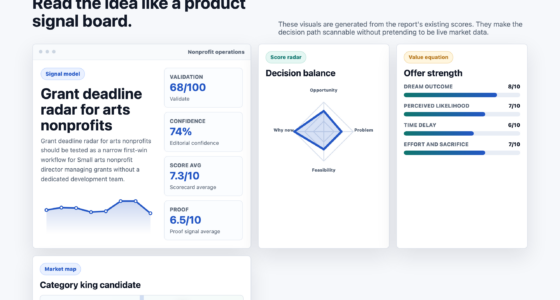

📊 Full opportunity report: Mobilised, Not Spent: What’s Left of Europe’s €200 Billion AI Offensive on ThorstenMeyerAI.com — validation score, market gap, and execution plan.
TL;DR
Europe’s €200 billion AI initiative is primarily a plan to mobilize private investment, with only a fraction of public funds actually committed. Major delays and gaps remain, questioning the strategy’s impact.
The European Commission’s €200 billion AI initiative, branded as a major offensive, is largely a plan to “mobilize” private investment rather than a direct expenditure. While the headline suggests a massive investment, only a small portion of actual public funds has been committed, and most of the money remains unspent and delayed.
The €200 billion figure is based on the concept of “mobilizing” private capital alongside €50 billion in public funds. In reality, only about €20 billion of that is genuinely public money, with roughly €5 billion earmarked for AI gigafactories and compute infrastructure. The rest depends on private investors, which Europe has struggled to attract due to fragmented markets, high energy costs, and regulatory hurdles.
Funding calls for the first AI gigafactory are not scheduled to open until July 2026, with the facilities expected to be operational between 2027 and 2028. Currently, only one site in Norway is under construction, and smaller AI factories are using existing supercomputers. Meanwhile, US tech giants are investing hundreds of billions annually, with Amazon, Microsoft, and others spending nearly $700 billion in 2026 alone, dwarfing Europe’s planned investments.
The core issues causing Europe’s lag—high electricity prices, slow permitting, fragmented markets, and reliance on US cloud services—are not addressed by the current strategy, which mainly consists of laws and frameworks rather than immediate investment or infrastructure development.
Mobilised, not spent
The EU is selling a €200 billion AI offensive. But the decisive word is “mobilised” — not “spent.” Work through the number and the headline shrinks dramatically before it reaches any effect.
2027–28 data centres expected to run
1 SITE under construction so far (Norway)
Late, slow, and not yet built.
A small, late, partly hypothetical cheque — without touching expensive energy, fragmented capital markets, slow permits, or the talent drain. The EU mistakes a funding pot for a strategy.
Impact of Europe’s Funding Approach on AI Competitiveness
This strategy’s reliance on private capital and delayed infrastructure means Europe risks falling further behind in AI development and deployment. The small, late investments do not address fundamental issues like energy costs, market fragmentation, or talent retention, which are critical for building a competitive AI ecosystem. Without substantial and timely investment, Europe’s AI ambitions may remain aspirational rather than operational, affecting its technological sovereignty and economic growth.
AI gigafactory construction kit
As an affiliate, we earn on qualifying purchases.
As an affiliate, we earn on qualifying purchases.
Europe’s AI Funding Strategy and Global Competition
The €200 billion figure was announced as part of the InvestAI program, aiming to position Europe as a leader in AI. However, the actual committed funds are minimal, and the timeline for infrastructure is slow. Meanwhile, US tech giants are investing massively—Amazon, Microsoft, and Meta alone spending nearly $700 billion in 2026—creating a significant gap in compute power, talent, and market share. Europe’s approach relies heavily on leveraging private investment, which has historically been limited due to market fragmentation and risk aversion.
Previous European initiatives have struggled to translate funding plans into tangible results, and current delays threaten to widen the competitiveness gap. The European Commission’s emphasis on laws and frameworks, such as the Chips Act revision and open-source strategies, complement but do not substitute for immediate, large-scale infrastructure investments.
“Taxpayers cannot foot this bill alone — Europe urgently needs private capital.”
— Ursula von der Leyen, European Commission President

ASUS Ascent GX10 AI Supercomputer, DGX Spark, NVIDIA GB10 Superchip, 128GB LPDDR5x, 1TB PCIe Gen4 NVMe SSD, Wi-Fi 7 & BT5.4, Agentic AI Ready, Supports OpenClaw, NemoClaw, Stackable Chassis
Extreme AI Performance: Powered by NVIDIA GB10 Grace Blackwell Superchip delivering 1 petaFLOP of AI performance and 128GB…
As an affiliate, we earn on qualifying purchases.
As an affiliate, we earn on qualifying purchases.
Uncertain Outcomes of Europe’s AI Funding Model
It remains unclear whether the EU will succeed in attracting the private investment needed to meet its leverage targets, given the current market fragmentation and risk aversion. The timeline for infrastructure development is also uncertain, with delays likely and no guarantee that planned gigafactories will be built or operational on schedule. Additionally, the impact of broader issues like energy costs and talent migration on Europe’s AI competitiveness remains unresolved.

Computer Security – ESORICS 2025: 30th European Symposium on Research in Computer Security, Toulouse, France, September 22–24, 2025, Proceedings, Part II (Lecture Notes in Computer Science)
As an affiliate, we earn on qualifying purchases.
As an affiliate, we earn on qualifying purchases.
Next Steps in Europe’s AI Investment and Infrastructure
The European Commission plans to open the first calls for AI gigafactory funding in July 2026, with infrastructure expected to be operational by 2027–2028. Progress will depend on the success of these calls, the ability to attract private co-investors, and policy measures addressing broader systemic issues. Monitoring the funding uptake and infrastructure development timelines will be critical in assessing whether Europe can bridge its AI gap within the current strategy.

Practical AI on the Google Cloud Platform: Utilizing Google's State-of-the-Art AI Cloud Services
As an affiliate, we earn on qualifying purchases.
As an affiliate, we earn on qualifying purchases.
Key Questions
How much of the €200 billion is actually spent?
Only about €50 billion is publicly committed, with roughly €20 billion allocated for AI infrastructure and gigafactories. The rest depends on private investment that has yet to be secured.
Why is Europe lagging behind the US in AI investments?
Europe faces challenges such as high energy costs, fragmented markets, slow permitting processes, and reliance on US cloud providers, which hinder large-scale AI infrastructure development.
When will the AI gigafactories be operational?
The first gigafactory sites are expected to be built and operational between 2027 and 2028, with funding calls opening in July 2026.
Will the current funding strategy be enough to close Europe’s AI gap?
It is uncertain. The strategy relies heavily on private investment, which Europe has struggled to attract, and does not directly address systemic issues like energy prices or talent retention.
What are the main challenges Europe faces in implementing this plan?
Major challenges include attracting sufficient private capital, overcoming regulatory and permitting delays, reducing energy costs, and building a competitive AI ecosystem that can match US investments.
Source: ThorstenMeyerAI.com