📊 Full opportunity report: The Advantages Of Phone-Photo Gauge Reading In Industrial Facilities on IdeaNavigator AI — validation score, market gap, and execution plan.

Turn your quiet moments into listening time
- Thousands of audiobooks, podcasts and originals
- Listen on your phone, tablet or Echo — also offline
- Cancel anytime
TL;DR
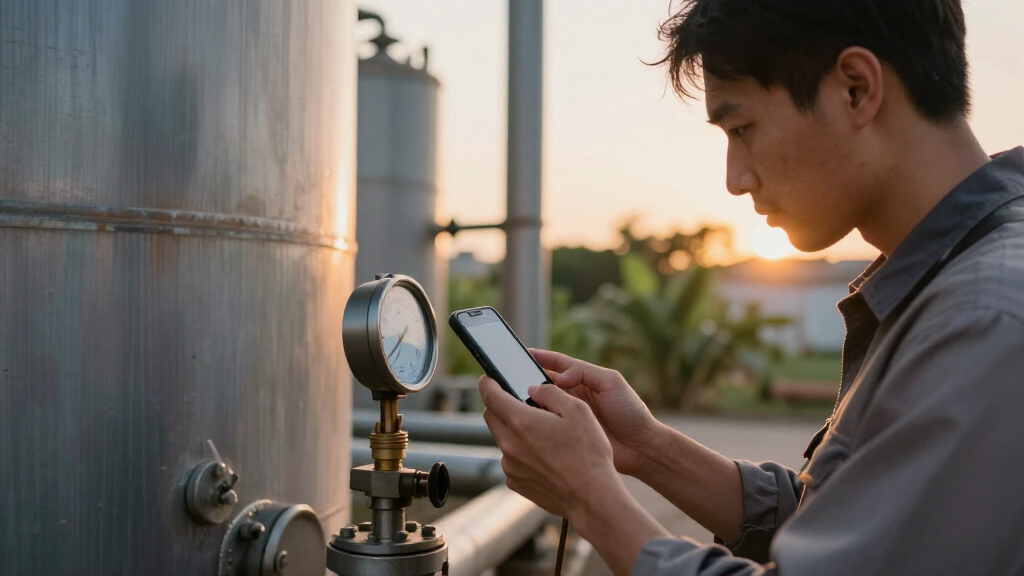
Industrial facilities are testing a new workflow where technicians use phone photos to record gauge readings, replacing manual clipboard methods. This approach promises increased accuracy, real-time anomaly detection, and better data trend analysis, without costly sensor retrofits.
Industrial facilities are increasingly adopting phone-photo gauge reading to replace traditional clipboard rounds, a move driven by advances in sight recognition models that reliably interpret analog gauges from regular phone images. This development offers a low-cost, scalable way to improve data accuracy, early failure detection, and maintenance workflows without retrofitting expensive IoT sensors.
According to recent pilot programs, technicians photograph gauges such as analog dials, sight glasses, and counters during their routine rounds. An app then automatically reads the gauge value from the photo, compares it against expected ranges, logs it with timestamp and location, and flags any anomalies immediately. This process has been tested at three facilities over a month, with preliminary results indicating a significant reduction in transcription errors compared to manual recording on paper or clipboard.
The approach leverages recent advances in vision models that reliably interpret images of analog gauges, making legacy equipment a source of real-time data without the need for costly sensor installations. The solution is offered via a tiered subscription model, charging per facility based on the number of gauges monitored.
Facility managers see this as a promising step toward more accurate, timely maintenance data, enabling early detection of developing failures and more effective trend analysis. The pilot aims to validate whether this method can outperform traditional manual rounds in error reduction and anomaly detection.
Potential Impact on Maintenance and Reliability
This innovation could transform maintenance workflows by providing more accurate, real-time data from legacy equipment, reducing costly failures and downtime. It offers a scalable, low-cost alternative to retrofitting sensor-heavy systems, especially for facilities with extensive legacy assets. Improved data accuracy and early failure detection can lead to significant cost savings and safety improvements, making this approach highly relevant for industrial operations seeking to modernize without large capital investments.
As an affiliate, we earn on qualifying purchases.
Legacy Equipment and the Need for Better Data
Many industrial facilities operate with aging equipment that relies on analog gauges, which traditionally have been read manually and recorded on paper. These methods are prone to transcription errors, delays, and lack of trend data, impairing predictive maintenance efforts. While IoT sensors can provide continuous data, retrofitting these on legacy systems is often prohibitively expensive. Recent advances in vision models that interpret gauge images reliably now open a cost-effective alternative: capturing gauge readings via phone photos during routine inspections.
This approach aligns with broader trends toward digital transformation in industry, emphasizing data-driven decision-making. Pilot programs are testing whether this method can deliver comparable or better accuracy than manual transcription, with the added benefit of immediate anomaly detection and trend building.
industrial gauge inspection camera
As an affiliate, we earn on qualifying purchases.
As an affiliate, we earn on qualifying purchases.
Uncertainties in Long-Term Effectiveness
It remains unclear whether the pilot results will scale reliably across diverse facilities and gauge types. Long-term data on accuracy, operational impact, and cost savings are still being collected, and wider adoption depends on consistent performance and integration with existing maintenance systems. Further validation is needed to confirm if this approach can replace or supplement traditional methods at scale.
As an affiliate, we earn on qualifying purchases.
Next Steps in Pilot Validation and Deployment
The ongoing pilot programs will compare error rates, anomaly detection efficiency, and maintenance outcomes over the coming months. Success could lead to broader adoption, with facilities expanding the use of phone-photo gauge reading and integrating it into their maintenance workflows. Further development may include refining the app, expanding gauge compatibility, and exploring automation options for larger-scale deployment.
As an affiliate, we earn on qualifying purchases.
Key Questions
How accurate are phone-photo gauge readings compared to manual transcription?
Preliminary pilot results indicate that phone-photo readings can significantly reduce transcription errors, with the accuracy depending on the quality of photos and the sophistication of the vision models used. Ongoing tests aim to quantify these improvements more precisely.
What equipment types can this method be used on?
The approach works on various analog gauges, including dials, sight glasses, and counters, as long as they are visually interpretable from a photo. Compatibility with different gauge types is part of ongoing validation efforts.
Will this replace traditional maintenance workflows entirely?
It is unlikely to replace manual methods entirely in the near term. Instead, it is expected to serve as a supplement, enhancing accuracy, early detection, and data collection while reducing manual errors.
How much does the subscription service cost?
The service is offered via tiered monthly subscriptions, charged per facility based on the number of gauges monitored. Exact pricing varies depending on gauge count and facility size.
What are the main challenges in adopting this technology?
Challenges include ensuring consistent photo quality, integrating the app with existing maintenance systems, and validating long-term reliability across diverse equipment and operational conditions.
Source: IdeaNavigator AI
Fall Picks
fall essentials
As an affiliate, we earn on qualifying purchases.