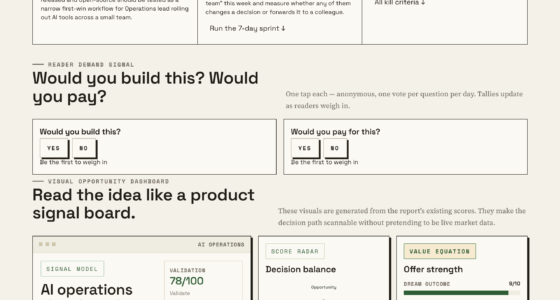

📊 Full opportunity report: The Skills Marketplace, Six Months Later: Predicted vs Actual on ThorstenMeyerAI.com — validation score, market gap, and execution plan.

Turn your quiet moments into listening time
- Thousands of audiobooks, podcasts and originals
- Listen on your phone, tablet or Echo — also offline
- Cancel anytime
TL;DR
Six months after predictions, the skills marketplace has grown significantly with over 4,200 skills and 120,000 monthly visitors. Structural complexities like fragmentation and platform proliferation challenge initial forecasts, revealing a profitable but uneven landscape.
Six months after Thorsten Meyer predicted the rise of a skills marketplace based on the SKILL.md standard, the ecosystem has materialized with over 4,200 skills actively listed and more than 120,000 monthly visitors, confirming the core prediction of marketplace emergence.
The directory at claudemarketplaces.com, last updated May 4, 2026, reports 4,200+ skills, 770+ MCP servers, and 2,500+ marketplaces. These figures indicate rapid growth, with estimates of 2,500 to 4,500 production-grade skills, aligning with the initial forecast of 1,000-3,000 skills by mid-2026.
Several structural factors have emerged that complicate the initial prediction. Surface fragmentation exists: skills uploaded to Claude.ai do not synchronize with API-based uploads, creating a form of internal lock-in. The marketplace landscape is highly fragmented, with at least five competing platforms—Agensi, Agent37, ClawdHub, SkillsMP, and LobeHub—none of which has established clear dominance. Top skills capture most revenue, with the long tail generating minimal income, confirming a winner-takes-most dynamic. Demand remains strong, evidenced by consistent traffic, but monetization remains concentrated among top creators and platforms.
The marketplace emerged.
Five of six predictions confirmed. Three structural facts the original analysis didn’t anticipate.
Six months after the original prediction: 4,200+ skills, 770+ MCP servers, 2,500+ marketplaces, 120K monthly visitors. Hosted-access monetization beat file-sales decisively. Cross-agent portability is real (Claude Code, OpenClaw, Codex, Cursor). But surface fragmentation persists. Platform consolidation has not happened. Winner-takes-most economics dominate within categories.
Six predictions. Six outcomes.
The November 2025 prediction said the skills marketplace would emerge as a structural shift. Five of six predictions confirmed empirically. One partial. Plus three structural facts the original analysis did not anticipate.
Five-plus platforms. No clear winner yet.
The marketplace emerged across multiple competing platforms with different distribution and monetization models. The 24-36 month consolidation window has begun. The winner integrates runtime + payments + entitlements + iteration + vendor-neutral distribution.
Three models. One scales.
The original prediction said hosted-access would beat file-sales. The empirical data confirms decisively. Roughly 10× revenue advantage for hosted access over file-sales. Median creator on Agent37: $300-1,500/mo. Top decile: $5-25K/mo. Top percentile: $50K+/mo.
IP given away at first download. Customer redistributes within team. “Objectively a terrible business model.” Default in GitHub-based distribution.
Returns to hourly consulting economics. Doesn’t scale beyond creator’s individual time. Pre-productization model. The trap skills were supposed to escape.
80%+ margins after $80/mo delivery cost. Iteration enabled by real usage data. Top decile $5-25K/mo. The model that wins.
The directional bet on the marketplace was right. Which platforms, which creators, and which enterprises capture the disproportionate share of the value — the answers will resolve over 2026-2028.
Four assignments. By role.
Pick a subdomain, not a top category.
The category-leading window is closing. Top categories (AWS tooling, db tooling, marketing automation) have established leaders. Target hosted-access (Agent37, Agensi). Test cross-agent on at least two agents. Price on outcomes ($99-499/mo for domain expertise). Plan for median ($300-1,500/mo). Treat top-decile ($5-25K/mo) as upside, not base case.
Ship cross-surface skill sync.
Current friction (Claude.ai vs API vs Claude Code separate deployments) is the largest structural barrier to marketplace growth. Fix is technically straightforward; strategic value substantial. Doing this in 2026 captures more of the marketplace value the company is enabling. Surface-fragmentation is the unfinished business of the skills launch.
Add the dimension you currently lack.
24-36 month consolidation window has begun. Agent37 needs Agensi’s economic clarity. Agensi needs Agent37’s integration breadth. Platform that integrates runtime + payments + entitlements + iteration + vendor-neutral distribution wins. Less integrated platforms become acquisition targets. Move fast.
Audit for reliability, not features.
Reliability premium is real. Pay for documented production track records, not feature breadth. Choose deployment surface deliberately (Claude Code dev / API prod / Claude.ai ad-hoc). Build internal MCP server portfolio for proprietary integrations — this is the integration moat. Cross-agent portable skills are the vendor-concentration hedge.
Implications of Marketplace Fragmentation and Dominance Patterns
The emergence of a sizable, active skills marketplace confirms the initial prediction of a shift toward a marketplace economy for agent skills. However, the structural complexity—particularly platform fragmentation and internal lock-in—poses challenges for creators and enterprises seeking interoperability and broad access. The concentration of revenue among top skills and platforms indicates a winner-takes-most pattern, which could influence future platform strategies and creator incentives.
As an affiliate, we earn on qualifying purchases.
Development of Skills Ecosystem and Market Dynamics
Thorsten Meyer’s November 2025 analysis predicted a marketplace based on the SKILL.md standard, with growth driven by cross-agent portability and monetization platforms. The actual six-month data shows rapid growth, with over 4,200 skills and 120,000 visitors, confirming the ecosystem’s viability. However, the landscape has become more complex than initially forecast, with significant fragmentation and structural lock-in issues emerging. The proliferation of competing platforms reflects ongoing efforts to address monetization and distribution needs, but no single platform has yet emerged as a clear leader. These developments indicate a maturing but uneven ecosystem that diverges from earlier expectations of simplicity and vendor neutrality.
“The marketplace has emerged decisively, but its structure is messier than predicted, with fragmentation and platform competition shaping the landscape.”
— Thorsten Meyer
API integration tools for skills marketplace
As an affiliate, we earn on qualifying purchases.
As an affiliate, we earn on qualifying purchases.
Unresolved Issues in Marketplace Interoperability and Leadership
It remains unclear which platform will ultimately dominate the ecosystem, if any. The internal lock-in caused by surface fragmentation complicates cross-platform compatibility, and the long-term sustainability of the winner-takes-most model is uncertain as new players and features emerge.
monetization tools for online skills platforms
As an affiliate, we earn on qualifying purchases.
As an affiliate, we earn on qualifying purchases.
Future Evolution and Potential Consolidation of the Skills Market
Expect ongoing platform competition, with possible consolidation as the market matures. Monitoring how platform dominance evolves and whether interoperability improves will be key, alongside tracking creator and enterprise adoption patterns. Further data over the next six months will clarify whether the current fragmentation persists or if a clear leader emerges.
As an affiliate, we earn on qualifying purchases.
Key Questions
Will a single platform dominate the skills marketplace?
It is currently uncertain. Multiple platforms compete, and no clear leader has emerged yet. Market dynamics may shift toward consolidation or continued fragmentation.
How does surface fragmentation affect creators?
Fragmentation creates internal lock-in, requiring creators to upload skills separately to different surfaces, which complicates interoperability and broad distribution.
Is monetization sustainable for all skill creators?
No. Revenue is concentrated among top skills and platforms, while most long-tail skills generate minimal income. The winner-takes-most pattern persists.
What role will new platforms play in the future of the marketplace?
New entrants could disrupt existing dynamics, but current data suggests the ecosystem is stabilizing around a few dominant players, with ongoing fragmentation likely for the near term.
Source: ThorstenMeyerAI.com
Fall Picks
fall essentials
As an affiliate, we earn on qualifying purchases.