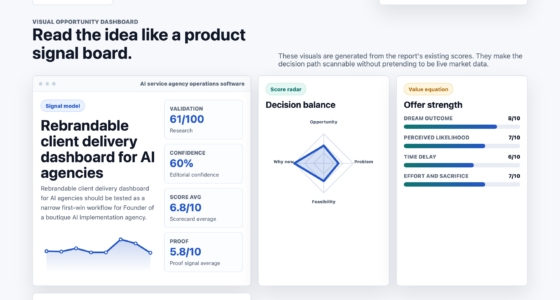
📊 Full opportunity report: Costco's Business Approach: An Alternative To Amazon's Strategy on IdeaNavigator AI — validation score, market gap, and execution plan.
Listen free for 30 days with Audible
Thousands of audiobooks and originals — cancel anytime.
Start your free trialAs an affiliate, we earn on qualifying purchases.
TL;DR
Costco is positioning itself as an alternative to Amazon by focusing on bulk sales and membership-based retail. This strategy challenges Amazon’s dominance and offers new options for small businesses and consumers.
Costco’s business model emphasizes bulk sales, membership revenue, and a focus on in-store shopping, contrasting sharply with Amazon’s e-commerce and logistics-driven strategy. This approach is gaining attention as a viable alternative for consumers and small businesses seeking reliability and value amid rapid shifts in the retail landscape.
Recent industry observations highlight Costco’s sustained growth and resilience, even as Amazon continues to expand its e-commerce dominance. Unlike Amazon, which relies heavily on fast delivery, vast product selection, and technological integration, Costco prioritizes a membership-based model that encourages repeat in-store visits and bulk purchasing. This strategy results in predictable revenue streams and a loyal customer base, often appealing to small businesses that benefit from wholesale prices and reliable stock.
Analysts note that Costco’s focus on physical stores and a limited product range—around 4,000 SKUs compared to Amazon’s millions—allows for tighter inventory control and lower operational costs. Its emphasis on in-person shopping creates a different customer experience, one rooted in trust, quality, and value, which resonates strongly during economic uncertainty or supply chain disruptions. Industry insiders suggest that this model acts as a counterbalance to Amazon’s logistics-heavy approach, providing an alternative that emphasizes stability over speed.
According to market signals, Costco’s recent financial reports show consistent growth in membership renewals and sales, even as Amazon’s share of retail shifts toward online dominance. The company’s CEO has publicly highlighted plans to expand its private label lines and enhance in-store experiences, further differentiating its approach from Amazon’s digital-first strategy. This divergence underscores a broader trend where retail is becoming more segmented, with some players doubling down on physical presence and others on digital innovation.
Implications of Costco’s Strategic Focus for Small Businesses
This shift indicates that small businesses and consumers are increasingly valuing reliability, bulk purchasing, and in-person shopping, especially during times of economic uncertainty. Costco’s model offers an alternative to Amazon’s fast, often impersonal, delivery-centric approach, which may influence how small companies choose suppliers and distribution channels. For entrepreneurs, understanding these differing strategies can inform decisions on sourcing, inventory management, and customer engagement, potentially shaping competitive advantages in their markets.
Furthermore, Costco’s success demonstrates that a business can thrive without relying solely on digital sales and rapid logistics. This could inspire small firms to explore hybrid models that combine online presence with physical retail, or to emphasize loyalty programs and membership-based revenue streams. Overall, Costco’s approach challenges the assumption that e-commerce alone drives retail growth, highlighting the importance of diversified strategies in a rapidly evolving market landscape.
bulk wholesale shopping for small businesses
As an affiliate, we earn on qualifying purchases.
As an affiliate, we earn on qualifying purchases.
Costco’s Business Model and Market Positioning
Founded in 1983, Costco has grown into one of the largest wholesale retailers globally, with over 800 warehouses worldwide. Its core strategy revolves around membership-based sales, bulk purchasing, and a limited but high-quality product selection. This model has historically emphasized low prices, high inventory turnover, and a focus on in-store shopping experiences.
Over the past decade, Amazon has transformed retail with its e-commerce platform, logistics infrastructure, and technological innovations. Amazon’s strategy has prioritized fast delivery, vast product variety, and digital convenience, which has reshaped consumer expectations and market dynamics. In response, traditional retailers like Costco have maintained their core principles but also adapted to digital channels, with online sales now contributing a growing share of revenue.
Industry analysts observe that Costco’s strategy is not just about resisting Amazon’s dominance but offering a different value proposition—one rooted in trust, stability, and tangible savings. This approach appeals especially during economic downturns when consumers and small businesses seek dependable suppliers and cost-effective solutions. The ongoing competition between these models reflects a broader shift in retail, where multiple strategies coexist and serve different customer segments.
As an affiliate, we earn on qualifying purchases.
Unclear Impact on Amazon and Small Business Strategies
While industry observers recognize Costco’s growing influence as an alternative retail model, it remains uncertain how significantly this will affect Amazon’s dominance in online retail or small business sourcing strategies long-term. It is also unclear whether other traditional retailers will adopt similar models or if Costco’s approach can be scaled further without compromising its core principles.
Additionally, the extent to which small businesses will shift their supply chain preferences toward Costco’s wholesale model versus Amazon’s digital offerings is still being evaluated. Market dynamics are evolving rapidly, and consumer behavior may continue to favor digital convenience, complicating predictions about the long-term impact of Costco’s strategy.
As an affiliate, we earn on qualifying purchases.
Future Developments in Retail Competition and Small Business Adoption
Industry analysts expect Costco to continue expanding its private label offerings and enhance digital integration without abandoning its physical store focus. Meanwhile, Amazon may respond by refining its logistics and customer experience to retain market share. Small businesses are likely to experiment with hybrid models, blending online and in-store sourcing, as they evaluate the cost-effectiveness and reliability of each approach.
Monitoring how consumer preferences evolve and how competitors adapt will be key. Industry observers suggest that early signs of success for Costco’s model could influence other retailers to diversify their strategies, creating a more segmented and resilient retail landscape. For small business operators, staying informed about these shifts will be essential for strategic planning and competitive positioning.
As an affiliate, we earn on qualifying purchases.
Key Questions
How does Costco’s business model differ from Amazon’s?
Costco focuses on membership-based wholesale sales, emphasizing in-store shopping, bulk purchasing, and limited product selection. In contrast, Amazon relies on a vast online marketplace, fast delivery, and technological innovations to serve a broad customer base globally.
Why is Costco considered an alternative to Amazon?
Because Costco offers a different value proposition—reliability, stability, and tangible savings—appealing especially during economic uncertainty, and serves as a physical retail counterpoint to Amazon’s digital-first approach.
Could small businesses benefit from Costco’s approach?
Yes, small businesses can leverage Costco’s wholesale prices and reliable supply chain, especially if they value in-person shopping and bulk purchasing, providing an alternative to Amazon’s logistics-driven model.
While Costco’s approach appeals to a different segment, its growth could challenge Amazon’s dominance in certain retail categories, particularly for small businesses and consumers seeking stability over speed.
What should small retailers watch for next?
They should monitor Costco’s expansion efforts, private label offerings, and digital integration, as well as Amazon’s responses to evolving consumer preferences and competitive pressures.
Source: IdeaNavigator AI
Fall Picks
fall essentials
As an affiliate, we earn on qualifying purchases.