📊 Full opportunity report: EU Car Rule Explained: Driver Monitoring Cameras In Every New Vehicle on IdeaNavigator AI — validation score, market gap, and execution plan.

Turn your quiet moments into listening time
- Thousands of audiobooks, podcasts and originals
- Listen on your phone, tablet or Echo — also offline
- Cancel anytime
TL;DR
Under the EU’s General Safety Regulation, every new car sold in the European Union must be fitted with driver monitoring technology — primarily camera-based systems that track drowsiness and distraction. The requirement, phased in for new type approvals and extended to all new registrations, is one of the most significant changes to in-cabin technology in decades.
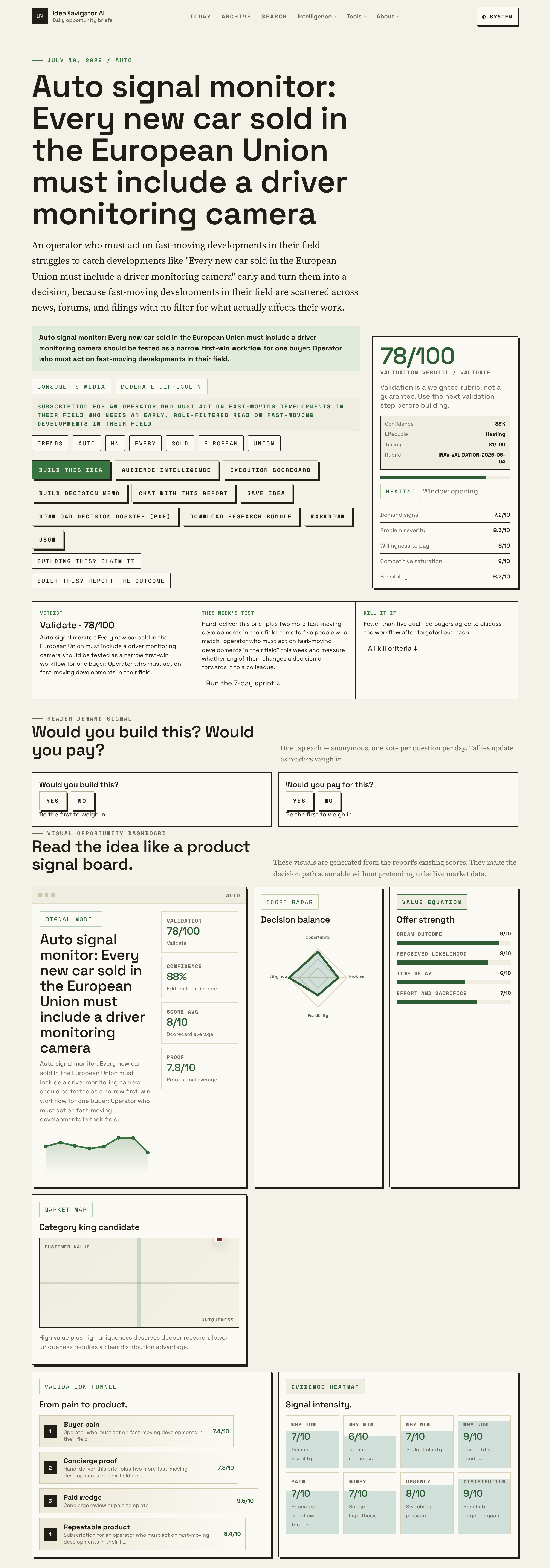
Every new car sold in the European Union must now be equipped with a driver monitoring system, a requirement under the bloc’s General Safety Regulation that has made camera-based drowsiness and distraction detection a standard feature rather than an optional extra. The mandate applies to new vehicle type approvals since July 2022 and to all new car registrations since July 2024, meaning buyers of newly registered vehicles across the EU are increasingly encountering cameras pointed at them from the steering column or dashboard. The development resurfaced in public discussion this week after a trending thread on Hacker News flagged it with a high relevance score, according to IdeaNavigator AI, which tracks fast-moving developments for industry operators.
The requirement stems from EU Regulation 2019/2144, commonly called the General Safety Regulation II, which entered into force in 2020 and introduced a broad package of mandatory safety technologies. Among them is the driver drowsiness and attention warning system (DDAW), which must assess the driver’s alertness through steering behaviour, eye movement, head position, or a combination of signals, and issue warnings when it detects fatigue or distraction. In practice, most manufacturers implement the system with an in-cabin camera that watches the driver’s face and eyes.
Also mandated under the same regulation is intelligent speed assistance (ISA), which uses camera- or map-based speed sign recognition to warn drivers when they exceed the limit, as well as event data recorders, emergency stop signals, lane-keeping assistance, and improved pedestrian protection for vans and trucks. The rules were phased in two stages: July 2022 for new vehicle models seeking type approval, and July 2024 for every new car registered in the EU, regardless of when the model was first approved.
Drivers cannot legally disable the drowsiness monitoring permanently, though most implementations allow temporary muting of warnings. The camera data is processed locally in the vehicle, and the regulation does not require continuous transmission of footage to manufacturers or authorities — a distinction that matters to privacy advocates but has not stopped debate about data collection practices.
What the Camera Mandate Changes for Drivers
The mandate makes driver monitoring a mass-market reality across the EU’s roughly 13 million annual new-car market, standardising a technology that was previously confined to premium models or sold as part of optional driver-assistance packages. For consumers, it changes the in-cabin experience: cameras will watch for closed eyes, drooping heads, and phone use, and the car will escalate warnings — first visual and audible, then in some implementations harder interventions.
For the auto industry, the rule has forced suppliers and manufacturers to redesign interiors, add processing hardware, and calibrate systems that must work reliably across drivers of widely varying appearance, eyewear, and lighting conditions. It also creates a compliance and liability dimension: a car that fails to warn a drowsy driver could expose the manufacturer to regulatory scrutiny.
For privacy, the rule places a camera in a vehicle by default for the first time at scale, keeping questions about data retention, third-party access, and cross-border enforcement firmly on the agenda. The EU’s data protection framework, GDPR, applies to how any biometric or camera data is handled, though enforcement details differ by member state.
How the EU Mandate Came Together
The General Safety Regulation was adopted in 2019 following years of negotiation between the European Parliament, the Council, and the Commission, with road-safety campaigners pushing for technology mandates as a way to cut traffic deaths. The EU’s stated goal at the time was to move toward its Vision Zero target of eliminating road fatalities, citing European Commission estimates that the required technologies could prevent tens of thousands of serious injuries over the coming decades.
The regulation aligned EU rules with updated UNECE international vehicle standards, allowing manufacturers to certify systems once across multiple markets. Drowsiness and distraction are implicated in a substantial share of serious crashes, which regulators cited as the core justification for requiring automated monitoring rather than relying on drivers to self-assess their fatigue. The UK, though no longer an EU member, adopted substantially similar requirements for new vehicles.
The Hacker News discussion this week, flagged by IdeaNavigator AI with an 88/100 signal score, reflects growing public awareness that a rule passed years ago is now visible in showrooms — and in the wiring of cars already on the road.
Open Questions on Enforcement and Data
Several aspects remain unclear or uneven in practice. Enforcement of the drowsiness-warning requirement varies by member state, and there is no unified EU standard for how sensitive the systems must be, which has produced widely different driver experiences across brands. Some early systems have drawn complaints about false positives — warnings triggered by sunglasses, low light, or normal glances at mirrors.
It is also not yet clear how regulators will treat camera data in legal disputes, such as crash investigations or insurance claims, nor whether future updates to the regulation will mandate stronger interventions like automatic speed limiting that cannot be overridden. The regulation does not currently require footage to be stored or transmitted, but manufacturer-specific privacy policies differ, and consumer groups have called for clearer guarantees.
Whether the systems measurably reduce fatigue-related crashes has not been independently established at fleet scale, according to safety researchers who note that real-world effectiveness data is still being collected.
The Mandate’s Next Compliance Milestones
Additional phases of the General Safety Regulation continue to roll out through the second half of the decade, with expanded requirements for advanced driver distraction warnings, improved pedestrian detection, and heavier-vehicle safety systems scheduled for later implementation dates. Manufacturers are expected to refine camera algorithms through over-the-air software updates as field data accumulates.
Watch for the European Commission’s periodic road-safety evaluations, which will assess whether the mandated technologies are delivering the projected casualty reductions, and for possible follow-up legislation on in-cabin data handling. Buyers in the EU encountering the systems for the first time can expect the technology to become more intrusive — and, manufacturers argue, more accurate — as enforcement tightens and second-generation systems reach the market.
Key Questions
Does every new car in the EU really have a driver monitoring camera?
Every new car registered in the EU since July 2024 must have a driver drowsiness and attention warning system. Most manufacturers implement this with an in-cabin camera, though the regulation technically requires the monitoring function rather than a specific sensor type.
Can I turn the driver monitoring system off?
The drowsiness warning cannot be permanently disabled, as it is a type-approval requirement. Most implementations allow warnings to be temporarily muted or reset, but the system reactivates automatically, typically at the start of each drive.
Does the camera record and send video anywhere?
The regulation does not require footage to be stored or transmitted; processing is designed to happen locally in the vehicle. However, manufacturer privacy policies vary, and GDPR rules govern any data that is collected, so checking your car’s specific policy is advisable.
Does the same rule apply in the UK?
Yes. Although the UK left the EU, it retained substantially similar vehicle safety requirements, so new cars registered in the UK also carry the mandated driver monitoring and intelligent speed assistance systems.
When did the requirement take effect?
In two stages: July 2022 for new vehicle models seeking type approval, and July 2024 for all new cars registered in the EU regardless of when the model was first approved.
Source: IdeaNavigator AI
Fall Picks
fall essentials
As an affiliate, we earn on qualifying purchases.