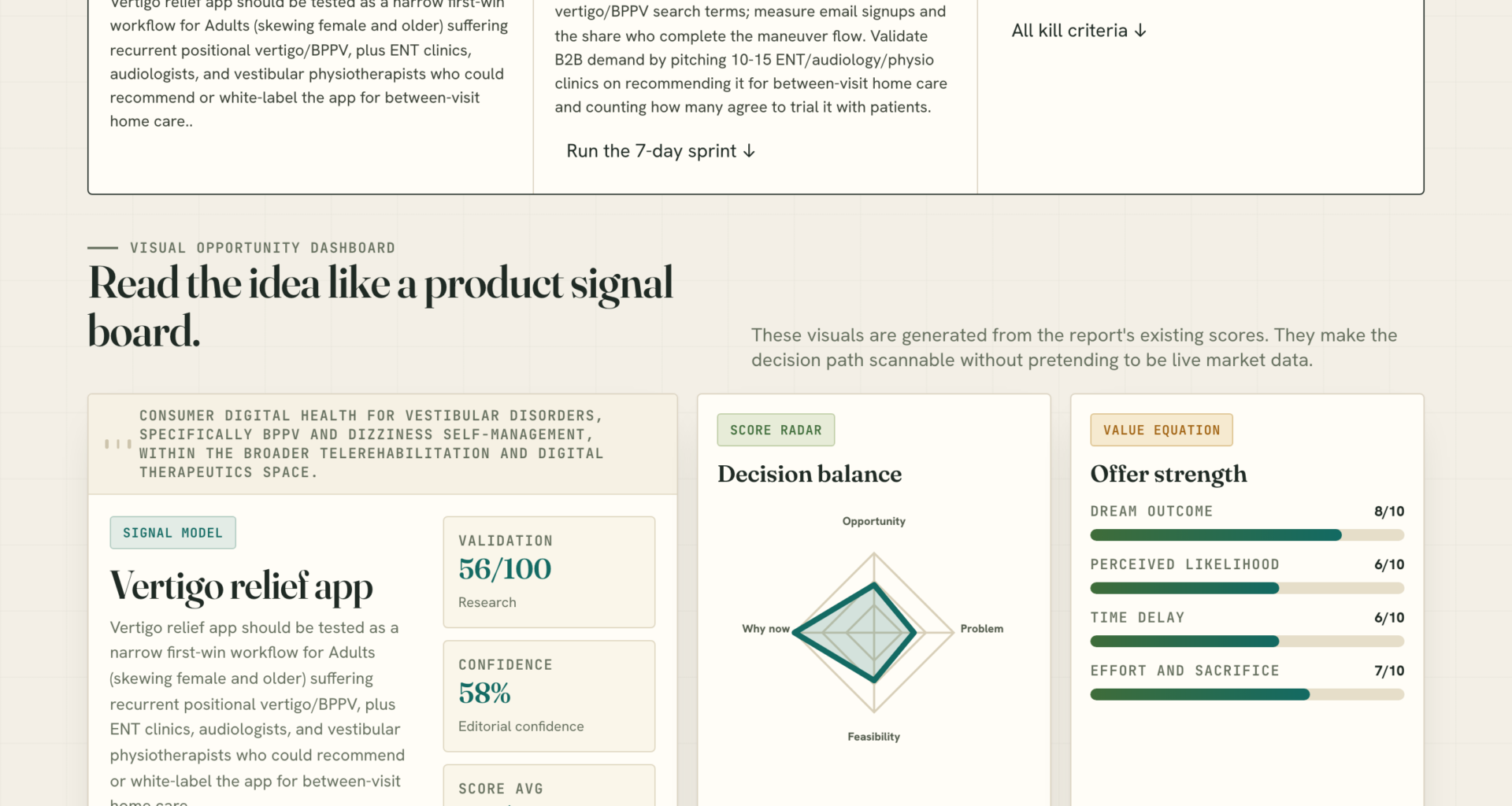

📊 Full opportunity report: Vertigo relief app on IdeaNavigator AI — validation score, market gap, and execution plan.
TL;DR
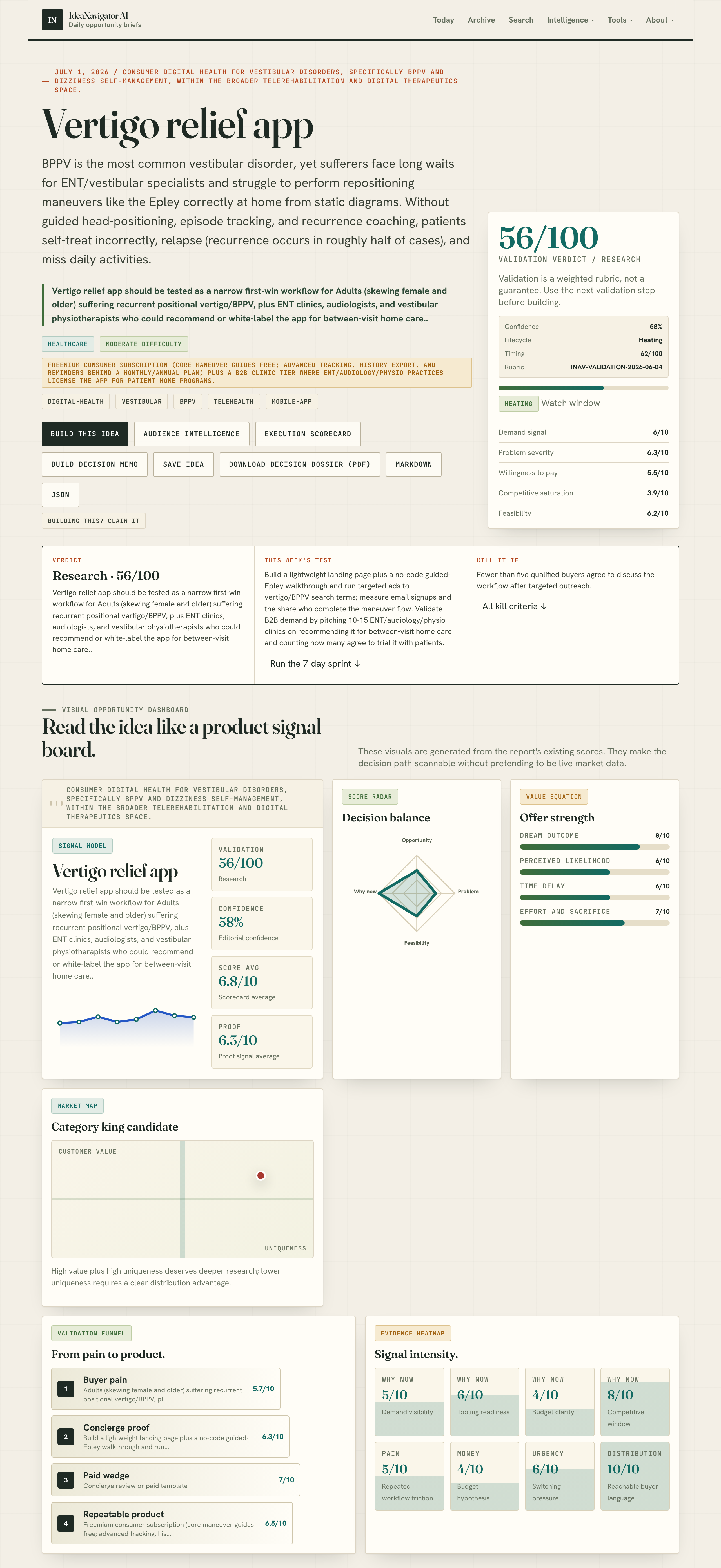
A vertigo relief app targeting adults with benign paroxysmal positional vertigo (BPPV) is being developed to guide self-treatment and track symptoms. It aims to fill gaps in current care, especially post-COVID, with plans for consumer and clinic versions. Validation strategies are underway.
A new vertigo relief app is in development to guide adults suffering from recurrent BPPV through repositioning maneuvers at home, aiming to improve self-treatment accuracy and reduce relapse rates. The app is designed for both consumer use and potential integration into ENT and vestibular clinics, addressing a significant gap in current vestibular care.
The app will feature step-by-step animated guides, audio cues, and gyroscope-based head-angle feedback to ensure correct execution of maneuvers like the Epley and Brandt-Daroff. It will also include symptom logging, episode tracking, and recurrence coaching to support ongoing management. The initial focus targets adults, especially older women, who often face long wait times for specialist care and struggle with static diagrams or instructions for self-treatment. For more insights, see related tools and apps.
Developers plan to validate the app by creating a landing page with a guided Epley walkthrough, measuring signups and maneuver completion rates. They also consider integrating with related health apps to enhance user engagement. They also intend to pitch ENT, audiology, and physiotherapy clinics about licensing the app for patient use between visits, gauging clinical demand through trial offers. The app will carry a clear disclaimer stating it is not a substitute for professional medical advice.
Potential Impact on Vertigo Self-Management
This app could significantly improve the quality of self-treatment for BPPV, which affects roughly half of diagnosed patients and often results in relapse without proper repositioning. By providing guided, real-time feedback, it aims to reduce incorrect self-treatment and improve patient outcomes. If adopted by clinics, it could streamline vestibular care, reduce wait times, and support telehealth models that gained prominence during the COVID-19 pandemic. The market for digital vestibular therapeutics is expanding, with an estimated value near USD 498 million in 2024 and expected growth of approximately 13.5% annually through 2033.
As an affiliate, we earn on qualifying purchases.
Growing Need for Home-Based Vestibular Care
Benign paroxysmal positional vertigo (BPPV) is the most common vestibular disorder, yet many patients face delays in accessing specialist care. Traditional treatment involves manual repositioning maneuvers performed in clinics, but static diagrams and limited clinician contact can lead to incorrect self-treatment. The COVID-19 pandemic accelerated the shift toward telehealth and home-based rehab, increasing demand for digital solutions that guide patients remotely. The development of smartphone sensors capable of measuring head movements accurately makes real-time, guided self-treatment feasible, and reimbursement models for digital therapeutics are maturing.
“Guided head-positioning with real-time feedback could reduce relapse rates and improve patient confidence in self-treatment.”
— an anonymous researcher
vestibular rehabilitation head movement device
As an affiliate, we earn on qualifying purchases.
As an affiliate, we earn on qualifying purchases.
Unanswered Questions About App Adoption
It is not yet clear how receptive clinics and patients will be to integrating this app into routine care, or how effectively users will perform maneuvers guided solely by a smartphone. The actual clinical impact, user engagement, and reimbursement pathways remain to be validated through pilot studies and trial implementations.
As an affiliate, we earn on qualifying purchases.
Next Steps for Validation and Deployment
Developers plan to launch a landing page and run targeted ads to measure interest and maneuver completion rates. They will also approach clinics to pilot the app, gather feedback, and assess clinical demand. A phased rollout for both consumer and B2B licensing is expected in 2024, with ongoing evaluation of user outcomes and integration feasibility.

Dioche Ons Tips Holder Magnetic Nail Tips Stand Holder – Versatile DIY Nail Practice Display Tool with Elegant Base for Home and Salon Use (#2)
- Versatile Nail Display: Showcases nail art and practice use
- Magnetic Design: Effortless attachment to magnetic base
- Easy Repositioning: Magnet allows quick nail plate adjustments
As an affiliate, we earn on qualifying purchases.
As an affiliate, we earn on qualifying purchases.
Key Questions
How does the app guide users through vertigo maneuvers?
The app provides animated step-by-step instructions, audio cues, and real-time gyroscope feedback to ensure correct head positioning during maneuvers like the Epley and Brandt-Daroff.
Is this app a replacement for seeing a healthcare professional?
No, the app includes a clear disclaimer emphasizing it is not a substitute for professional medical advice. Users are advised to consult a clinician if symptoms worsen or red-flag signs appear.
Will clinics be able to recommend or license this app for their patients?
Yes, developers plan to offer a clinic licensing tier, allowing ENT, audiology, and physiotherapy practices to incorporate the app into patient care between visits.
When will the app be available for download?
The app is currently in development, with a planned launch in 2024 after validation and pilot testing phases.
How will the app track symptom recurrence and effectiveness?
The app will log dizziness episodes, triggers, and severity over time, helping users and clinicians monitor progress and recurrence patterns.
Source: IdeaNavigator AI