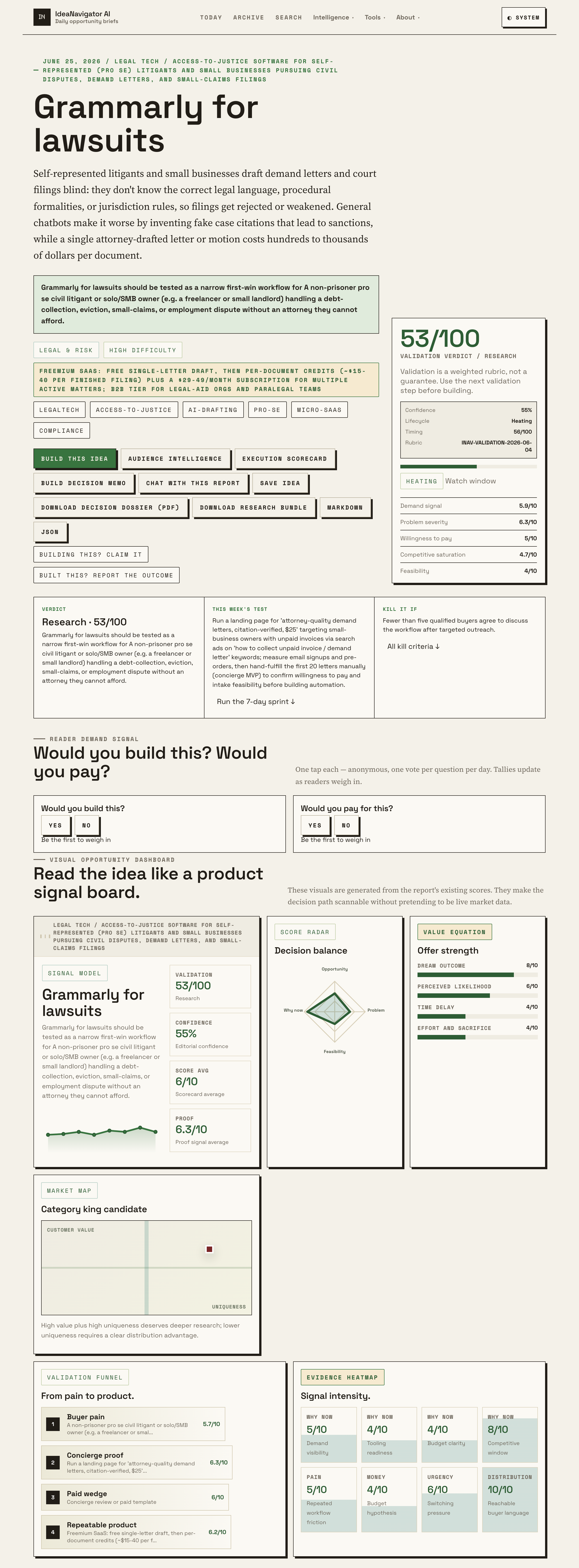
📊 Full opportunity report: The Role Of Grammarly In Making Legal Processes More Accessible on IdeaNavigator AI — validation score, market gap, and execution plan.
TL;DR
A new tool leveraging Grammarly aims to help non-lawyers draft court documents with verified legal citations and proper formatting. This development could make civil legal processes more accessible for self-represented parties and small businesses, addressing a critical gap in access to justice.
Developers are testing a new web application that integrates Grammarly-like verification to assist self-represented litigants and small business owners in drafting legally compliant court documents. This innovation aims to address the challenges faced by non-lawyers in navigating complex legal language, procedural rules, and citation accuracy, which often lead to rejected or weakened filings. The tool’s development comes amid growing concerns over the proliferation of AI-generated citations in court filings and the urgent need for verification-focused drafting aids.
The proposed application targets individuals handling civil disputes without legal representation, such as debt collection, eviction notices, small-claims, or employment disputes. It guides users through structured intake questions—covering parties involved, dispute amount, contractual details, and jurisdiction—and then generates formatted demand letters or court filings. The system performs an internal ‘lawsuit Grammarly’ check, flagging weak or missing elements, and verifies each legal citation against a real legal database to prevent hallucinated or inaccurate references.
According to sources familiar with the project, this approach aims to reduce errors typical of generic language models, which have been responsible for a significant number of hallucinated citations in court filings. The application intends to produce court-ready, e-signature-compatible documents that meet jurisdictional formatting standards, thereby improving the quality and credibility of filings made by non-lawyers. The initial focus is on small-business owners and landlords, with plans to expand to other civil dispute types.
Potential Impact on Access to Justice for Non-Lawyers
This development could significantly improve access to justice by empowering self-represented litigants and small businesses to draft accurate, legally compliant documents without costly legal fees. By reducing errors and increasing the reliability of filings, the tool may lower rejection rates and court sanctions associated with citation errors and procedural mistakes. If successful, it could serve as a model for broader adoption of verification-enhanced AI tools in legal workflows, helping bridge the gap between legal complexity and layperson capability.
legal citation verification software
As an affiliate, we earn on qualifying purchases.
As an affiliate, we earn on qualifying purchases.
Growing Need for Court-Ready Legal Drafting Tools
Over 60% of civil cases in the U.S. now involve parties without legal representation, with 27% of federal civil cases from 2000 to 2019 featuring pro se litigants. Despite this, many self-represented parties struggle with drafting accurate legal documents due to unfamiliarity with procedural formalities, legal language, and citation standards. Existing AI tools, especially large language models, have contributed to the problem by generating hallucinated citations, which can lead to sanctions or case rejection. The urgency for verification-focused drafting tools has grown as courts experience increasing volumes of AI-generated errors, prompting developers to explore solutions that combine AI assistance with rigorous citation verification.
“The key challenge is ensuring that AI-generated legal documents are both accurate and compliant with court standards, which is why verification and formatting are critical.”
— an anonymous researcher
court document drafting tools for self-represented litigants
As an affiliate, we earn on qualifying purchases.
As an affiliate, we earn on qualifying purchases.
Unclear Scope and Adoption of the Verification Tool
It is not yet clear how widely this tool will be adopted, whether it will effectively prevent citation hallucinations at scale, or how courts will respond to filings generated with AI verification. The project is still in early testing phases, and real-world validation remains pending. Additionally, questions remain about the legal community’s acceptance of AI-verified documents and whether the tool can handle the diversity of jurisdictional formatting requirements.
legal formatting software for court filings
As an affiliate, we earn on qualifying purchases.
As an affiliate, we earn on qualifying purchases.
Next Steps in Development and Testing Phases
Developers plan to pilot the tool with a small group of self-represented litigants and small-business owners, collecting feedback on usability, accuracy, and legal compliance. They will measure the tool’s effectiveness in reducing citation errors and improving filing success rates. Based on initial results, further refinements will be made before broader rollout. Simultaneously, efforts to establish partnerships with legal aid organizations and court systems are underway to facilitate adoption and integration into existing workflows.
As an affiliate, we earn on qualifying purchases.
Key Questions
How will the tool verify legal citations?
The system will cross-reference each citation against a verified legal database to confirm accuracy and prevent hallucinations, ensuring citations are valid and relevant.
Will this tool replace lawyers for civil filings?
No, it is designed to assist self-represented litigants and small businesses in drafting accurate documents, not to replace professional legal advice.
When will the tool be available for public use?
The project is currently in testing phases, with a pilot rollout expected within the next year, pending successful validation and user feedback.
Can this technology be expanded to other areas of law?
Yes, future versions could incorporate additional dispute types and legal procedures, but initial focus remains on civil demand letters and small-claims filings.
What are the limitations of this verification approach?
The system’s effectiveness depends on the quality of the legal database used for verification and may face challenges in jurisdictions with complex or unique formatting requirements.
Source: IdeaNavigator AI