📊 Full opportunity report: Fair-value appraisals for used GPUs and AI hardware on IdeaNavigator AI — validation score, market gap, and execution plan.

Turn your quiet moments into listening time
- Thousands of audiobooks, podcasts and originals
- Listen on your phone, tablet or Echo — also offline
- Cancel anytime
TL;DR
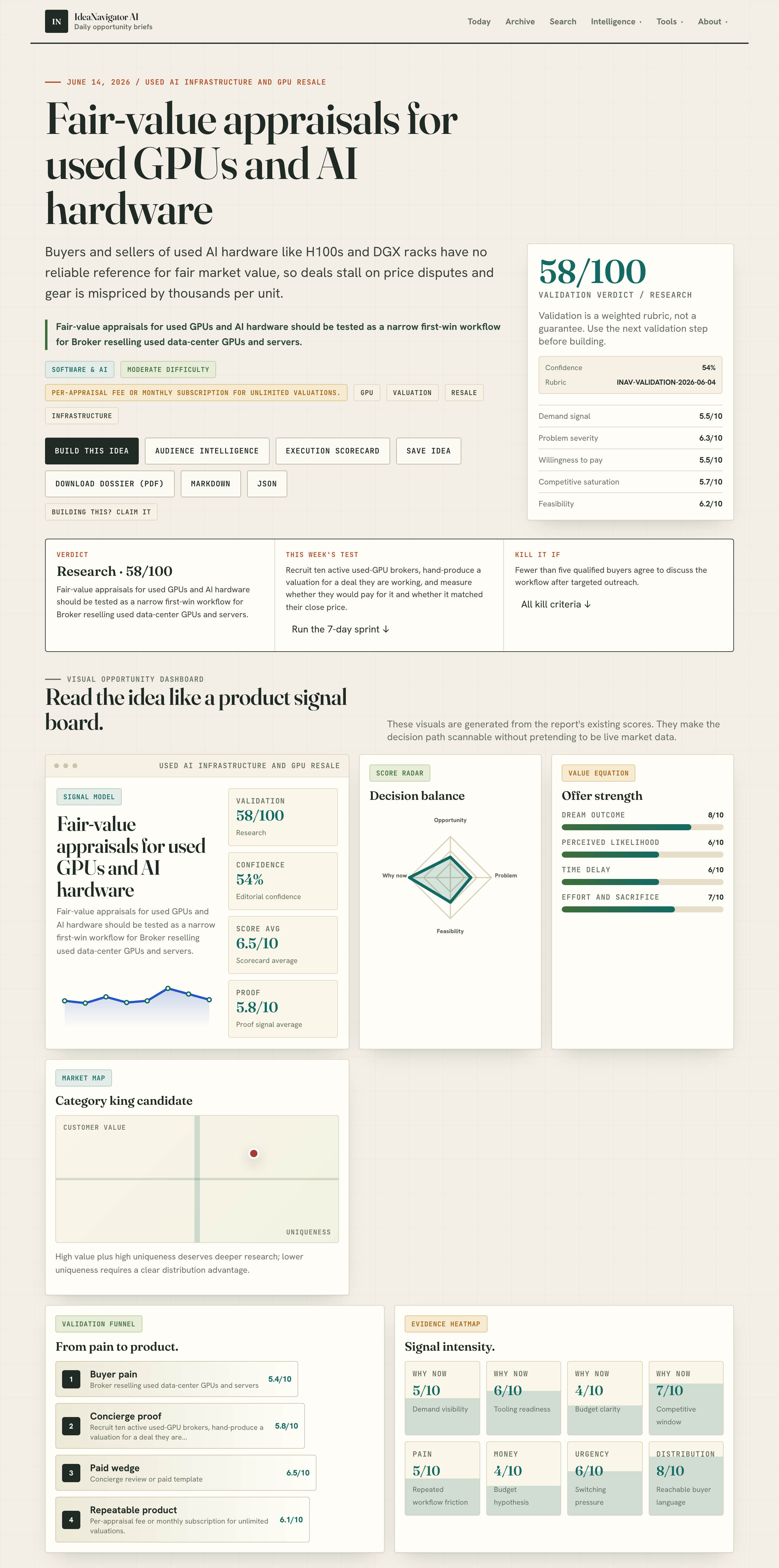
A proposed manual fair-value appraisal system for used GPUs and AI hardware seeks to provide brokers with reliable pricing benchmarks. This development addresses market opacity caused by recent hardware surplus and could streamline resale transactions.
A new manual valuation tool for used data-center GPUs and AI hardware is being tested as a way to establish transparent, fair market prices for resale. This initiative aims to address longstanding issues of pricing disputes and misvaluation in the secondary market, which has been exacerbated by hyperscalers and labs rapidly refreshing their GPU fleets.
The proposed system involves a manual valuation sheet where brokers input details such as GPU model, condition, and quantity. The tool then generates a fair-value range based on three recent comparable sales pulled from public listings. This approach is intended as a first-step workflow to bring clarity and consistency to the secondary market for used AI hardware.
According to sources familiar with the development, the system is designed for use by brokers involved in reselling used data-center GPUs and servers, particularly high-demand models like Nvidia H100s and DGX racks. The goal is to create a reliable reference point that reduces deal stalls caused by disagreements over price, which often reach thousands of dollars per unit.
Market participants are testing this manual appraisal method by recruiting ten active used-GPU brokers. They will compare the appraised values with actual close prices on recent deals to assess whether the tool provides accurate estimates and whether brokers would pay for such a service. The testing phase is ongoing, and wider adoption depends on initial validation results.
Impact on Used AI Hardware Resale Market
This development could significantly improve transparency in the secondary market for used AI hardware, reducing pricing disputes and enabling more efficient transactions. By providing brokers with a standardized, data-driven valuation method, it may also help stabilize prices and foster trust among buyers and sellers. If successful, this approach could become a foundational step toward more automated and scalable fair-value assessments in the future.
As an affiliate, we earn on qualifying purchases.
Market Surge and Pricing Challenges in Used AI Hardware
The secondary market for used AI hardware has grown rapidly as hyperscalers and research labs refresh their GPU fleets, often discarding or reselling recent-generation equipment. This influx has created a large volume of hardware with no transparent pricing benchmark, leading to frequent disputes and mispricing—sometimes by thousands of dollars per unit.
Currently, most resale transactions rely on informal negotiations or limited public listings, which lack consistency and reliability. The absence of a standardized valuation method has hindered liquidity and slowed deal closures. Industry insiders see the development of a fair-value appraisal system as a timely response to these issues, aiming to bring more order to a chaotic market.
“This manual valuation approach could serve as a vital first step toward establishing transparent, reliable prices for used AI hardware, especially as the market grows more complex.”
— an anonymous researcher
AI hardware resale valuation tools
As an affiliate, we earn on qualifying purchases.
As an affiliate, we earn on qualifying purchases.
Uncertainties in Adoption and Accuracy
It is not yet clear how accurately the manual valuation sheet will reflect actual market prices across different hardware models and conditions. The success of the approach depends on the validation process with participating brokers, and wider adoption remains uncertain until the initial testing results are available. Additionally, questions remain about whether this method can scale or be automated in the future.
As an affiliate, we earn on qualifying purchases.
Next Steps in Validation and Broader Deployment
The immediate next step is to complete the validation phase with the ten participating brokers, comparing appraised values with actual deal prices. If the results are favorable, developers plan to refine the tool and consider offering it as a paid service or subscription. Broader rollout and potential automation are likely to follow if the manual approach proves effective.
As an affiliate, we earn on qualifying purchases.
Key Questions
How will this appraisal system improve used GPU resale?
It aims to provide brokers with a reliable, standardized price range based on recent comparable sales, reducing disputes and increasing market transparency.
Is this system automated or manual?
The current version is a manual valuation sheet designed for initial testing. Automation may be considered in future iterations based on validation results.
What hardware models are targeted?
The focus is on high-demand, recent-generation data-center GPUs like Nvidia H100s and similar AI hardware used in enterprise and research settings.
When will this system be available for wider use?
Wider deployment depends on the validation phase; if successful, developers may release a refined version within the next few months.
Could this approach be applied to other hardware types?
Potentially, yes. If successful for GPUs and AI servers, similar valuation methods could be adapted for other used data-center hardware in the future.
Source: IdeaNavigator AI
Fall Picks
fall essentials
As an affiliate, we earn on qualifying purchases.