
Quantum computing is making steady progress with researchers building more advanced processors and developing new algorithms. While some machines can perform basic tasks, qubit stability remains a key challenge, affecting their reliability. Efforts focus on improving error correction and physical qubit design to extend coherence times. As these issues are addressed, quantum computers could revolutionize fields like cryptography and optimization. Keep exploring to discover how ongoing innovations are shaping this exciting technology’s future.
Key Takeaways
- Quantum computers leverage qubits in superposition, enabling complex calculations beyond classical capabilities.
- Current progress includes developing processors capable of executing basic quantum algorithms.
- Qubit stability (decoherence) remains a major challenge, affecting computation reliability and coherence times.
- Advances focus on error correction, improved qubit materials, and physical implementations like superconducting circuits and trapped ions.
- Future prospects involve achieving scalable, stable quantum systems with transformative impacts on cryptography, optimization, and scientific research.

Have you ever wondered how computers could solve complex problems much faster than today’s machines? The answer lies in the fascinating world of quantum computing, where quantum algorithms and qubit stability play vital roles. Unlike classical computers that process information in bits—either a 0 or a 1—quantum computers use qubits, which can exist in multiple states simultaneously thanks to superposition. This unique property allows quantum computers to perform many calculations at once, making them potentially far more powerful for specific tasks. However, harnessing this power isn’t straightforward. Quantum algorithms are specially designed to exploit quantum mechanics, enabling solutions to problems that would take classical computers an impractical amount of time. Algorithms like Shor’s algorithm for factoring large numbers or Grover’s algorithm for database searching exemplify how quantum strategies can dramatically outperform classical ones. But there’s a significant challenge: maintaining qubit stability, or coherence, over time.
Qubit stability is a major hurdle in quantum computing development. Qubits are incredibly sensitive to their environment, which can cause them to lose their quantum state—a phenomenon known as decoherence. Even tiny disturbances from temperature fluctuations, electromagnetic interference, or material imperfections can disrupt calculations. This fragility limits the duration and accuracy of quantum computations. That’s why researchers focus heavily on improving qubit stability through advanced error correction techniques and better qubit designs. They experiment with different physical implementations, such as superconducting circuits, trapped ions, or topological qubits, each aiming to minimize errors and extend coherence times. Achieving longer qubit stability directly translates to more reliable quantum algorithms and more powerful computations. Advances in material science are also contributing to improved qubit coherence times, helping to address this critical challenge.
While the field is still in its early stages, significant progress has been made. Companies and research institutions are building increasingly sophisticated quantum processors, and some can perform basic quantum algorithms successfully. Nonetheless, the quest to improve qubit stability remains ongoing. The better we comprehend and control qubit coherence, the closer we get to realizing the full potential of quantum algorithms for real-world applications like cryptography, optimization, and material science. As you follow this rapidly evolving field, remember that overcoming qubit stability issues is key to opening quantum computing’s transformative power. With continued innovation, what seems like science fiction today could become an everyday tool tomorrow, revolutionizing how we solve problems across countless industries.

Quantum Computing for Everyone (Mit Press)
As an affiliate, we earn on qualifying purchases.
As an affiliate, we earn on qualifying purchases.
Frequently Asked Questions
How Will Quantum Computing Impact Cybersecurity?
Quantum computing will critically impact cybersecurity by potentially breaking traditional encryption methods with powerful quantum algorithms. You’ll need to prepare for quantum encryption, which uses the principles of quantum mechanics to create more secure communication. As quantum algorithms advance, they could crack current cryptographic systems, so staying ahead involves developing quantum-resistant encryption. Embracing these changes is essential to keep your data safe in a rapidly evolving digital landscape.
What Industries Will Benefit Most From Quantum Advancements?
You’ll see industries like finance and pharmaceuticals benefit most from quantum advancements. Quantum finance could revolutionize risk modeling and optimize investments faster than ever. Meanwhile, drug discovery becomes more efficient as quantum computers simulate molecular interactions precisely. These breakthroughs enable you to develop innovative solutions, streamline processes, and gain a competitive edge. As quantum tech evolves, expect significant impacts on sectors that rely heavily on complex calculations and data analysis.
When Will Quantum Computers Be Commercially Available?
You can expect quantum computers to become commercially available within the next decade. Achieving quantum supremacy and improving hardware scalability are key milestones, but widespread use depends on overcoming these challenges. As researchers make progress, you’ll see more practical applications emerge, especially for industries like finance, cryptography, and material science. So, while a precise date is uncertain, the timeline looks promising for broader commercial adoption soon.
What Are the Ethical Considerations of Quantum Technology?
You should consider that over 70% of experts worry about quantum ethics, especially privacy implications. Quantum technology could break current encryption, risking data security. Ethically, you need to address responsible use, prevent misuse, and guarantee transparency in development. As quantum advances, balancing innovation with safeguarding privacy becomes vital, so you must stay informed and advocate for regulations that protect individual rights and societal interests in this rapidly evolving field.
How Does Quantum Hardware Differ From Classical Computers?
You notice that quantum hardware differs from classical computers because it uses qubits instead of bits. Qubits can exist in multiple states thanks to superposition, but their stability, known as qubit stability, is challenging. Quantum entanglement links qubits instantaneously, enabling powerful computations. Unlike classical systems, quantum hardware relies on these phenomena, making it more complex but potentially far more powerful for specific tasks.

Quantum Sensing Experiments with Superconducting Qubits
As an affiliate, we earn on qualifying purchases.
As an affiliate, we earn on qualifying purchases.
Conclusion
As you look ahead, quantum computing feels like standing at the edge of a vast, shimmering ocean, its waves of possibility crashing gently. You can sense the untapped potential beneath the surface—mysteries waiting to be unraveled, innovations just beyond the horizon. With each breakthrough, you’re fueling a journey into uncharted waters, where the future is a bright, uncharted constellation shimmering in the night sky, inviting you to explore its endless horizons.
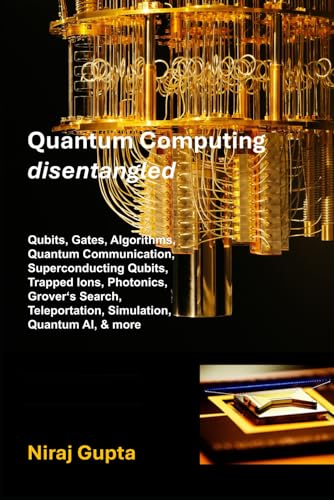
Quantum Computing Disentangled: Qubits, Gates, Algorithms, Quantum Communication, Superconducting Qubits, Trapped Ions, Photonics, Grover‘s Search, Teleportation, Simulation, Quantum AI, and more
As an affiliate, we earn on qualifying purchases.
As an affiliate, we earn on qualifying purchases.

Quantum Error Correction
As an affiliate, we earn on qualifying purchases.
As an affiliate, we earn on qualifying purchases.