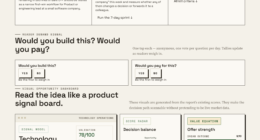
📊 Full opportunity report: The $14 Billion Mistral Initiative: Europe’s Hope For AI Independence on ThorstenMeyerAI.com — validation score, market gap, and execution plan.
TL;DR
Europe’s Mistral project, backed by €11.7 billion and aiming for $20 billion valuation, is developing a sovereign AI model to challenge US dominance. For more on Europe’s AI initiatives, see Europe’s AI efforts. Its future depends on model performance and infrastructure independence.
Mistral, Europe’s leading AI startup with a valuation exceeding €11.7 billion, has secured a major funding round and is positioning itself as a sovereign alternative to US and Chinese AI labs. This development marks a strategic effort by Europe to establish an independent AI ecosystem, reducing reliance on US cloud providers and hardware, and fostering local infrastructure and model development.
According to sources, Mistral’s last confirmed valuation was €11.7 billion following a €1.7 billion Series C funding round in September 2025 led by Dutch lithography firm ASML, which acquired roughly 11% stake. Reports indicate that the company is in talks or closing a further raise of around $3.5 billion, potentially valuing it at over $20 billion. Mistral’s revenue has grown sharply, reaching an estimated annual recurring revenue of approximately $400 million by early 2026, up from about $20 million a year earlier, with CEO Arthur Mensch targeting $1 billion by the end of 2026.The company’s strategy centers on developing a European, open-weight AI model and infrastructure that emphasizes sovereignty. Its architecture allows data and model execution within customers’ own environments, addressing data residency and privacy concerns, which are key considerations in European AI sovereignty efforts. Mistral is also building Mistral Compute, a European GPU cloud infrastructure backed by €4 billion in data-center investments across France and Sweden, some powered by nuclear energy, to ensure infrastructure independence. The company has acquired infrastructure firm Koyeb to bolster its stack and is shipping open-weight models to foster developer adoption, funneling usage into paid APIs and enterprise contracts.
Europe’s sovereignty bet,
priced at $14B and climbing.
If SAP owns the data and Siemens owns the factory, Mistral builds the thing neither wants: the model itself — European, open-weight, sovereign. The continent’s answer to a world with only two American frontier labs.
The wedge: real where structural, weak where aspirational
✓ Real (structural)
- EU domicile = procurement advantage for regulated + public sector
- Split control/data-plane: execution inside the customer’s environment
- ASML’s ~11% stake ties it to Europe’s tech-industrial core
- Macron endorsement, €109B French AI commitments — industrial policy
⚠ Weak (aspirational)
- Model quality lags frontier — ~3rd on the OCR leaderboard, not 1st
- “Sovereignty via openness” erodes as US + Chinese open models proliferate
- Runs on NVIDIA silicon + Azure distribution — partial independence
- ~$400M ARR vs rivals’ tens of billions
Sovereignty buys procurement preference. It does not suspend the capability race.
Confirmed mark is the ASML-led round; the 2026 raise and ARR are reported/estimated. Figures dated.
The single question: is “European and sovereign” a durable advantage enough to sustain a frontier lab against far better-capitalized rivals — or a procurement preference that erodes as capable open models arrive from every direction? Mistral is not for sale; the plan is IPO. Europe has bet $14B+ that it’s the former.

Programming Languages and Systems: 27th European Symposium on Programming, ESOP 2018, Held as Part of the European Joint Conferences on Theory and Practice … Notes in Computer Science Book 10801)
As an affiliate, we earn on qualifying purchases.
As an affiliate, we earn on qualifying purchases.
Strategic Impact of Mistral’s Sovereignty Approach
Mistral’s push for AI sovereignty represents a significant shift in Europe’s industrial policy and technological independence efforts. By developing a European-controlled AI model and infrastructure, it aims to reduce dependence on US and Chinese tech giants, potentially shaping the future landscape of AI governance and procurement within Europe. Success could bolster Europe’s position in the global AI race and influence regulatory and market dynamics, but challenges remain regarding model quality and infrastructure reliance.

AI Data Center Infrastructure Engineering: Power Distribution, Liquid Cooling, High-Density Networking, and Energy Efficiency for GPU Training … Hardware & Compiler Engineering Series)
As an affiliate, we earn on qualifying purchases.
As an affiliate, we earn on qualifying purchases.
European AI Ambitions and Industry Support
Europe has long sought to establish its own technological sovereignty, particularly in AI, where US and Chinese dominance is pronounced. The Mistral initiative aligns with France’s political backing, including President Macron’s public support for domestic AI over US alternatives. The €100 billion+ AI investment commitments across Europe, combined with industrial giants like ASML backing Mistral, underscore the continent’s strategic focus on building a sovereign AI ecosystem. However, the competition remains fierce, with US and Chinese labs rapidly advancing open-weight models and infrastructure capabilities.
“Our goal is to build an AI model that is truly European and sovereign, capable of serving regulated sectors and reducing dependence on US cloud and hardware providers.”
— Arthur Mensch, CEO of Mistral

LLM Systems Engineering: Training and Building Large Language Models – Engineering AI Models Through Fine-Tuning, Continued Pretraining, and From-Scratch Development
As an affiliate, we earn on qualifying purchases.
As an affiliate, we earn on qualifying purchases.
Challenges to Mistral’s Sovereign AI Vision
While Mistral’s funding, valuation, and strategic goals are confirmed, several uncertainties remain. The company’s models currently lag behind US and Chinese front-runners in raw capability, and third-party evaluations place Mistral’s flagship models behind the frontier in speed and performance. Additionally, infrastructure reliance on American hardware and cloud services complicates the sovereignty narrative. It is unclear whether Mistral can scale its models to match global leaders or fully realize infrastructure independence without further technological breakthroughs.

DRRI Europe Schuko Plug CEE 7-7 Plug 16A 250V to IEC 60320 C19 Power Cord for Servers | PDU| PC Computers| Monitors (6ft)
Plug A:Europe CEE7/7 Schuko plug;Plug B:IEC60320 C19 female
As an affiliate, we earn on qualifying purchases.
As an affiliate, we earn on qualifying purchases.
Next Milestones for Mistral’s Strategic Development
In the coming months, Mistral is expected to finalize its latest funding round, potentially surpassing a $20 billion valuation. The company will likely continue refining its models and expanding its European AI infrastructure, including the rollout of its GPU cloud and open-weight models. Monitoring model performance benchmarks and infrastructure independence progress will be critical, as well as any shifts in European political support or regulatory frameworks that could influence Mistral’s trajectory.
Key Questions
What is the main goal of the Mistral initiative?
Mistral aims to develop a sovereign, European-controlled AI model and infrastructure to reduce dependence on US and Chinese AI labs, emphasizing data residency, jurisdiction, and local hardware.
How is Mistral funded and valued?
Its last confirmed valuation was €11.7 billion after a €1.7 billion Series C in September 2025, with reports of a potential $3.5 billion raise at over $20 billion valuation. The funding is led by ASML, a key European industrial player.
What are the main challenges Mistral faces?
The company’s models are currently behind US and Chinese front-runners in raw capability, and infrastructure reliance on American hardware and cloud services complicates its sovereignty claims. Achieving true independence remains uncertain.
Why is European AI sovereignty important?
It aims to ensure European control over critical AI infrastructure, reduce dependence on foreign technology, and foster local innovation aligned with European political and economic interests.
Source: ThorstenMeyerAI.com