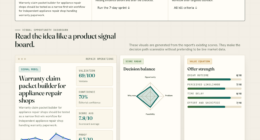

📊 Full opportunity report: The deployment. How the AI labs verticallyintegrated into the serviceslayer — the Palantir modelat scale. on ThorstenMeyerAI.com — validation score, market gap, and execution plan.
TL;DR
In early May 2026, Anthropic and OpenAI announced major investments to embed AI models directly into enterprise workflows using Palantir-inspired deployment models. This move aims to control the entire deployment process, capturing more revenue and operational dependency, but raises questions about scalability and margins.
In early May 2026, the two largest AI labs, Anthropic and OpenAI, announced simultaneous, substantial investments to embed their AI models directly into enterprise workflows, adopting a deployment approach modeled after Palantir’s forward-deployed engineer strategy. This move signifies a shift from merely selling models to owning the entire deployment and integration process, aiming to deepen operational dependency and capture more revenue from enterprise AI adoption.
Anthropic revealed a $1.5 billion enterprise-services venture involving Blackstone, Hellman & Friedman, and Goldman Sachs, focusing on embedding Claude into mid-market companies. Hours later, OpenAI announced its $4 billion “Deployment Company” (DeployCo), valued at $10 billion pre-money, with 19 investment partners and an immediate acquisition of consulting firm Tomoro, which deploys 150 engineers from day one. Both labs are adopting a model similar to Palantir’s, where embedded engineers work directly with clients to build, implement, and maintain AI systems in production environments.
This approach emphasizes not just model access but the full deployment lifecycle, including workflow redesign, security, and operational integration. The strategy aims to address the bottleneck in enterprise AI adoption, which research shows that 95% of generative AI pilots fail to move beyond experimentation. By owning deployment, the labs aim to turn AI into a recurring, token-metered revenue stream, embedding operational dependency and increasing switching costs for clients.
Experts note that this move transforms the labs from model providers into full-service deployment partners, blurring the lines between software and consulting. The approach is labor-intensive, resembling traditional consulting, but with the potential for scalable, recurring revenue in the token economy. However, questions remain about whether margins will expand as platform standardizes or contract due to the labor demands of deployment.
The deployment.
How the AI labs vertically
integrated into the services
layer — the Palantir model
at scale.
the identical structural move
the labs had the smaller half
why the embedded customer is rational
the unresolved scalability question
- Blackstone, H&F, Goldman ($300M / $300M / $150M)
- Apollo, General Atlantic, Leonard Green, GIC, Sequoia
- Embed Claude in PE portfolio companies — hundreds of mid-market firms
- Aligned with ~80% enterprise mix
- $10B pre-money · 19 partners (TPG, Bain, Advent, Brookfield)
- Bought Tomoro — 150 FDEs day one (Tesco, Virgin Atlantic, Red Bull)
- Builds the enterprise depth it lacked
- ~2.7x the capital of Anthropic’s vehicle
(the labs sold this)
(the deployment move claims this)
↓
build &
own
The labs have concluded the model is not the product — the deployment is — and moved, in the same week, to own the layer where the model meets the operation. Whether that makes them something larger than software companies or merely rebuilds a labor-bound consulting business at consulting margins is the Palantir question they have all inherited.Thorsten Meyer · The Deployment · Enterprise Reorg 03
Implications of Labs’ Vertical Integration Strategy
This development marks a fundamental shift in enterprise AI strategy, as the largest labs move beyond model licensing toward full deployment ownership. By embedding engineers into client operations, they aim to create operational lock-in, generate continuous revenue, and dominate the enterprise AI market. This could reshape the consulting industry, as labs aim to disintermediate traditional firms by combining model deployment and operational execution within a single platform. However, the labor-intensive nature of this approach raises concerns about long-term margins and scalability, making it a high-stakes gamble that could redefine the economics of enterprise AI.

Your AI Survival Guide: Scraped Knees, Bruised Elbows, and Lessons Learned from Real-World AI Deployments
As an affiliate, we earn on qualifying purchases.
As an affiliate, we earn on qualifying purchases.
Strategic Shift Toward Deployment-Centric AI Integration
Until early 2026, AI labs primarily focused on developing and licensing models, with enterprise adoption seen as a bottleneck. Research from MIT indicated that 95% of generative AI pilots failed to scale beyond initial testing phases, highlighting the need for better deployment strategies. Palantir’s forward-deployed engineer model, refined over years in defense and intelligence, has now been adopted by the AI labs as a blueprint for enterprise integration. The move reflects a broader industry recognition that model performance is no longer the main barrier; instead, the challenge lies in integrating AI into business workflows securely and effectively.
Previously, consulting firms managed deployment, but labs aim to internalize this function, capturing the associated revenue and operational lock-in. The parallel between Palantir’s model and the labs’ new approach underscores a strategic pivot from software licensing to full-service deployment, with the potential to transform enterprise AI economics.
“The labs are adopting Palantir’s deployment model because the bottleneck is no longer the model but the integration and operational deployment, which they aim to own entirely.”
— Thorsten Meyer
ENTERPRISE COHERENCE in the Age of AI
As an affiliate, we earn on qualifying purchases.
As an affiliate, we earn on qualifying purchases.
Uncertainties About Long-Term Scalability and Margins
It remains unclear whether the labor-intensive deployment model will scale profitably in the long term, or if margins will compress as the number of clients grows and each requires proportional deployment effort. The question of whether the platform will standardize and expand margins or remain a costly, bespoke service is still open. Additionally, it is uncertain whether this strategy will successfully displace traditional consulting firms or lead to a new hybrid economic model.

AI Engineering Starter Kit: The Practical Guide to Build, Train, and Deploy Real AI Applications with LLMs, MLOps, and Cutting-Edge Tools – Step-by-Step Projects for Aspiring AI Engineers.
As an affiliate, we earn on qualifying purchases.
As an affiliate, we earn on qualifying purchases.
Next Steps in Enterprise AI Deployment and Market Impact
Expect further announcements from both labs regarding deployment milestones, client onboarding, and operational results. Industry observers will monitor whether margins improve as deployment processes standardize or if labor costs continue to weigh on profitability. Regulatory and security considerations will also influence deployment strategies, particularly as AI systems become more embedded in critical operations. The ongoing evolution will determine if the labs’ integrated model becomes the dominant paradigm in enterprise AI or if it encounters scalability limits.

Workflow Automation with Microsoft Power Automate: Design and scale AI-powered cloud and desktop workflows using low-code automation
As an affiliate, we earn on qualifying purchases.
As an affiliate, we earn on qualifying purchases.
Key Questions
What is the Palantir-inspired deployment model used by AI labs?
The model involves deploying engineers directly into client organizations to build, integrate, and maintain AI systems, creating operational dependency and ensuring continuous engagement rather than just licensing models.
Why are AI labs investing heavily in deployment capabilities?
Because research shows that model performance is no longer the main bottleneck; the challenge is operational integration. Owning deployment allows labs to capture more revenue and deepen client lock-in.
What are the risks of the deployment strategy?
The approach is labor-intensive and resembles consulting, which could lead to margin compression if deployment costs grow faster than revenue. Scalability remains uncertain.
How does this move affect the traditional consulting industry?
Labs aim to disintermediate consulting firms by owning both the AI models and their deployment, potentially transforming the enterprise services landscape.
What is the significance of this development for the AI industry?
This shift signals a move toward full-stack enterprise AI solutions, emphasizing operational integration over model innovation, which could reshape industry economics and competitive dynamics.
Source: ThorstenMeyerAI.com