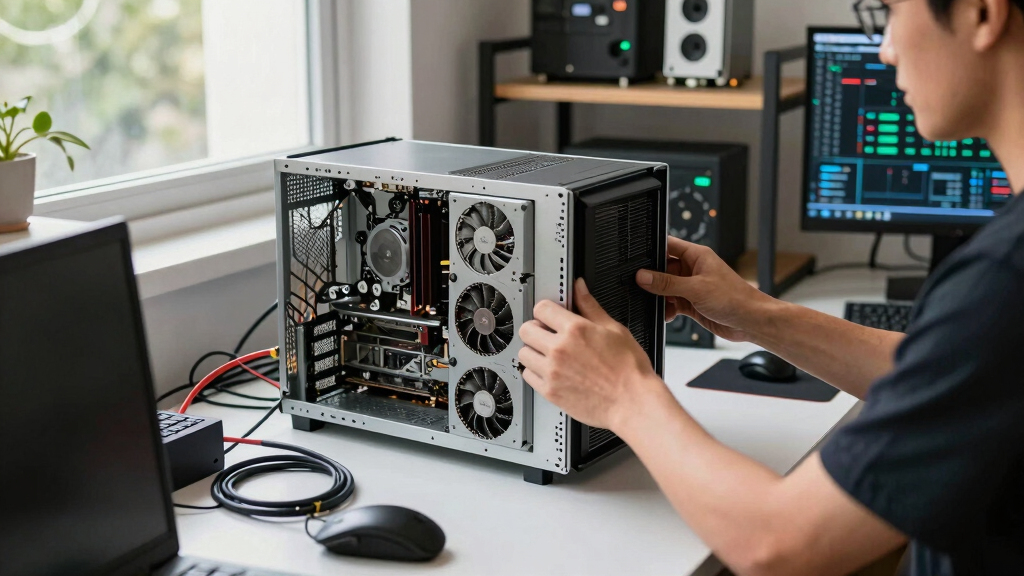

📊 Full opportunity report: The Real Cost Of A Local-Inference Rig In 2026 on ThorstenMeyerAI.com — validation score, market gap, and execution plan.
TL;DR
In 2026, owning a local inference rig for large AI models involves significant hardware costs, primarily driven by VRAM needs. The most cost-effective setup varies by model size, with used GPUs like the RTX 3090 offering high VRAM-per-dollar. The choice of hardware depends on model size and budget, impacting AI deployment strategies.
In 2026, the cost of building a local inference rig for large language models (LLMs) is heavily influenced by VRAM capacity and hardware choices, with the most cost-effective solutions often involving used GPUs like the RTX 3090. This shift impacts AI deployment strategies, especially for those prioritizing privacy and cost control.
The core factor in local inference hardware is the VRAM cliff: models must fit entirely into GPU memory to run efficiently. For instance, a 70B model requires roughly 43GB at FP16 precision, making high-end single GPUs like the RTX 5090 suitable but expensive. Many users find that older, used GPUs such as the RTX 3090 (24GB) offer better VRAM-per-dollar, often costing $600–850, and can be linked via NVLink to pool memory up to 48GB. This makes multi-3090 setups a popular, budget-friendly choice for medium to large models. For models exceeding 70B, multi-GPU or large-memory Macs are necessary, with costs rising significantly.While newer flagship cards like the RTX 5090 provide speed benefits due to higher bandwidth, they are often not the most economical for inference, where VRAM capacity and cost are more critical. The value approach emphasizes matching hardware to the model size, with the threshold for practical local inference around 24GB of VRAM. Beyond this, the hardware costs increase sharply, and the benefits diminish unless a specific large model is regularly used.
The real cost of a local-inference rig
Owning beats renting for steady AI work — so what does a local rig cost in 2026? The unintuitive, good news: the most expensive build is almost never the smartest one. It all comes down to one rule.
The difference is only whether the weights fit. LLM inference is memory-bandwidth-bound — VRAM capacity is the hard limit you build around. Compute specs are mostly noise.
The squeeze reframes the rig like everything else in this series: discipline beats maximalism. VRAM is exactly the memory under most pressure, so over-buying it is the 128GB-“to-be-safe” trap, only worse per gigabyte. Take the cheap, high-value step to 24GB (the gateway to the 30B class), reach for used 3090s and MoE models, and use quantization to climb a tier without buying silicon. Sized right, the rig pays for itself against the cloud’s ever-rising hidden bill. Next: Apple Silicon’s quiet memory advantage.
Implications for AI Deployment and Cost Management
Understanding the true costs of local inference rigs in 2026 helps AI practitioners and organizations make informed hardware investments. The emphasis on VRAM capacity over raw compute power shifts the market, favoring used GPUs and multi-GPU configurations. Cost-effective local setups can significantly reduce cloud expenses, but require careful hardware selection based on model size and workload.
This impacts how businesses approach AI deployment, balancing upfront hardware costs against ongoing cloud bills. It also influences hardware market dynamics, with older GPUs gaining renewed relevance due to their VRAM-per-dollar advantage.

NVIDIA GeForce RTX 3090 Founders Edition Graphics Card (Renewed)
Item Package Dimension – 15.0L x 12.25W x 4.25H inches
As an affiliate, we earn on qualifying purchases.
As an affiliate, we earn on qualifying purchases.
Hardware Trends and Model Size Requirements in 2026
By 2026, the landscape of AI inference hardware has evolved, driven by the increasing size of models and the necessity for high VRAM capacity. Models like the 70B Llama 3 require over 40GB of VRAM, pushing users toward multi-GPU setups or large-memory Macs. Meanwhile, older GPUs such as the used RTX 3090 continue to offer exceptional value for inference tasks, especially when pooled via NVLink.
Recent developments include the decline of flagship cards as the default choice for inference, replaced by cost-effective, high-VRAM used cards. The market also sees a growing role for Apple Silicon Macs, which leverage unified memory to surpass traditional GPU limitations, though with different performance trade-offs.
“For inference, VRAM capacity and cost per gigabyte are the key metrics, not raw compute speed. Used GPUs like the RTX 3090 often deliver the best value.”
— Thorsten Meyer
NVIDIA GeForce RTX 3090 Founders Edition Graphics Card (Renewed)
Item Package Dimension – 15.0L x 12.25W x 4.25H inches
As an affiliate, we earn on qualifying purchases.
As an affiliate, we earn on qualifying purchases.
Remaining Questions About Hardware Efficiency and Future Trends
It is not yet clear how upcoming hardware releases or advancements in memory technology will alter the cost and feasibility landscape for local inference rigs in 2026. The long-term durability of used GPUs and their compatibility with future models remains uncertain, as does the impact of new AI model architectures on VRAM requirements.
Additionally, the role of Apple Silicon and other non-GPU solutions in large-scale inference is still developing, with performance and cost trade-offs to be clarified in the coming months.
multi-GPU inference rig setup
As an affiliate, we earn on qualifying purchases.
As an affiliate, we earn on qualifying purchases.
Next Steps for Building Cost-Effective Local Inference Setups
Consumers and organizations should monitor GPU market trends, especially the availability and pricing of used high-VRAM cards like the RTX 3090. As model sizes continue to grow, investing in multi-GPU configurations or large-memory Macs may become more practical. Hardware vendors may also release new products that shift the VRAM-cost balance, influencing future buying decisions.
Additionally, users should evaluate their specific model needs carefully, ensuring that hardware investments align with actual inference workloads to maximize value and performance.

Apple 2026 MacBook Pro Laptop with Apple M5 Pro chip with 15-core CPU and 16-core GPU: Built for AI, 14.2-inch Liquid Retina XDR Display, 24GB Unified Memory, 1TB SSD, Wi-Fi 7; Space Black
FAST RUNS IN THE FAMILY — The 14-inch MacBook Pro with the M5 Pro or M5 Max chip…
As an affiliate, we earn on qualifying purchases.
As an affiliate, we earn on qualifying purchases.
Key Questions
What is the most cost-effective GPU for local inference in 2026?
Used RTX 3090s, especially when pooled via NVLink, offer the best VRAM-per-dollar for inference tasks, often outperforming newer flagship cards on this metric.
How does VRAM capacity influence hardware choices for large models?
Models need to fit entirely into GPU VRAM to run efficiently. For example, a 70B model requires around 43GB, making high-VRAM GPUs or multi-GPU setups essential for large models.
Are newer GPUs worth the extra cost for inference purposes?
Not necessarily. For inference, VRAM capacity and cost per gigabyte are more important than raw compute speed, so older used GPUs often provide better value.
Can Apple Silicon Macs replace GPU-based inference rigs?
Yes, due to their unified memory, Macs can handle large models effectively, though performance may differ from dedicated GPUs. They offer an alternative path for large-scale inference.
Source: ThorstenMeyerAI.com