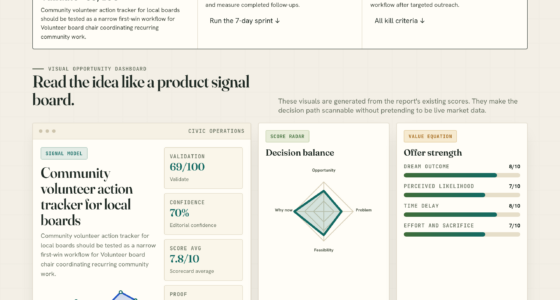

📊 Full opportunity report: The Dilemma Of Regulating AI When We Are Still Learning on ThorstenMeyerAI.com — validation score, market gap, and execution plan.
TL;DR
Europe has implemented the world’s most comprehensive AI regulation but falls behind in developing frontier AI models. This gap could weaken its ability to defend against hybrid threats, which increasingly rely on advanced AI tools.
Europe’s leading AI regulation, the AI Act, is in place, yet the continent remains behind in building the frontier AI models needed for effective defense against hybrid threats, exemplified by a drone incident at Leipzig/Halle airport.
Overnight Tuesday, a drone carrying explosives was spotted near Leipzig/Halle airport’s south runway, a key military and logistics hub linked to Ukraine. The drone was defused by police using a bomb-disposal robot, and Germany has launched a counterterrorism investigation. Simultaneously, a DHL cargo aircraft collided with an unknown object mid-air and diverted to Hanover. Authorities have not officially attributed the drone to any country, but suspicion points toward Russia, given the target and recent patterns of hybrid attacks.
Thorsten Meyer, citing sources, notes that this incident underscores a broader issue: Europe’s focus on regulating AI—via the AI Act—has not translated into building the frontier models necessary for effective defense. European AI models lag behind U.S. and Chinese counterparts, with the continent’s best models at roughly half the frontier level, and the gap widening over time.
Experts emphasize that hybrid threats—comprising sabotage, cyberattacks, disinformation, and infrastructure probing—operate at machine speed, relying heavily on advanced AI systems for detection and response. Europe’s current AI capabilities are insufficient for these demands, risking a capability deficit in critical defense domains.
An explosive drone on a military cargo hub’s runway. A “professional hybrid threat,” said the interior minister — “a new level of danger.” It’s a moment to say something uncomfortable about how Europe is meeting the era it has entered.
▲ Opinion · strategic argument is the author’s ownEurope’s reflex to a new technology is to regulate it — and it’s genuinely good at it. The AI Act is the most comprehensive AI law on Earth. The discomfort is what sits underneath.
The sloppy version of this argument is wrong, and I won’t make it. The real connection runs one level deeper — through the word “hybrid.”
The rebuttal: just use American AI. For many things, today, Europe can. But defense is the specific case where you can’t.
The strongest version of the other side, because parts of it are right and it deserves to be heard.
- Regulation and capability aren’t zero-sum — Europe is investing (InvestAI, gigawatt data centers)
- Drone defense is mostly physical security and intelligence, not frontier LLMs — I overweight my own field
- Sovereign defense AI may need a smaller controllable model, not a leaderboard chase
- Setting global norms has real value, capability or not
Only capability does that — and it’s the thing we’ve been legislating around instead of building.
Implications of Europe's AI Capability Shortfall for National Security
This situation highlights a critical security concern: Europe's extensive regulation of AI has not been matched by the development of the frontier models needed for autonomous defense against hybrid threats. As adversaries leverage advanced AI to conduct rapid, deniable attacks, Europe's lag in AI development could hamper its ability to detect, respond to, and neutralize such threats effectively. This gap risks turning AI regulation into a limitation rather than a safeguard, potentially exposing European infrastructure and military assets to greater danger in future conflicts.

AI In Cybersecurity: Simplifying Cyber Risk with Smart, Affordable Tools for Small Business Defense
As an affiliate, we earn on qualifying purchases.
As an affiliate, we earn on qualifying purchases.
Europe's AI Development and Regulatory Approach Compared to Global Leaders
Europe has established the AI Act, a comprehensive regulatory framework aimed at governing AI development and deployment. However, recent assessments, such as the Artificial Analysis Intelligence Index, show that European AI models—like Mistral—are only at about 30% of the frontier level, compared to U.S. and Chinese models, which are at 55–61%. The trajectory indicates that Europe’s AI capabilities are stagnating relative to global competitors, despite its regulatory leadership. This disconnect between regulation and technological capability has become more pronounced as hybrid threats increase in sophistication and speed.
Historically, Europe’s approach has prioritized regulation over technological possession, which now risks leaving it vulnerable to the very threats it aims to counter. The incident at Leipzig/Halle exemplifies how hybrid warfare exploits this capability gap, relying on AI tools that Europe has yet to develop domestically or control fully.
"We have written the world's leading rulebook for a technology we do not lead in building."
— Thorsten Meyer
As an affiliate, we earn on qualifying purchases.
Unclear Impact of AI Lag on Future Hybrid Threats
It remains uncertain how quickly Europe can close the AI capability gap and whether current efforts will be sufficient to counter increasingly sophisticated hybrid threats. The exact attribution of the drone incident is also unconfirmed, and the broader geopolitical implications are still unfolding.
As an affiliate, we earn on qualifying purchases.
Next Steps for Europe's AI Development and Security Strategies
European policymakers and defense agencies are likely to prioritize accelerating the development of frontier AI models and integrating them into national security infrastructure. Initiatives like the Joint Centre for Countering Hybrid Threats may push for increased domestic AI possession, but actual progress depends on funding, research, and technological breakthroughs. Monitoring how these efforts unfold over the coming months will reveal whether Europe can bridge its capability gap in time to counter future hybrid threats effectively.
As an affiliate, we earn on qualifying purchases.
Key Questions
Why does Europe's AI regulation lag behind its technological development?
Europe has focused heavily on creating comprehensive rules and ethical frameworks for AI, but this has not translated into building or possessing the most advanced AI models, which are primarily developed in the U.S. and China.
How does AI capability affect hybrid warfare defense?
Advanced AI models are crucial for detecting, analyzing, and responding to fast-moving, deniable hybrid threats such as cyberattacks, sabotage, and disinformation campaigns. Lagging AI development can weaken a country's defensive response.
Could Europe rely on American AI systems for defense instead of developing its own?
While possible, relying on foreign AI systems creates dependency and risks losing control over critical defense tools when relations strain or export restrictions change. Sovereign AI is essential for autonomous and resilient defense capabilities.
What are hybrid threats, and why are they difficult to counter?
Hybrid threats combine cyberattacks, disinformation, sabotage, and other tactics in a coordinated, deniable manner, often at machine speed. They exploit vulnerabilities in both technology and human oversight, making them challenging to detect and counter without advanced AI tools.
Source: ThorstenMeyerAI.com