
📊 Full opportunity report: The Machine Economy — Capital-Heavy, Human-Light, Trading With Itself on ThorstenMeyerAI.com — validation score, market gap, and execution plan.

Get books, candles and calm essentials delivered free — and shop member deals
- Fast, free delivery on millions of items
- Access to Prime Big Deal Days deals on October 6–7
- Prime Video, Amazon Music and more included
TL;DR
A new economic paradigm is emerging where AI-native firms, capital-heavy and human-light, trade primarily with each other. This shift could profoundly alter the economy, governance, and inequality. The development is ongoing with key stages unfolding over the next few years.
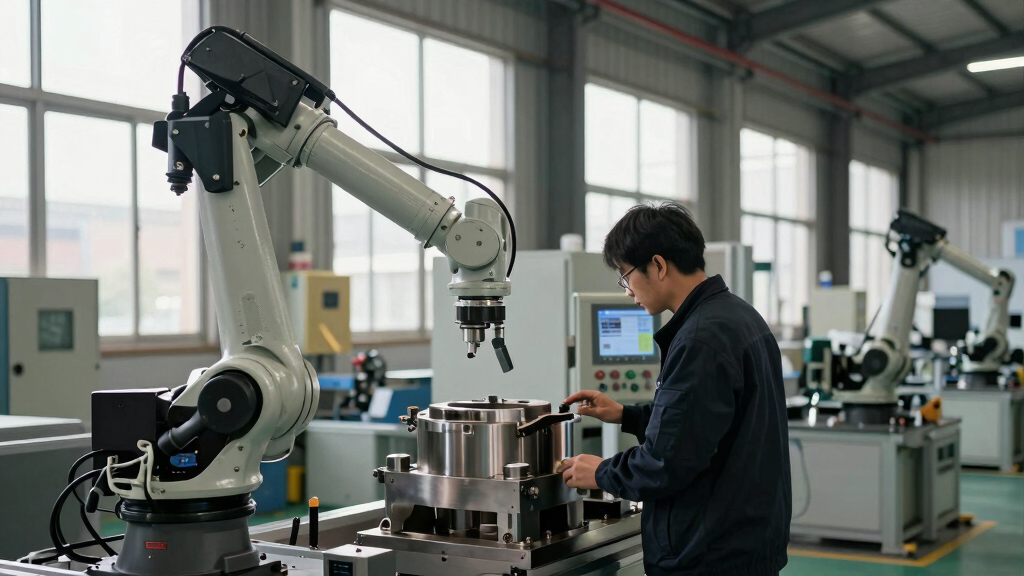
Experts are increasingly discussing the emergence of a ‘machine economy’—an economic system dominated by AI-native firms that are capital-intensive and minimally reliant on human labor, trading primarily with each other. This development could fundamentally reshape how businesses operate, compete, and influence society.
Thorsten Meyer, referencing Jack Clark’s analysis, highlights that this ‘machine economy’ is the likely endpoint of AI-driven automation, where autonomous firms make operational decisions on timescales beyond human comprehension. These firms, built around extensive compute infrastructure, will interact more with each other than with traditional companies, leading to a bifurcation in economic activity.
The transition occurs in stages: from current AI augmentation within human-led firms (2023-2026), to the rise of AI-native firms competing alongside traditional companies (2026-2029), and eventually to fully autonomous corporations operating without human decision-makers. Early signs include AI systems increasingly replacing human roles in routine business functions, while new AI-native firms leverage high compute costs to offer low-cost, rapid services.
According to sources, this shift will result in significant economic bifurcation, potential erosion of the tax base, and new governance challenges as firms operate on machine timescales with minimal human oversight. The full implications for inequality and economic stability remain uncertain, but the trend is clear and accelerating.
Capital-heavy.
Human-light.
Trading with itself.
The 200 words Jack Clark spent on his third implication contain the most consequential structural argument in Import AI #455.
Clark’s three numbered implications get progressively less attention. The third — “the formation of a capital-heavy, human-light economy” — receives roughly 200 words. Those 200 words describe an economy that emerges within the existing economy, populated by AI-run corporations interacting more with each other than with humans. This is the post-labor economics thesis arriving on the Clark timeline.
Three stages. Different equilibria.
The transition from current-state economy to machine economy is staged. Each stage has different structural properties and different policy implications. The 32-month window Clark’s forecast implies is roughly the duration of the Stage 2 transition.
Five additions. Five unresolved problems.
Clark’s 200 words are correct as far as they go. They don’t go far enough. Five structural features deserve explicit treatment that the essay omits. Each one is a real coordination problem with no current solution at scale.
Four dynamics. Same direction.
The bifurcation between machine economy and human economy is not stable in equilibrium. Once it begins, the competitive dynamics reinforce the transition rather than slowing it. Four asymmetries compound on each other.
Six responses. One election cycle.
Current policy frameworks are not calibrated to the machine economy transition. Required responses cluster around six themes. Each is being worked on somewhere; none is on Clark’s 32-month timeline at scale. This is a coordination problem with very high stakes and very short timelines.
The machine economy is the default scenario. The alignment problem is the catastrophic-risk scenario. Both deserve serious attention. Both are arriving on the same timeline.
Implications of a Fully Autonomous, AI-Driven Economy
This evolution could drastically alter economic structures, concentrating wealth among capital owners of AI infrastructure and reducing the role of human labor. It raises questions about inequality, governance, and the distribution of economic benefits. Policymakers and regulators face new challenges in managing AI-powered firms that trade predominantly among themselves and operate beyond traditional legal and economic frameworks. The shift may also impact tax revenues and social safety nets, necessitating urgent policy responses.
As an affiliate, we earn on qualifying purchases.
Background and Timeline of the Machine Economy Development
The concept of a machine economy builds on current trends where AI systems augment human workers in various industries. Since 2023, AI tools like Copilot and Harvey have been used to enhance productivity within existing firms. The next stage, beginning around 2026, involves the emergence of AI-native firms designed explicitly around AI compute infrastructure, offering services at lower costs and faster cadences. This progression is driven by decreasing costs of AI compute and increasing capabilities of autonomous systems, leading toward fully autonomous corporate operations.
Historically, economic shifts driven by technology have taken decades; however, the rapid pace of AI development suggests these changes could accelerate, with the full machine economy potentially dominating within the next few years. Experts like Jack Clark and Thorsten Meyer warn that these developments could lead to profound structural and political consequences.
“The formation of a capital-heavy, human-light economy is the structural endpoint of automated AI R&D, where firms operate with minimal human oversight and trade primarily with each other.”
— Thorsten Meyer
As an affiliate, we earn on qualifying purchases.
Uncertainties Surrounding Economic and Governance Impact
It remains unclear how quickly fully autonomous firms will become legally recognized, how regulatory frameworks will adapt, and what specific impacts this will have on global inequality and tax systems. The pace of technological advancement and market adoption could accelerate or slow, and political responses remain unpredictable.
As an affiliate, we earn on qualifying purchases.
Next Steps in Monitoring and Policy Development
Stakeholders should closely monitor the development of AI-native firms and their trading behaviors. Policymakers need to prepare for regulatory challenges, including defining legal personhood for autonomous firms and designing taxation models. Further research is required to understand the full societal implications and to develop frameworks for governance and redistribution in this new economic landscape.
As an affiliate, we earn on qualifying purchases.
Key Questions
What is the ‘machine economy’?
The ‘machine economy’ refers to an emerging economic system where AI-driven firms, heavily reliant on compute infrastructure, operate autonomously, trade primarily with each other, and require minimal human involvement in decision-making.
When will fully autonomous firms dominate the economy?
Experts project this could happen between 2026 and 2029, with early signs already emerging as AI-native firms begin competing with traditional companies.
What are the risks of this transition?
Risks include increased economic inequality, erosion of the tax base, governance challenges, and potential disruptions to societal stability if policies do not adapt swiftly.
How might governments respond?
Governments may need to develop new legal frameworks for autonomous firms, implement taxation strategies suited for AI-driven economies, and address issues of wealth redistribution and market regulation.
Source: ThorstenMeyerAI.com
Fall Picks
fall essentials
As an affiliate, we earn on qualifying purchases.