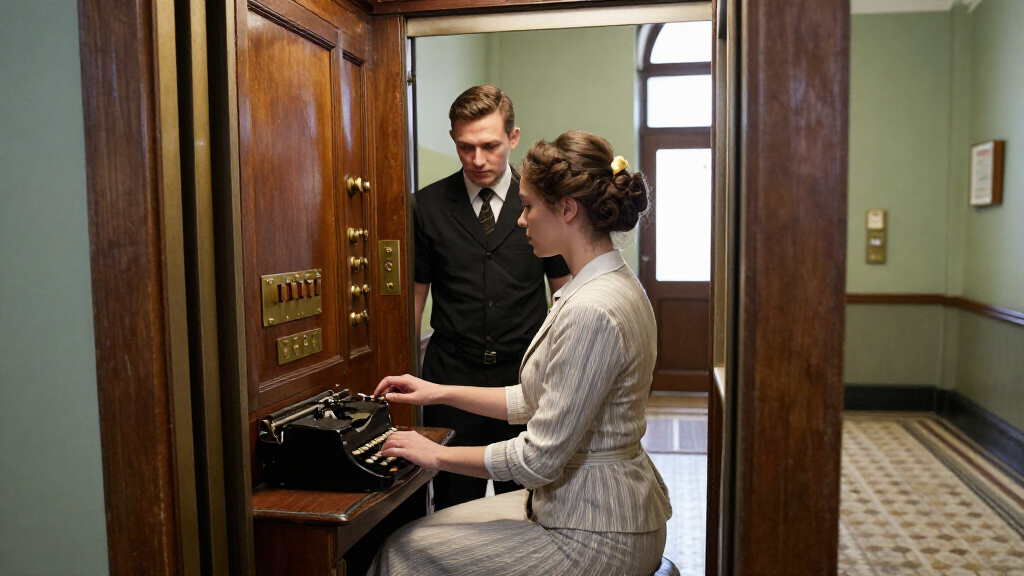

🔍 Read the full analysis: Jobs That Faded From View: Elevator Operators, Typists, Typesetters on ThorstenMeyerAI.com

Turn your quiet moments into listening time
- Thousands of audiobooks, podcasts and originals
- Listen on your phone, tablet or Echo — also offline
- Cancel anytime
TL;DR
A November 21, 2026, historical report examines the decline of elevator operators, typists and typesetters as technology changed their work. It cites economist James Bessen’s finding that, among 271 occupations tracked from 1950 to 2010, only elevator operators largely disappeared because of automation; the account cautions that the popular link between a 1945 strike and operatorless elevators is not documented.
A November 21 report from ThorstenMeyerAI.com traces how automation and changing office technology reshaped elevator operators, typists and typesetters, arguing that whole occupations rarely disappear even when particular jobs do. The account cites economist James Bessen’s study of 271 detailed U.S. census occupations from 1950 to 2010: he found that only elevator operators largely disappeared because of automation, while most technological change took over tasks rather than entire jobs.
The report places the decline of elevator operators alongside the spread of automatic elevators. The U.S. census counted about 97,000 operators in 1950, after the occupation grew from roughly 13,000 in 1900. Otis says its first attendant-free Autotronic system went into service in 1950 at the 11-story Atlantic Refining Building in Dallas. The account says the census count had fallen to about 37,000 by 1970; the Bureau of Labor Statistics no longer lists elevator operators as a separate occupation.
It also revisits a five-and-a-half-day Manhattan strike in 1945, involving 16,600 elevator operators and other building service workers in 2,100 buildings, as reported by TIME at the time. The workers were protesting a War Labor Board wage ruling. The report says later accounts often connect the strike to building owners’ adoption of automatic elevators, but it found no document establishing that the walkout caused the change.
Typing illustrates how a job can shrink when its central task changes. The report says the United States had 985,000 word processors and typists in 1988, while a 2025 figure was about 40,400. It also recounts conflict over typesetting: in Germany, a three-week strike in 1978 sought to keep text design in the hands of skilled print workers. In 1998, the typesetter apprenticeship was merged into a new media-design trade, according to the account.
Infographic 01 · The number to remember
The one job automation wiped out
Elevator operators rose with the skyscrapers and fell with the automatic elevator. Of 271 occupations in the 1950 census, it is the only one that automation largely wiped out.
US elevator operators · census · thousands
Story vs. evidence
- Documented (TIME, 8 Oct 1945): 16,600 elevator operators and building workers on strike in 2,100 Manhattan buildings for five and a half days.
- Documented (Otis, company account): 1948 a recorded voice to help passengers trust automatic elevators; 1950 the first building with Otis high-speed, no-operator elevators (Dallas).
- Not documented: that the strike made owners switch to automatic elevators. A popular story; no source we found shows it.
Census figures: economically active persons 14 and over, each census in its own classification (1950 in the 1950 classification). Today the BLS publishes no separate count of elevator operators; installers and repairers are a different occupation.
Sources: US Census Bureau, Historical Statistics of the United States (1975), series D 233-682 (row D 587); J. Bessen, How Computer Automation Affects Occupations (2016); TIME, 8 Oct 1945; Otis company history; BLS Employment Projections 2025-35 (27 Aug 2026).
Powered by Thorsten Meyer AI
What These Job Histories Show
The histories offer a grounded way to think about current concerns that AI will eliminate jobs. Bessen’s finding, as presented in the report, does not mean workers are insulated from automation: tasks can be removed, occupations can contract, and workers may need to move into different roles. It does caution against treating a technology’s ability to perform a task as proof that an entire occupation will vanish.
The report also points to office and administrative support as a sizable area of potential change. It says about one in nine U.S. jobs remains in that occupational group and that the BLS projected in August 2026 that the group would shrink faster than any other through 2035, partly because of AI tools. That projection is a forecast, not a count of jobs already lost, and the report does not provide the projection’s detailed assumptions here.
Products Worth Considering

Oral-B iO Series 7 Deep Clean + Protect Rechargeable Electric Toothbrush, Black, with 2 Brush Heads and Charging Travel Case

Withings ScanWatch Light Hybrid Smartwatch – White

Garmin Forerunner 165 GPS Running Smartwatch, 43 mm, Black
As an affiliate, we earn on qualifying purchases.
From Manual Lifts to Office Software
Elevator operators were once a visible part of city life because early automatic systems had to win passengers’ trust. Otis’s company history says the firm offered recorded voices for automatic Autotronic elevators in 1948 while attendants were still present. One message asked passengers to let the doors close. Two years later, the Dallas building introduced a system designed to run without an operator.
Office work followed a different path. The typewriter helped create large typing pools, and the report says the census count for stenographers, typists and secretaries rose from 134,000 in 1900 to 3.9 million in 1970. Word processors and personal computers then changed how documents were produced. In the printing trade, the 1978 German strike shows that workers also contested who would control new production tools and design work.
These examples are not identical: an elevator operator’s core task could be automated in a way that typing and document production were not. Together, they frame the report’s central distinction between automating a task and removing an occupation.
““In only one case—elevator operators—can the decline and disappearance of an occupation be largely attributed to automation.””
— James Bessen, Boston University economist, as quoted in the report
The Strike’s Role Remains Unproven
The report distinguishes the documented 1945 strike from the later claim that it prompted building owners to replace elevator operators. TIME reported the scale and duration of the walkout, but the report says it found no document proving a causal link to the adoption of automatic elevators. That connection should be treated as a popular account, not an established explanation.
Some figures also need careful comparison. The report gives a 1988 count of 985,000 word processors and typists and a 2025 figure of about 40,400, but the supplied material does not specify the exact category definitions behind both figures. It says official forecasters expected a 6% decline by 2000 and that the actual decline was 51%, but does not provide the underlying forecast series or calculation in the material supplied. The 2035 BLS projection is also a forecast, not a settled outcome.
Tracking Work Through 2035
The next measurable test is whether the BLS’s August 2026 projection for office and administrative support is borne out as employment data accumulate through 2035. That will show how the occupational group changes, though it will not by itself establish how much change came from AI rather than other economic or technological forces.
For the historical examples, the report’s account leaves the key interpretive question open: where technology removes tasks, do workers move into related work, or does the occupation itself contract beyond recovery? The answer varies by job. The evidence presented here supports tracking specific occupations, task changes and time periods separately rather than treating every labor-saving technology as proof that a whole job category will disappear.
Key Questions
Did the 1945 elevator strike cause operators to be replaced?
The cause is not established. The strike is documented, but the report says it found no document showing that the walkout caused building owners to adopt automatic elevators.
What does “1 of 271” refer to?
Economist James Bessen followed 271 detailed occupations from the 1950 U.S. census through 2010. As quoted in the report, he found that only elevator operators largely disappeared because of automation.
Have typists disappeared entirely?
No. The report gives a 2025 U.S. figure of about 40,400 word processors and typists, down from 985,000 in 1988. The figures describe a steep decline, not the complete disappearance of all such work.
What does the BLS projection say about office jobs?
The report says the BLS projected in August 2026 that office and administrative support would shrink faster than any other occupational group through 2035, partly because of AI tools. It is a projection, not a report of confirmed future job losses.
Source: ThorstenMeyerAI.com