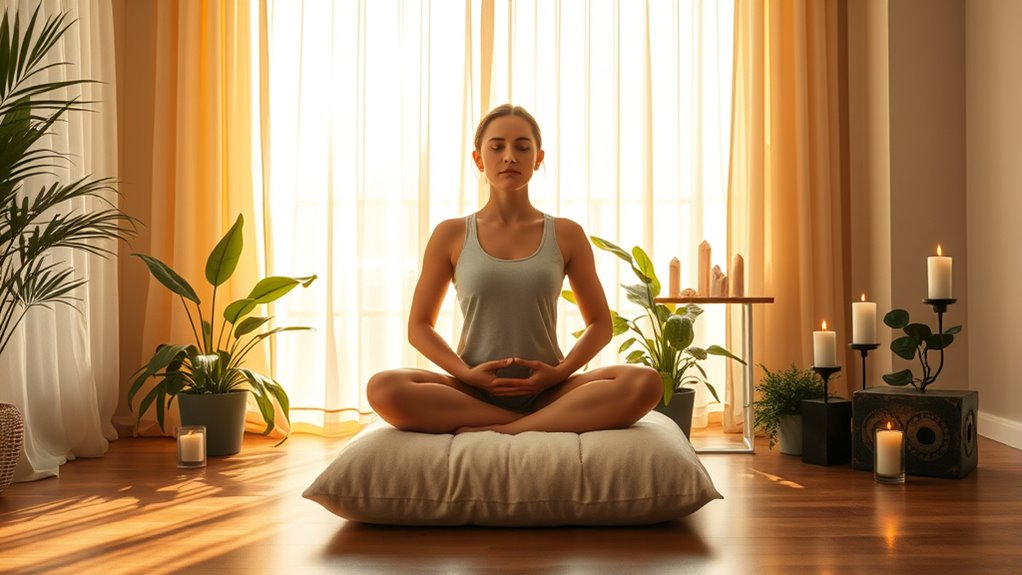

To enhance your intuitive insight through meditation, focus on combining mindfulness and breathing exercises daily. Pay close attention to your thoughts and feelings without judgment while practicing breath awareness, which helps calm your mind and clear mental clutter. Techniques like box breathing or alternate nostril breathing can deepen your relaxation, making subtle impressions more accessible. Keep practicing consistently, and you’ll notice your inner wisdom becoming clearer—if you continue, you’ll discover even more ways to strengthen this connection.

Turn your quiet moments into listening time
- Thousands of audiobooks, podcasts and originals
- Listen on your phone, tablet or Echo — also offline
- Cancel anytime
Key Takeaways
- Incorporate daily mindfulness meditation to cultivate present-moment awareness and observe subtle intuitive signals.
- Use breathing exercises like box breathing or alternate nostril breathing to calm the mind and enhance receptivity.
- Combine mindfulness with focused breath awareness to deepen mental clarity and access inner insights more easily.
- Practice regularly, even briefly, to strengthen your ability to recognize and trust intuitive impressions.
- Create a quiet, distraction-free environment to foster mental space for intuitive insights to emerge naturally.

Meditation practices have gained popularity as effective tools for reducing stress, improving focus, and boosting overall well-being. When you start exploring meditation to enhance your intuitive insight, you’ll find that incorporating mindfulness techniques and breathing exercises can be especially powerful. These methods help you quiet the mind and tune into your inner awareness, making it easier to access your natural intuition.
Mindfulness techniques involve paying close attention to your thoughts, feelings, and bodily sensations without judgment. As you practice, you learn to observe your mental patterns and emotional responses more objectively. This heightened awareness creates a mental space where intuitive insights can emerge more clearly. For example, during a mindfulness session, you might focus on the present moment, noticing the sensations of your breath or the sounds around you. This anchors your attention and minimizes mental clutter, allowing your intuitive faculties to become more accessible over time.
Practicing mindfulness sharpens awareness, creating mental space for clearer intuitive insights to emerge naturally.
Breathing exercises are another fundamental component of meditation that can enhance your intuitive abilities. When you consciously slow down your breath or practice specific breathing patterns, you activate your parasympathetic nervous system, which promotes relaxation and mental clarity. Deep, diaphragmatic breathing reduces stress hormones, creating a calm mental state conducive to intuitive insights. You might try techniques like box breathing—inhale for four seconds, hold for four seconds, exhale for four seconds, and hold again for four seconds—or alternate nostril breathing to balance your energy and sharpen your focus. Regular practice helps you develop a quiet, receptive mind, better able to pick up subtle cues and insights from within.
Combining mindfulness techniques with breathing exercises creates a synergy that amplifies your intuitive potential. As you become more skilled at maintaining a calm, centered state, you’ll notice that insights come more effortlessly. These practices help dissolve mental noise, making space for your inner wisdom to surface. Over time, you’ll start recognizing intuitive nudges—small, subtle impressions—that guide your decision-making and deepen your understanding of situations.
Consistency is key. Daily meditation, even if only for a few minutes, will strengthen your ability to access intuitive insight whenever you need it. By focusing on mindful awareness and intentional breathing, you lay a solid foundation for heightened intuition. You’ll find that as your practice deepens, you become more attuned to your inner voice, enabling you to navigate life with greater confidence and clarity.
As an affiliate, we earn on qualifying purchases.
Frequently Asked Questions
How Long Should I Meditate Daily for Better Intuition?
You should meditate for about 10 to 20 minutes daily to boost your intuition. Consistency is key, so try to make it a daily habit. Focus on mindfulness and use breathing techniques to deepen your practice. Even short sessions can be effective if you stay committed. Over time, this regular practice enhances your intuitive insight, helping you become more aware of subtle cues and inner guidance.
Can Meditation Help Overcome Mental Blocks to Insight?
Yes, meditation can help you overcome mental blocks to insight by fostering mindfulness awareness and accessing your subconscious. When you meditate regularly, you quiet mental chatter and create space for deeper understanding. This process allows you to tap into hidden thoughts and feelings, dissolving mental barriers. With consistent practice, you’ll find it easier to access insights, break through blocks, and trust your intuition more confidently.
Are There Specific Meditation Styles Best for Intuition?
Yes, certain meditation styles boost intuition, especially those focused on mindfulness benefits and chakra balancing. Practices like guided visualizations and loving-kindness meditation help you tune into your inner wisdom. By balancing your chakras, particularly the third eye and crown, you open channels for intuitive insights. Regularly practicing these styles enhances your ability to access subconscious knowledge and deepen your intuitive understanding naturally.
How Do I Know if My Intuition Is Improving?
Think of your intuition as a garden. If you notice more vibrant blooms—trusting instincts and recognizing signals—it means your garden is thriving. You’ll feel more confident making decisions, sensing subtle cues, and trusting your gut. Small insights become clearer, like a gentle breeze guiding you. When your inner voice feels stronger and more consistent, it’s a sign your intuition is improving, helping you navigate life’s twists with increased clarity.
Is Guided Meditation More Effective Than Silent Meditation?
Guided meditation can be more effective for you if you prefer structure and external guidance, helping you achieve mental clarity faster. It’s especially good when you’re new to meditation techniques, as the instructor’s voice keeps you focused. Silent meditation, however, fosters deeper self-awareness and can enhance intuition over time. Try both to see which method boosts your mental clarity and intuitive insight more effectively, then stick with what works best for you.
breath awareness meditation timer
As an affiliate, we earn on qualifying purchases.
As an affiliate, we earn on qualifying purchases.
Conclusion
Now that you’ve explored these meditation practices, you’re well on your way to sharpening your intuitive insight. Remember, practice makes perfect, and consistency is key. As you continue to meditate regularly, you’ll find your inner voice becomes clearer and more reliable. Don’t forget, patience is a virtue—sometimes, you just have to keep at it and trust that the pieces will fall into place. Stay committed, and your intuition will flourish before you know it.
As an affiliate, we earn on qualifying purchases.
alternate nostril breathing guide
As an affiliate, we earn on qualifying purchases.
As an affiliate, we earn on qualifying purchases.
Fall Picks
fall essentials
As an affiliate, we earn on qualifying purchases.