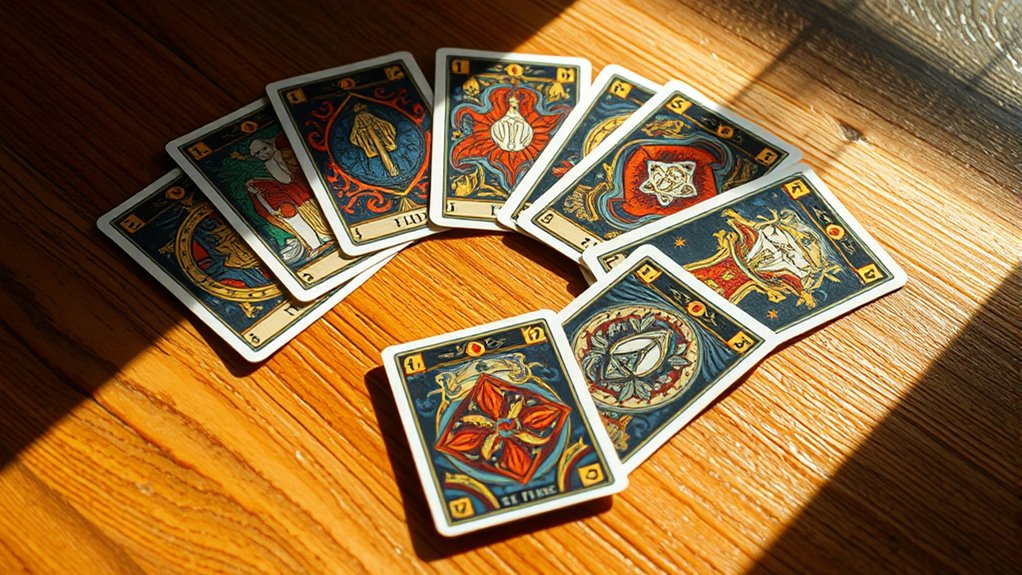

Tarot is a powerful self-reflection tool that uses symbolic imagery to help you explore your inner world. As you connect with the cards, you can gain insights into your subconscious thoughts, feelings, and desires. The vivid symbols encourage you to interpret your personal meaning, fostering self-awareness over prediction. By engaging with these images regularly, you’ll strengthen your intuition and build trust in your inner wisdom. Keep exploring to discover how tarot can deepen your self-understanding.
Key Takeaways
- Tarot acts as a mirror, helping increase self-awareness by exploring inner thoughts, feelings, and subconscious patterns.
- Symbolic imagery on cards prompts personal interpretation, connecting visuals with individual emotions and life circumstances.
- Using Tarot encourages slowing down and questioning, revealing hidden desires and underlying issues for deeper understanding.
- Regular practice enhances intuition and confidence in accessing inner wisdom through symbolic recognition.
- Engaging with Tarot fosters self-reflection, emotional insights, and decision-making clarity by connecting with personal archetypes and subconscious messages.

Tarot cards have long been associated with divination, but they also serve as powerful tools for self-reflection. When you engage with a tarot deck, you’re not just seeking answers from an external source; you’re opening a door to explore your inner world. Each card features symbolic imagery that’s rich with meaning, inviting you to interpret the symbols based on your current feelings and circumstances. These images often depict archetypal scenes, figures, and objects that resonate on a subconscious level, helping you connect with your intuition. As you study the imagery, you may find that certain symbols evoke specific thoughts or emotions, guiding you toward intuitive insights you might not have considered consciously. Incorporating the study of imagery enhances your ability to interpret the messages more deeply. The process of working with tarot encourages you to slow down and examine your thoughts and feelings more deliberately. When a card appears in a reading, it acts as a mirror reflecting your internal state. You’re prompted to ask yourself questions about what the symbolism might mean in your life. For example, if the Tower card shows a structure struck by lightning, you might interpret it as a sign of upheaval or revelation. The symbolic imagery pushes you to contemplate your situation from different angles, helping you uncover underlying issues or hidden desires. This isn’t about predicting the future but about gaining clarity and awareness of your current path. Using tarot as a self-reflection tool also develops your intuitive skills. As you become more familiar with the cards, you start trusting your gut feelings about what each image signifies. You might notice that certain symbols evoke strong emotional reactions or memories. Over time, this process sharpens your intuition, enabling you to interpret not just the cards but also your life experiences more deeply. The act of drawing and contemplating cards becomes a meditative practice, fostering a deeper understanding of yourself. The more you work with the symbolic imagery, the more confident you’ll grow in your ability to access intuitive insights, which can guide your decisions and help you navigate life’s challenges with greater self-awareness. Engaging regularly with symbolic imagery can also deepen your understanding of personal archetypes and their influence on your life choices. Developing a visual language through consistent practice can facilitate more meaningful connections with your inner wisdom. In essence, tarot is a visual language that speaks directly to your subconscious. By engaging with its symbolic imagery, you open yourself to insights that are uniquely personal. It becomes a dialogue between your conscious mind and your inner wisdom, making tarot an enriching tool for self-discovery. Rather than relying solely on external validation, you learn to trust your own intuitive responses, empowering you to explore your life’s questions with clarity and confidence.

GZHBAE Shadow Tarot Deck, 78 Tarot Cards for Self Reflection, Inner Work
- Number of Cards: 78 cards with Major and Minor Arcana
- Card Material: 400 GSM coated paper
- Card Size: 2.74 x 4.72 inches
As an affiliate, we earn on qualifying purchases.
As an affiliate, we earn on qualifying purchases.
Frequently Asked Questions
Can Tarot Cards Predict the Future Accurately?
You might wonder if tarot cards can predict the future accurately. While some believe in their insight, accuracy debates persist because tarot primarily offers guidance and reflections rather than definitive future predictions. You shouldn’t rely solely on tarot for certainty, but instead use it as a tool to explore possibilities and self-awareness. It’s more about understanding your current path than expecting precise predictions about the future.
How Often Should I Perform a Tarot Reading?
When considering how often you should perform a tarot reading, think about your frequency questions and personal goals. Many find that weekly or monthly readings work well, integrating them into ritual practices to gain clarity and insight. Trust your intuition to determine the right rhythm, whether daily, sporadically, or during specific moments. Regular practice helps deepen your connection to the cards and enhances your self-reflection journey.
Are Tarot Cards Suitable for Beginners Without Prior Knowledge?
They say, “You’re never too old to learn,” and that’s true for tarot too. As a beginner, you don’t need prior knowledge to start exploring tarot symbolism. Using simple spreads and focusing on your intuition helps with beginner practice. Cards can be very forgiving, so give it a try—you’ll learn as you go. Tarot’s a journey, not a race, and even beginners can find meaning in their readings.
Can Tarot Help in Making Major Life Decisions?
You can use tarot to help make major life decisions by tapping into your intuition development and gaining emotional insight. The cards serve as mirrors for your inner thoughts, clarifying feelings and options you might overlook. While tarot doesn’t give definitive answers, it encourages you to explore your intuition deeply, leading to more confident choices. Trust your emotional insights and interpret the cards as guidance, not absolute certainty.
What Are the Common Misconceptions About Tarot Reading?
Many people believe mysticism misconceptions and superstition myths about tarot reading. You might think it predicts the future or controls outcomes, but it’s really a tool for self-reflection. Tarot isn’t about luck or magic; it helps you explore your thoughts and feelings. Don’t fall for false beliefs—tarot is a personal, intuitive process, not a source of supernatural power or fortune-telling.
The Ultimate Guide to Tarot: A Beginner's Guide to the Cards, Spreads, and Revealing the Mystery of the Tarot (Volume 1)
As an affiliate, we earn on qualifying purchases.
As an affiliate, we earn on qualifying purchases.
Conclusion
As you explore tarot as a self-reflection tool, remember it’s like peeling back layers of an onion—each card reveals something new about yourself. Trust your intuition and be patient with your journey. With every reading, you’re planting seeds of insight that can grow over time. Keep an open mind, and soon you’ll discover that the cards can serve as a mirror, guiding you through life’s twists and turns with clarity and courage.

The Tarot Companion: A Portable Guide to Reading the Cards for Yourself and Others
As an affiliate, we earn on qualifying purchases.
As an affiliate, we earn on qualifying purchases.

Archetype Cards
- Product Type: Archetype Cards
As an affiliate, we earn on qualifying purchases.
As an affiliate, we earn on qualifying purchases.