
📊 Full opportunity report: Agentic Loop Failure Modes: A Production Taxonomy at the End of Year One on ThorstenMeyerAI.com — validation score, market gap, and execution plan.
TL;DR
After one year of deploying agentic AI systems, researchers have developed a detailed taxonomy of failure modes. This helps engineers diagnose and address issues more effectively, improving system reliability.
Researchers have finalized a production taxonomy of failure modes in agentic AI systems after one year of deployment, providing a structured vocabulary for diagnosing issues in operational environments. This development aims to improve debugging, evaluation, and architectural decisions for engineers managing these systems.
Over the past year, extensive failure data from production agentic AI deployments has enabled the creation of a taxonomy categorizing failure modes into six main groups with fifteen specific modes. This taxonomy, presented at ICML 2026 through dedicated workshops, offers a practical framework for engineers to identify, classify, and respond to failures more efficiently.
The six categories include drift failures, semantic issues, reasoning and coordination failures, behavioral errors, state management problems, and adversarial or specification failures. Each mode is characterized by its detection difficulty, typical failure point, recovery cost, and available architectural mitigations. For example, drift failures like semantic drift are difficult to detect and often surface late, while tool interface errors are easier to identify and mitigate.
Industry reports, such as the Agents of Chaos audit and the AgentRx failure localization paper, support these findings, highlighting that most failures are related to state management and coordination. The taxonomy is designed to serve operational needs, helping teams quickly pinpoint failure types and choose appropriate responses, rather than focusing solely on academic completeness.
Fifteen named failure modes.
First year of production agentic deployment is over. Year two is the structured-mitigation phase.
ICML 2026 has two dedicated workshops on the topic. Academic frameworks have arrived (Shahnovsky-Dror POMDP drift, Agent Drift study, AgentRx). Production reports have arrived (Agents of Chaos at OpenClaw, METR Task Complexity). The data is enough. The taxonomy is overdue. Six categories. Fifteen modes. Mapped to detection difficulty, production cost, mitigation maturity.
Six categories. Fifteen modes. Year one’s debugging vocabulary.
More granular taxonomies exist in the academic literature; they are useful for specific subdomains. For production engineering, the right granularity is the one a team can hold in working memory while debugging. Six categories is approximately that.
A bad assumption at step 3 contaminates step 50. Surfaces at step 200.
Failures rarely break at the obvious moment. The agent demonstrates plausible behavior at every individual step — but the trajectory has drifted. By the time anyone notices, the originating cause is hundreds of steps in the past.
Six categories. Six different priorities.
Production agentic systems should optimize their engineering investment in order of return-on-engineering, not moral hierarchy. Tool interface first (high frequency, easy fix). Adversarial last (catastrophic but rare).
The teams that adopt the taxonomy, invest in the eval harness, and implement the architectural patterns will capture the reliability gap and the customer trust that comes with it. Year two is the structured-mitigation phase.
Four assignments. By role.
Build targeted probes for each named mode.
The eval-harness gap is the single largest unsolved problem for production agentic deployments. Build the targeting probes. Publish evaluation methodologies. The lab that produces a credible end-to-end agentic eval harness for the failure modes in this taxonomy captures durable strategic position. Current state of the art is fragmented; consolidation overdue.
Audit production systems against six categories.
For each: confirm whether targeted detection exists, whether the team can identify the originating step of a failure, whether mitigation patterns are in place. Most production systems have substantial gaps in state management, coordination, adversarial modes. Cost of remediation is high but lower than catastrophic incident cost.
Adopt the taxonomy as debugging vocabulary.
Library the failure-mode patterns. Implement at least the easy mitigations (tool interface, termination) before deploying. Invest in trajectory replay tooling early — debugging time savings alone justify engineering cost. Teams that systematically debug against the taxonomy ship more reliable agents than teams that don’t.
Submit to FMAI and FAGEN.
The field needs negative results, minimal reproductions, falsifiable mechanistic hypotheses. Current academic literature is heavy on framework proposals and light on operational definitions and minimal reproductions. The ICML 2026 workshops are explicitly soliciting both. Best Paper Awards available; non-archival venue allows dual submission.
Operational Benefits of a Structured Failure Vocabulary
This taxonomy provides a critical operational tool for engineering teams, enabling precise diagnosis and targeted mitigation of agentic AI failures. By standardizing failure descriptions, teams can reuse mitigation strategies, build institutional knowledge, and improve system robustness. It also allows for more focused evaluation of AI systems, moving beyond generic success metrics to specific failure mode detection and prevention. Ultimately, this enhances the reliability and safety of deployed agentic systems, which are increasingly integral to enterprise operations and critical infrastructure.
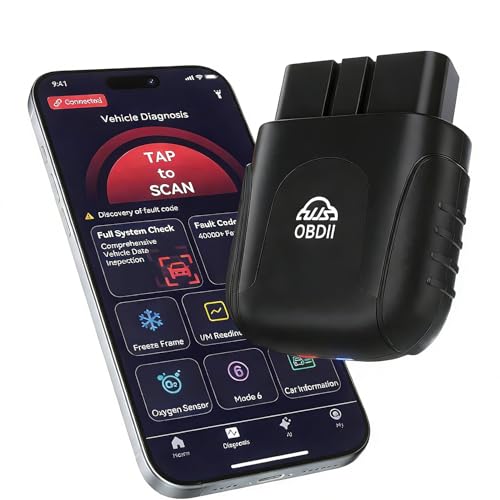
UJS Rocco OBD2 Scanner Bluetooth for iOS Android, AI Diagnostic Tool for Car Repair, No Subscription Fee, AutoVIN, 45000+ Fault Codes, Check & Clear Engine Codes, Real-Time Data, Vehicles 1996+(Black)
- AI-Generated Car Health Reports: Quick, easy-to-understand diagnostics
- Wireless & Compact Design: Lightweight, cable-free, stays in your car
- Real-Time Performance Monitoring: Live data graphs for engine insights
As an affiliate, we earn on qualifying purchases.
As an affiliate, we earn on qualifying purchases.
First Year of Agentic AI Deployments and Growing Failure Data
The first year of deploying agentic AI systems at scale has yielded a substantial dataset of failure incidents. Academic workshops at ICML 2026, such as FMAI and FAGEN, have formalized this knowledge into frameworks like POMDP drift models and behavioral typologies. Industry reports, including the Agents of Chaos audit and the METR Task Complexity Analysis, reveal that failures often cluster around state management and coordination issues, with some catastrophic adversarial failures occurring rarely but unpredictably. This evolving understanding underscores the need for a practical, operational taxonomy to guide ongoing development and debugging efforts.
“The taxonomy is designed to give engineers a vocabulary for diagnosing failures, enabling targeted responses and faster resolution.”
— Thorsten Meyer

AI DEBUGGING SYSTEMS: Finding and Fixing Code with Intelligence
As an affiliate, we earn on qualifying purchases.
As an affiliate, we earn on qualifying purchases.
Remaining Challenges in Failure Detection and Response
While the taxonomy covers a broad range of failure modes, some categories, particularly drift and adversarial failures, remain difficult to detect early. The effectiveness of proposed architectural mitigations varies, and new failure modes may emerge as systems evolve. Additionally, capturing the full spectrum of failure modes in diverse operational contexts is ongoing, and further refinement of detection tools is needed.
As an affiliate, we earn on qualifying purchases.
Next Steps for Industry Adoption and Refinement
Engineering teams will adopt this taxonomy to improve failure detection and mitigation strategies. Future work includes developing automated detection tools tailored to each failure mode, expanding the taxonomy with real-time diagnostic capabilities, and refining architectural responses based on ongoing deployment data. Continued collaboration between academia and industry will be essential to adapt the taxonomy as agentic AI systems grow more complex and widespread.

TESIA Black Mold Test Kit for Home – AI Detection App, 8 Tests + 30 Scans
- All-in-One Home Testing System: Combines testing, app guidance, and review
- Instant Surface Scanning: Use your phone to scan walls and joints
- Flexible Testing Options: Quick surface scans or deeper testing with plates
As an affiliate, we earn on qualifying purchases.
As an affiliate, we earn on qualifying purchases.
Key Questions
How does this taxonomy improve debugging in practice?
It standardizes failure descriptions, enabling engineers to quickly identify failure types, reuse mitigation strategies, and build better diagnostic tools.
Are these failure modes applicable to all agentic AI systems?
The taxonomy is based on data from the first year of large-scale deployments and is designed to be broadly applicable, though some modes may vary with system architecture and operational context.
What are the most challenging failure types to detect?
Drift failures, especially semantic drift and coordination failures, are among the hardest to detect early due to their subtle and gradual nature.
Will this taxonomy evolve over time?
Yes, ongoing deployments and research will refine and expand the taxonomy, incorporating new failure modes and improved detection methods.
How does this impact future AI system design?
Designers can target specific failure modes with architectural responses, leading to more robust, reliable, and safer agentic systems.
Source: ThorstenMeyerAI.com