
📊 Full opportunity report: Best Quiet CPU Coolers for Sustained AI/Compute Loads on ThorstenMeyerAI.com — validation score, market gap, and execution plan.
TL;DR
This article reviews the best quiet CPU coolers for sustained AI and compute workloads in 2026. It compares air and liquid options, emphasizing reliability, noise levels, and cooling performance for long-duration tasks.
In 2026, the top quiet CPU coolers for sustained AI and compute workloads are identified as the Noctua NH-D15 G2, Thermalright Peerless Assassin 120 SE, and Arctic Liquid Freezer III Pro 360, among others. These models are designed to handle continuous high loads while maintaining low noise levels, essential for reliable AI workstation performance.
The Noctua NH-D15 G2 remains the benchmark for air cooling, offering exceptional thermal capacity and near-silent operation under continuous load, making it ideal for high-end, always-on AI workstations. The Thermalright Peerless Assassin 120 SE provides a highly cost-effective alternative, delivering approximately 95% of flagship performance at a third of the price, suitable for mainstream to high-end CPUs. For those prioritizing silence, the be quiet! Dark Rock Pro 5 offers near-invisible noise levels while maintaining efficient cooling during prolonged workloads. Meanwhile, the Arctic Liquid Freezer III Pro 360 stands out as the top liquid AIO option, capable of managing high TDP workloads reliably over extended periods, with a reputation for stability and quiet operation.
These recommendations are based on recent testing and expert consensus, emphasizing cooling capacity at low fan speeds, reliability over years of operation, and noise levels during sustained inference or training tasks. The choice between air and liquid cooling depends on workload intensity, hardware configuration, and noise sensitivity. Notably, air coolers with larger surface areas and slower fans excel at maintaining steady temperatures quietly, while high-performance AIOs are better suited for the hottest chips under continuous stress.
Best quiet CPU coolers
for sustained AI loads.
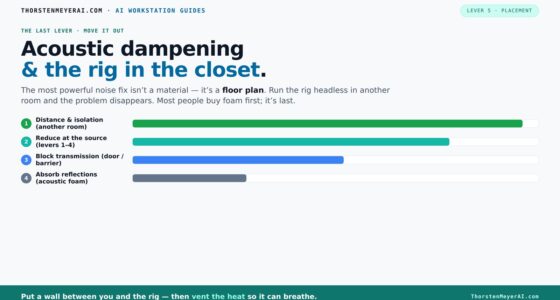
A cooler that’s fine for gaming bursts can run out of headroom on hour three of an inference job. What matters here isn’t peak capacity — it’s holding a steady temperature at a quiet fan speed, all day. Tap your priority in Part 3 to find your pick.
- Mainstream to high-end CPU, power-capped.
- You run it 24/7 — no pump to fail, ever.
- You want zero maintenance for years.
- Quiet matters more than the last few degrees.
- Top-tier CPU under sustained all-core load.
- A big air tower won’t physically fit (multi-GPU case).
- You want maximum sustained thermal headroom.
- You’ll accept a pump as one more moving part.
Why Quiet Cooling Is Critical for AI Workstations
For AI and high-performance computing tasks, maintaining steady, low temperatures over long periods is crucial. Excessive noise or thermal fluctuations can disrupt workflows and reduce hardware lifespan. The adoption of specialized coolers ensures reliability, reduces maintenance, and minimizes acoustic distractions in professional environments. As AI workloads grow in complexity and duration, choosing the right cooling solution becomes essential for operational stability and efficiency.

be quiet! Pure Rock Pro 3 Black CPU Air Cooler | 6 High Performance 6mm Heat Pipes with HDT Technology | 120mm Quiet PWM Fan | AMD:AM4 AM5/Intel LGA 1700/1150/1151/1200 | Black | BK042
- High-Performance Copper Heat Pipes: 6 nickel-plated copper heat pipes for peak cooling
- Optimized 120mm PWM Fan: Pure Wings 3 fan with enhanced airflow and pressure
- Compact Offset Design: Double-tower cooler with adjustable fan height for compatibility
As an affiliate, we earn on qualifying purchases.
As an affiliate, we earn on qualifying purchases.
Evolution of Cooling Solutions for AI Workloads
Traditional CPU cooling focused primarily on gaming and short bursts of high load. However, as AI inference and training tasks increasingly demand sustained CPU performance, cooling strategies have shifted. High-end air coolers like the Noctua NH-D15 G2 have maintained relevance due to their reliability and quiet operation, while liquid coolers have gained popularity for managing higher TDP chips under continuous load. The market now emphasizes cooling capacity at low noise levels, reflecting the needs of professional AI workstations that run 24/7.
Recent tests and reviews in 2026 confirm that large dual-tower heatsinks and larger fans outperform smaller, high-RPM models in maintaining stable temperatures quietly over long durations. The trend toward fanless and hybrid cooling solutions also indicates a focus on noise reduction without sacrificing thermal performance.
"For sustained inference workloads, your cooler's ability to keep temperatures steady without ramping fans is paramount. Larger, slower fans and bigger heatsinks are the key."
— Thorsten Meyer, AI hardware expert

ID-COOLING FX360 LCD 360mm AIO CPU Cooler, 1.48" Customizable LCD Display
- Full-Color LCD Display: 1.48-inch customizable LCD screen with graphics
- ARGB Lighting Ring: Dynamic lighting for visual enhancement
- High-Performance Cooling: 396×120×27mm radiator with 350W TDP
As an affiliate, we earn on qualifying purchases.
As an affiliate, we earn on qualifying purchases.
Remaining Questions About Cooler Longevity and Compatibility
While current models are highly rated, long-term reliability data for some liquid coolers under continuous AI workloads is limited. It is also unclear how newer case designs and motherboard configurations might influence cooler compatibility and airflow dynamics. Additionally, the impact of future chip TDP increases on cooling capacity remains to be seen, as does the evolving landscape of hybrid cooling solutions.
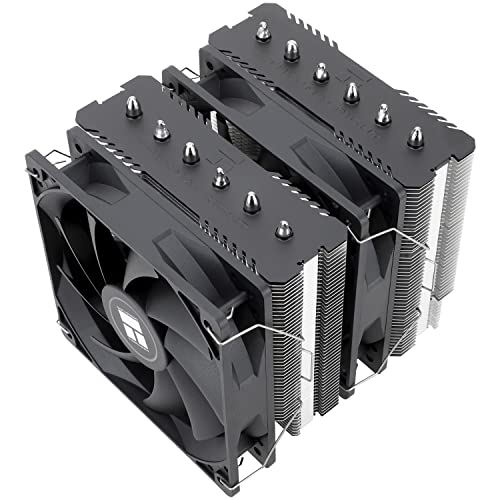
Thermalright Peerless Assassin 120 SE CPU Cooler, 6 Heat Pipes AGHP Technology, Dual 120mm PWM Fans, 1550RPM Speed, for AMD:AM4 AM5/Intel LGA 1700/1150/1151/1200/1851,PC Cooler
- Brand Origin: Taiwan-based with 20+ years experience
- Product Dimensions: 125x135x155mm
- Heat Sink Material: Aluminum with dual tower design
As an affiliate, we earn on qualifying purchases.
As an affiliate, we earn on qualifying purchases.
Future Developments in Quiet Cooling for AI Tasks
Manufacturers are expected to introduce more hybrid and fanless cooling options tailored for AI workloads, emphasizing even lower noise and higher reliability. Continued testing and real-world deployment will clarify which solutions best balance thermal performance, noise, and longevity. Users should monitor upcoming product releases and performance reviews to inform future upgrades.

Noctua NH-L9x65 chromax.Black, Premium Low-Profile CPU Cooler (65mm, Black)
- Compact Low-Profile Design: Only 65mm tall for space-saving builds
- Large Footprint: 95x95mm size avoids RAM and PCIe interference
- Optimized Fan: NF-A9x14 92mm PWM fan with low-noise adaptor
As an affiliate, we earn on qualifying purchases.
As an affiliate, we earn on qualifying purchases.
Key Questions
Are air coolers sufficient for all AI workloads?
For most mainstream and high-end CPUs under typical AI workloads, high-quality air coolers like the Noctua NH-D15 G2 are sufficient. However, extremely high TDP chips or very long, intensive training sessions may benefit from liquid cooling solutions.
How important is noise level in selecting a CPU cooler for AI workstations?
Noise level is critical, especially in office or shared environments, as sustained high noise can be distracting. Cooler choices like the be quiet! Dark Rock Pro 5 are designed for near-silent operation during prolonged loads.
What are the main tradeoffs between air and liquid cooling in 2026?
Air coolers are generally more reliable and maintenance-free but may be less effective at very high TDPs. Liquid AIOs handle higher heat loads more efficiently and can be quieter at high performance but involve pump components that can fail over time.
Should I consider fanless cooling for a dedicated AI workstation?
Fanless coolers like the Noctua NH-P1 are suitable for environments where absolute silence is required, but they are generally limited to lower TDP CPUs and may not handle the highest workloads without additional cooling strategies.
Source: ThorstenMeyerAI.com