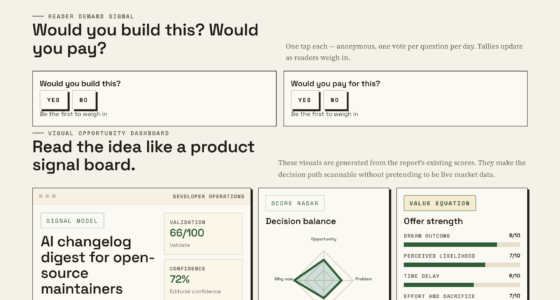

📊 Full opportunity report: Real-Time Business Liquidation Alerts: Your Competitive Edge on IdeaNavigator AI — validation score, market gap, and execution plan.

Turn your quiet moments into listening time
- Thousands of audiobooks, podcasts and originals
- Listen on your phone, tablet or Echo — also offline
- Cancel anytime
TL;DR
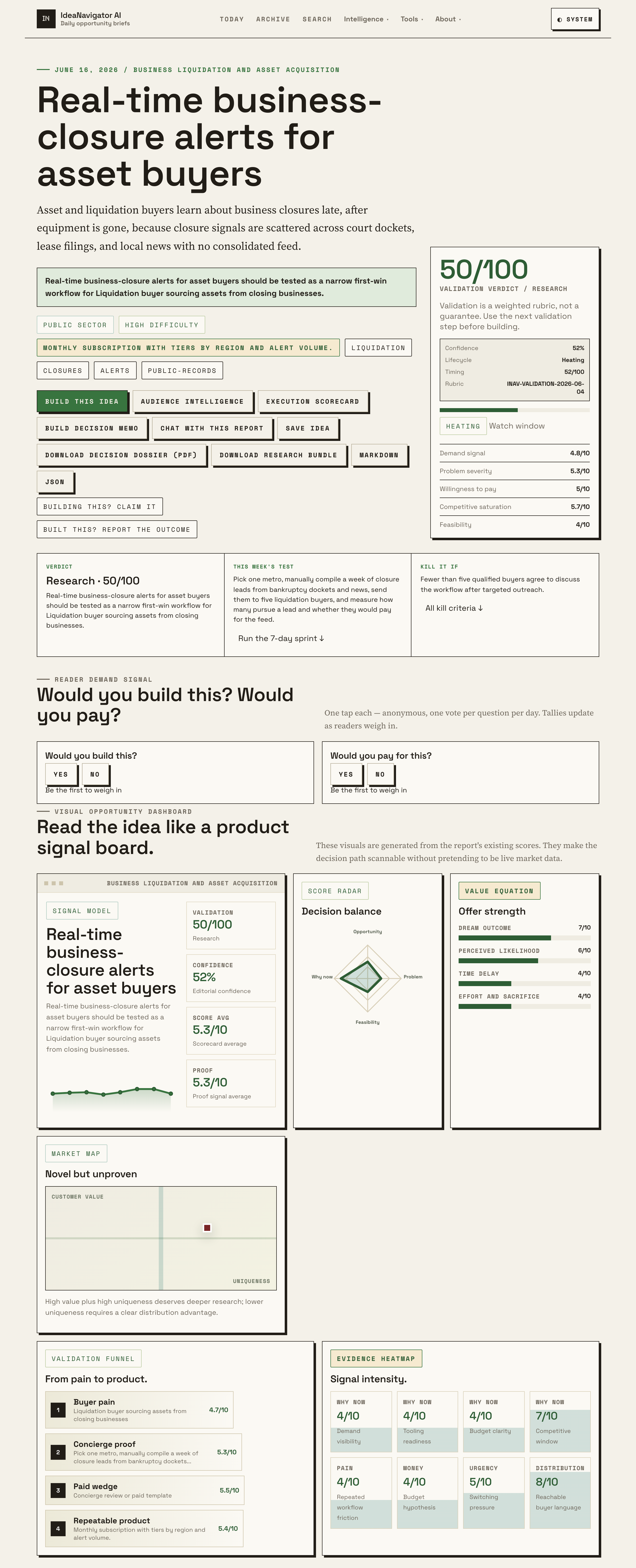
A new system for real-time alerts on business closures is being tested for liquidation asset buyers. This could give buyers faster access to closing businesses and their assets, improving sourcing efficiency.
Liquidation asset buyers are set to gain a new tool: real-time alerts on business closures, currently being tested as a way to provide faster access to assets from closing companies. This initiative addresses a longstanding challenge—buyers often learn about closures too late, after equipment and assets have already been sold or removed, limiting their opportunities.
The proposed system involves a manually curated daily alert where buyers specify a region and asset category. Human analysts then scan bankruptcy dockets, lease filings, and local news to identify businesses that are closing, and compile relevant details such as business type, estimated asset value, and closure timeline. This process aims to deliver timely, actionable leads to liquidation buyers, who often rely on scattered, delayed signals.
According to an anonymous source involved in the testing, this approach is designed to be a first step—an MVP—that could later evolve into automated, real-time feeds. The initial test will focus on a single metro area, with five liquidation buyers participating to measure how many pursue the leads and whether they would pay for ongoing alerts. Revenue models include a monthly subscription tiered by region and alert volume.
The opportunity arises amid elevated small-business closures and bankruptcies following the pandemic, with electronic filings making real-time aggregation feasible for the first time. Currently, signals are scattered across court dockets, lease filings, and local news, often with significant delays.
Potential Impact on Asset Acquisition Strategies
This development could significantly improve the efficiency of liquidation asset sourcing, giving buyers a competitive edge by reducing the lag time between business closure and asset acquisition. Faster access to closure information can increase the likelihood of purchasing assets before they are sold or removed, potentially leading to better pricing and inventory opportunities for liquidation firms and investors.
Moreover, if successful, this model could disrupt existing channels that rely on manual searches or delayed notices, leading to a more streamlined, data-driven market for business assets. It also reflects a broader trend toward real-time data aggregation in the liquidation industry, driven by the increased digitalization of bankruptcy and legal filings.
business liquidation asset scanner
As an affiliate, we earn on qualifying purchases.
As an affiliate, we earn on qualifying purchases.
Growing Need for Timely Closure Data Post-Pandemic
Post-pandemic economic disruptions have led to a surge in small-business closures and bankruptcies, creating a larger pool of assets available for liquidation. Traditionally, liquidation buyers have depended on court notices, local news, and lease filings, which are often slow to surface and scattered across multiple sources. The electronic filing of bankruptcy and legal documents now makes it feasible to aggregate closure signals more efficiently and in near real-time.
Previous efforts to improve asset sourcing have relied on manual research or subscription-based legal alert services, but these often lack immediacy. The new alert system aims to fill this gap by providing a curated, daily update tailored to specific regions and asset types, potentially transforming how liquidation assets are sourced and acquired.
“This system is designed to give liquidation buyers faster, more reliable leads, which could significantly improve their chances of acquiring assets before they are gone.”
— an anonymous source involved in testing
As an affiliate, we earn on qualifying purchases.
Unclear Details on Automation and Scalability
It is not yet clear whether the alert system will evolve into an automated, real-time feed or remain a manual process. The scalability of this approach across multiple regions and asset categories also remains uncertain, as does the long-term willingness of buyers to pay for such alerts.
Further testing will determine if the model can be expanded and how it compares to existing data sources in terms of timeliness and accuracy.
As an affiliate, we earn on qualifying purchases.
Next Steps in Testing and Market Adoption
The initial testing phase involves a single metro area with five liquidation buyers, with results expected within the coming weeks. Success metrics include the number of leads pursued and willingness to subscribe. If results are positive, the system could expand to additional regions and automate alerts, potentially becoming a standard tool in liquidation asset sourcing.
Industry stakeholders will be watching for further developments and potential commercial rollout, which could reshape how liquidation assets are identified and acquired in a post-pandemic economy.
As an affiliate, we earn on qualifying purchases.
Key Questions
How does the alert system work?
Buyers specify a region and asset category, and analysts manually scan bankruptcy dockets, lease filings, and local news to identify closing businesses. They then compile and send daily alerts with relevant details.
Will this replace existing legal alert services?
It is too early to tell, but the system aims to complement current sources by providing more timely, curated information tailored to specific buyer needs.
Can this system be automated in the future?
Yes, the initial plan is to test manual curation, but automation is a goal if the pilot proves successful, enabling real-time alerts across multiple regions.
What are the main benefits for liquidation buyers?
Faster access to closing business information, increased chances of acquiring assets before they are sold or removed, and potential cost advantages in competitive markets.
Source: IdeaNavigator AI
Fall Picks
fall essentials
As an affiliate, we earn on qualifying purchases.