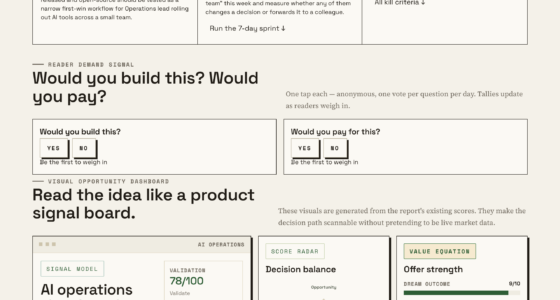
📊 Full opportunity report: RSVP-and-payment co-host tool for supper club hosts on IdeaNavigator AI — validation score, market gap, and execution plan.

Turn your quiet moments into listening time
- Thousands of audiobooks, podcasts and originals
- Listen on your phone, tablet or Echo — also offline
- Cancel anytime
TL;DR

A new tool designed for independent supper club hosts is in testing, allowing them to manage RSVPs, dietary restrictions, and payments via a single link. The aim is to simplify event management and reduce no-shows.
A new RSVP-and-payment co-host tool for independent supper club hosts is being tested to streamline managing guest lists, dietary restrictions, and payments for recurring private dinners.
The tool aims to serve hosts of private salons and supper clubs who currently rely on manual messaging, spreadsheets, and separate payment platforms to organize recurring events. It offers a simple dashboard where hosts can send a single invite link collecting RSVPs, dietary notes, and payments, then view a confirmed guest list with a waitlist.
This initiative is designed as a minimal viable product (MVP) to validate the concept. It is currently being tested with approximately ten active supper-club hosts, who are invited to run their next event using the tool manually. The goal is to measure reductions in no-shows and assess willingness to pay a per-seat fee or a flat monthly subscription.
The platform’s creators see it as a potential market for private event organizers seeking a more integrated solution for recurring, invite-only dinners. Revenue would come from service fees or subscription models, aiming to address a gap between public ticketing platforms and manual communication methods.
Potential Impact on Private Event Management
If successful, this tool could significantly simplify the logistics of private supper clubs and salons, reducing administrative overhead and improving attendance rates. It could also pave the way for more scalable, automated event management for small-scale, recurring gatherings, which are currently underserved by existing platforms. For hosts, this means less time spent on coordination and more focus on the event experience.
Products Worth Considering

Withings Sleep Under-Mattress Sleep Tracking Pad

BowFlex Results Series SelectTech Adjustable Dumbbells (Pair)

Garmin Forerunner 165 GPS Running Smartwatch, 43 mm, Black
As an affiliate, we earn on qualifying purchases.
Growing Interest in In-Person Community Events
The surge in in-person community dinners and salons has emerged as a response to digital fatigue, with more individuals seeking intimate, recurring gatherings. However, existing tools are fragmented, often relying on manual messaging, spreadsheets, or public ticketing platforms that are not tailored for invite-only, recurring events. This gap creates inefficiencies and increases the risk of no-shows, prompting interest in integrated solutions. The proposed RSVP-and-payment tool is part of a broader trend toward specialized event management for small, private gatherings.
“The idea is to reduce the manual workload for hosts and improve attendance through streamlined RSVP and payment collection.”
— an anonymous researcher
Unconfirmed Aspects and Development Uncertainties
It is not yet clear how widely the tool will be adopted beyond the initial testing group, or how it will be priced and marketed at scale. The effectiveness in reducing no-shows and increasing convenience remains to be validated through user feedback and data collection. Additionally, details about future features, integrations, or expansion plans are still under development.
Next Steps for the RSVP-and-Payment Platform
The testing phase will continue with approximately ten supper-club hosts, who will run their upcoming events using the platform. Data collected from these trials will inform further development, including potential feature enhancements and pricing strategies. A broader rollout may follow if initial results are positive, alongside marketing efforts targeting private event organizers seeking streamlined management tools.
Key Questions
When will the tool be available to more hosts?
There is no confirmed launch date yet; the current focus is on testing with a small group of hosts to validate the concept.
How will the platform charge for its service?
Potential revenue models include a per-seat service fee or a flat monthly subscription, but specifics are still being finalized.
Will the platform integrate with existing payment or calendar tools?
Details about integrations are still under consideration; the initial MVP focuses on core RSVP, dietary notes, and payment collection.
Is this tool limited to certain types of private gatherings?
Currently, it is aimed at independent supper clubs and salons running recurring paid dinners, but future versions could expand to other private event formats.
What are the main benefits for hosts using this tool?
The platform aims to reduce manual coordination, improve attendance, and simplify payment processing for recurring private dinners.
Source: IdeaNavigator AI