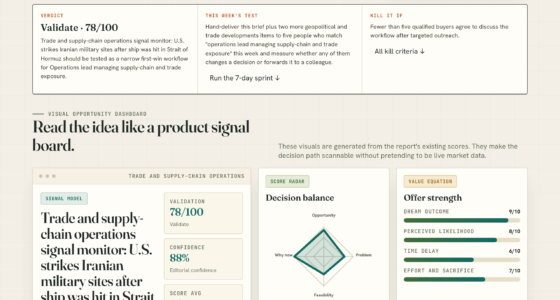

📊 Full opportunity report: The Local-First Agentic Operator on ThorstenMeyerAI.com — validation score, market gap, and execution plan.

Get books, candles and calm essentials delivered free — and shop member deals
- Fast, free delivery on millions of items
- Access to Prime Big Deal Days deals on October 6–7
- Prime Video, Amazon Music and more included
TL;DR
An innovative approach enables one person, aided by agentic AI, to build and operate diverse software products across domains, challenging traditional organizational models. This development signals a shift toward individual-led tech creation.
A single operator, empowered by agentic AI, has demonstrated the ability to build and manage a diverse portfolio of 18 complex software products, a feat previously achievable only by organizations. This development highlights a shift in software creation, emphasizing individual capability over organizational scale. For more on how individual operators are transforming software, see The pyramid cracks. What agentic AI does to the consulting leverage model.
The portfolio includes products such as content engines, validation systems, decision-making tools, and ISR platforms, all built by one person using agentic AI. These products embody four core principles: they are local-first, provider-agnostic, built by a non-developer with AI assistance, and edited through subtraction.
This approach challenges the traditional model where large teams and companies develop complex systems. Instead, it demonstrates that a single operator, with the right tools, can replicate what previously required organizational resources. The emphasis on local infrastructure and swappable models underpins this shift, providing flexibility and resilience against vendor lock-in.
The portfolio’s diversity across domains—from content management to satellite ISR—serves as evidence that the underlying principles are broadly applicable, not confined to specific industries.
The Local-First Agentic Operator
Eighteen products that looked like a sprawl were never eighteen things. They were one thing, built eighteen times. This is the thesis underneath all of them — named.
- Not “solo beats funded team.” Depth still wins most single contests. The narrower, truer claim: the floor moved — one person can now do what recently took many.
- Breadth is strength and risk. Eighteen products is resilience and a focus problem; several are seeds, not trees.
- The AI part is assisted, not autonomous. Strip away human judgment and subtraction and you get faster mediocrity, not a portfolio.
- A pattern, not a prescription. This fit one operator, one skill set, one moment. The honest version of any manifesto includes “this worked for me.”
A synthesis and a statement of one operator’s working philosophy — independent commentary, produced with AI assistance under human editorial oversight. The views are the author’s own and may change. This is not business, financial, legal, or technical advice, and the four-facet framing is a personal operating pattern, not a prescription or a claim of results. Individual products carry their own terms, disclaimers, and limitations in their respective articles; several are early- or positioning-stage. Product, model, and company names are trademarks of their respective owners; mention does not imply endorsement.
Implications of Individual Software Creation at Scale
This development could transform the landscape of software development, reducing reliance on large organizations and enabling more individuals to build and operate complex systems. It raises questions about the future of tech startups, the role of AI as a power tool for non-developers, and potential shifts in market dynamics. The ability for a single person to maintain multiple sophisticated products could democratize innovation but also introduces new challenges around oversight, security, and quality control.
As an affiliate, we earn on qualifying purchases.
Background of the Single-Operator, AI-Enabled Portfolio
Historically, building and maintaining complex software required sizable teams and organizational infrastructure. Recent advances in agentic AI have begun to lower these barriers, allowing individuals to create and manage systems that once demanded extensive resources. The series of 18 products, unveiled over 18 days, illustrates this paradigm shift, emphasizing a new stance: that one person, with the right principles and tools, can operate at organizational scale.
This approach aligns with emerging trends toward decentralization, local-first infrastructure, and vendor flexibility, reflecting a broader movement in the tech industry towards individual empowerment through AI.
“The portfolio is what that stance produces when you run it for a while. One operator, not one company.”
— Thorsten Meyer
As an affiliate, we earn on qualifying purchases.
Unanswered Questions About Long-Term Viability
It remains unclear how sustainable and scalable this approach is over time, especially regarding quality control, security, and managing complex systems without organizational oversight. The long-term reliability of single operators maintaining multiple products using agentic AI is still being tested, and potential risks or limitations are yet to be fully understood.
As an affiliate, we earn on qualifying purchases.
Next Steps for Adoption and Validation
Further experimentation and real-world deployment will reveal whether individual operators can sustain this model at scale. Observers expect to see more case studies, performance metrics, and possibly new tools designed to support solo operators. Industry stakeholders will also watch for regulatory and security implications as this approach gains traction.
AI-powered software development tools
As an affiliate, we earn on qualifying purchases.
As an affiliate, we earn on qualifying purchases.
Key Questions
How does a single person build such diverse products?
They use agentic AI tools that assist in coding, editing, and managing systems, allowing non-developers to create complex software by guiding AI with descriptive instructions.
What are the risks of relying on individual operators?
Potential risks include security vulnerabilities, inconsistent quality, and difficulties in managing multiple complex systems without organizational oversight.
Will this approach replace traditional organizations?
It may complement or disrupt existing models, enabling more individuals to participate in software creation, but large-scale organizations will likely remain essential for certain complex or high-stakes systems.
Is this feasible for all types of software?
While versatile, the approach is currently best suited for systems where local infrastructure, flexibility, and iterative editing are critical. Highly regulated or mission-critical systems may require additional safeguards.
Source: ThorstenMeyerAI.com
Halloween Picks
halloween
As an affiliate, we earn on qualifying purchases.