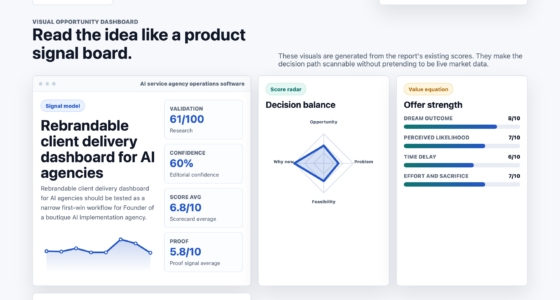

📊 Full opportunity report: AI Tools & Automation: A Strategic Guide For 2024 on ThorstenMeyerAI.com — validation score, market gap, and execution plan.

Turn your quiet moments into listening time
- Thousands of audiobooks, podcasts and originals
- Listen on your phone, tablet or Echo — also offline
- Cancel anytime
TL;DR
AI tools and automation are transforming workflows in 2024, helping organizations reduce repetitive work and improve decision-making. This guide outlines current trends, best practices, and what remains uncertain.
In 2024, organizations are increasingly adopting AI tools and automation to streamline workflows, analyze data, and enhance productivity. These technologies are no longer just experimental but are becoming integral parts of business operations, according to industry sources.
Recent industry analyses highlight that AI tools are now capable of handling tasks such as content creation, data analysis, project management, and repetitive administrative work. The original analysis can be found in AI Tools & Automation: The Complete Guide. The challenge for organizations is shifting from finding suitable AI tools to effectively integrating them into existing workflows. Experts emphasize that successful automation begins with clearly defining the tasks that are frequent, time-consuming, and easy to verify. For more insights, see The Top AI Automation Tools For Streamlining Work In 2026. Thorsten Meyer notes that combining rule-based automation with AI-driven interpretation offers the most reliable results.
Many organizations are starting with AI-assisted suggestions or drafts, gradually moving toward more autonomous execution as safeguards and data quality improve. Learn about the latest trends in AI Automation Trends & Tools To Watch In 2026. The focus remains on balancing AI capabilities with human oversight to ensure responsible and effective use. Industry reports suggest that AI deployment at the organizational level involves mapping current processes, identifying bottlenecks, and designing workflows that leverage AI at appropriate levels of autonomy.
AI Tools & Automation: A Strategic Guide for 2024
AI has moved from isolated experiments into everyday workflows. The strategic challenge is no longer finding a tool—it is designing a reliable system that combines automation, AI interpretation, quality data and accountable human oversight.
The four practical automation zones
The strongest starting points pair meaningful time savings with outputs that people can quickly inspect, correct and approve.
Creation & synthesis
Draft reports, summarize research, repurpose content and generate structured first versions—while keeping editorial review in the loop.
Data analysis
Classify information, surface anomalies, explain trends and convert unstructured inputs into decision-ready summaries.
Project management
Capture actions, prioritize requests, prepare status updates and route work to the right owner without losing accountability.
Administrative work
Handle repetitive scheduling, data entry, document processing and routine communications through predictable workflows.
Assisted response
Recommend answers, retrieve relevant knowledge and prepare personalized drafts for a human to validate before delivery.
Signal detection
Monitor patterns, flag exceptions and assemble context—supporting judgment without silently replacing the decision owner.
Move from workflow audit to controlled scale
Automation succeeds when process design comes before tool selection. Each stage should produce evidence for the next.
Map
Document the current process, handoffs, delays and decision points.
Prioritize
Score tasks by frequency, effort, risk and ease of verification.
Pilot
Test one bounded workflow with a clear owner and baseline.
Measure
Track time saved, output quality, exceptions and corrections.
Scale
Expand only after controls, training and monitoring are proven.
Choose the right level of machine control
Autonomy should match consequence. As uncertainty and business impact rise, human review becomes more important.
| Operating mode | AI role | Human role | Best fit | Risk profile | 2024 posture |
|---|---|---|---|---|---|
| Assist | Suggests options and retrieves context | Decides and executes | Research, planning, analysis | ✓Lower | Recommended start |
| Draft | Produces a complete first version | Reviews, edits and approves | Content, reports, communications | ~Moderate | Scale with review |
| Execute | Acts within predefined boundaries | Monitors exceptions and outcomes | Routing, scheduling, routine updates | ~Variable | Use guardrails |
| Autonomous | Interprets, decides and acts | Audits after execution | Stable, reversible, low-impact work | ✗Higher | Limit deployment |
Rules provide control. AI provides interpretation.
The strongest workflows combine deterministic automation for known conditions with AI for ambiguity, language and unstructured information.
The key to successful AI automation lies in starting with well-defined tasks and gradually increasing autonomy, always balancing AI suggestions with human oversight.Thorsten Meyer / Strategic principle
What remains uncertain
Technical progress is rapid, but organizational adoption will be shaped by trust, governance, data readiness and regulatory change.
Data quality
Incomplete, outdated or biased inputs can make automated outputs confidently wrong.
Governance
Ownership, approval rights and escalation paths are still immature in many organizations.
Regulation
Evolving requirements may change which data, models and automated decisions are acceptable.
Workforce impact
Long-term effects on roles, skills and organizational structure remain difficult to predict.
The next moves for responsible adoption
Treat AI automation as an operating-model change—not a software purchase. Strategy, people, process and controls must evolve together.
Build a strategic roadmap
Connect automation priorities to business outcomes, process owners, dependencies and measurable success criteria.
Invest in practical training
Teach teams how to frame tasks, inspect outputs, protect sensitive data and recognize model limitations.
Establish governance
Define approved uses, accountable owners, review requirements, monitoring routines and incident procedures.
Stay adaptive
Track technical and regulatory shifts, reassess controls and share lessons across teams and industry networks.
Why AI and Automation Strategies Impact Business Efficiency
The integration of AI tools and automation in 2024 is expected to significantly enhance operational efficiency, reduce manual workload, and enable faster decision-making. As organizations automate routine tasks, employees can focus on strategic and creative activities, potentially leading to innovation and competitive advantages. Proper planning and oversight are essential to mitigate risks such as errors, bias, or loss of control. Industry leaders and policymakers are increasingly emphasizing the importance of responsible AI use.
As an affiliate, we earn on qualifying purchases.
Evolution of AI Adoption in Business Workflows
Over recent years, AI technology has transitioned from experimental projects to mainstream applications across various sectors. Early efforts focused on automating simple tasks, but recent advancements have enabled AI to interpret complex, unstructured data and support decision-making. Industry reports from 2023 indicated a surge in AI-powered tools for content production, data analysis, and project management, with many organizations adopting these tools gradually. The current focus is on integrating AI into existing systems, designing workflows that combine rule-based automation with AI interpretation, and establishing responsible use guidelines.
“The key to successful AI automation lies in starting with well-defined tasks and gradually increasing autonomy, always balancing AI suggestions with human oversight.”
— Thorsten Meyer
As an affiliate, we earn on qualifying purchases.
Unresolved Challenges in AI Integration for 2024
Uncertainties remain regarding the speed at which organizations will adopt autonomous decision-making capabilities, particularly in high-stakes environments. Data quality, ethical considerations, and evolving regulatory frameworks may influence the pace and scope of AI deployment. Discussions continue around the long-term effects on employment and organizational structures, with an emphasis on responsible AI practices to mitigate potential risks.
As an affiliate, we earn on qualifying purchases.
Next Steps for Organizations Embracing AI in 2024
Organizations are advised to develop clear AI adoption strategies, invest in employee training, and establish governance frameworks for responsible AI use. Future developments may include more sophisticated AI models capable of managing complex, unstructured tasks with higher levels of autonomy, provided safety and ethical standards are maintained. Staying informed about regulatory changes and engaging in industry collaborations will be important for successful AI integration.
As an affiliate, we earn on qualifying purchases.
Key Questions
What are the best practices for starting AI automation projects?
Begin with clearly defined, repetitive tasks that are easy to verify. Map current workflows, identify bottlenecks, and choose AI levels of autonomy that balance suggestions, drafts, and execution with human oversight.
How can organizations ensure responsible AI use?
Develop governance frameworks, monitor AI outputs regularly, verify critical decisions, and stay informed about evolving regulations and ethical guidelines.
What types of tasks are most suitable for AI automation in 2024?
Content creation, data analysis, project management, and routine administrative work are currently the most suitable tasks for AI-driven automation.
What remains uncertain about AI adoption in organizations?
Long-term impacts on employment, ethical considerations, regulatory developments, and the pace at which organizations will trust AI for autonomous decision-making are still uncertain.
What should organizations do next to adopt AI effectively?
Develop strategic roadmaps, invest in staff training, establish governance policies, and stay updated on technological and regulatory changes.
Source: ThorstenMeyerAI.com
Fall Picks
fall essentials
As an affiliate, we earn on qualifying purchases.