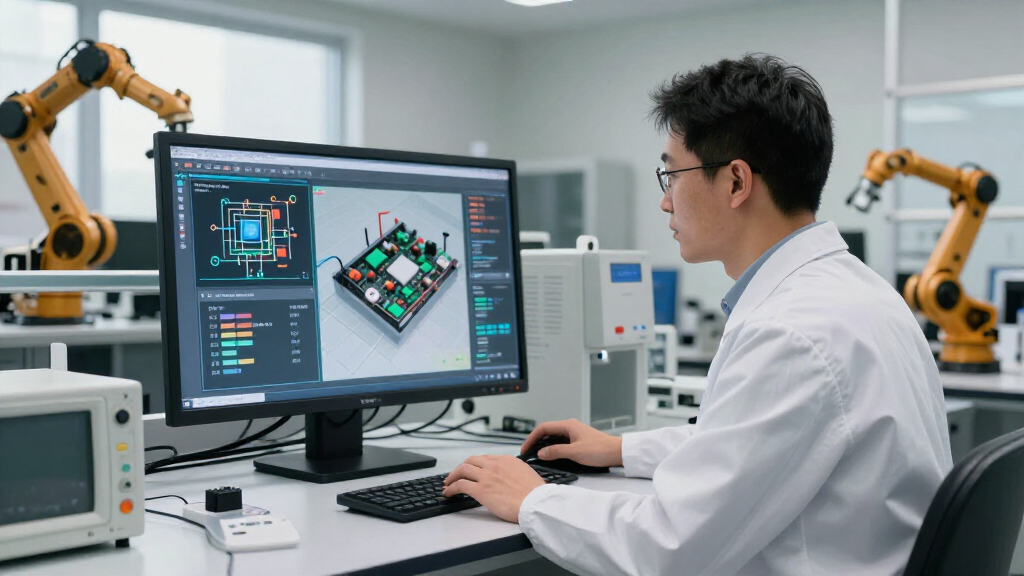

📊 Full opportunity report: How China’s Focus On Real-World AI Applications Is Paying Off on ThorstenMeyerAI.com — validation score, market gap, and execution plan.

Turn your quiet moments into listening time
- Thousands of audiobooks, podcasts and originals
- Listen on your phone, tablet or Echo — also offline
- Cancel anytime
TL;DR
China is making significant advances in AI by prioritizing practical, real-world applications over theoretical research. This shift is resulting in measurable progress and increased industrial deployment, backed by state support. However, challenges remain in scaling and reliability.
China is increasingly demonstrating tangible progress in deploying artificial intelligence in real-world applications, moving beyond research prototypes to scalable solutions with measurable impact. This shift is driven by deliberate policy focus and significant state backing, making China a notable player in practical AI deployment.
Recent reports indicate that Chinese firms, notably Huawei and SMIC, are advancing in integrating AI into manufacturing and industrial processes. Huawei aims to produce over a million high-end AI-accelerator chips this year, reflecting a strategic push toward AI-driven innovation. Meanwhile, SMIC has demonstrated 7-nanometer chip production using older DUV tools, with ongoing efforts to develop 5-nanometer capabilities, signaling a move up the manufacturing stack.
Despite these achievements, significant hurdles remain. Yield rates for advanced chips in China are still substantially below global standards, with SMIC achieving around 20 percent yield at 5-nanometer nodes, compared to approximately 90 percent in leading fabs. China’s reliance on imported materials, such as high-purity photoresist from Japan, highlights ongoing dependencies. Experts assess that domestically produced tools lag several generations behind those of global leaders like ASML, with commercial sub-10-nanometer production not expected before 2030. Additionally, the existing installed base of equipment requires ongoing maintenance from Western suppliers, creating a dependency that China seeks to reduce.
Every few weeks a headline says China cracked the last hard problem in chipmaking — and triggers alarm in one camp, triumph in the other. Both overreact, because both mistake a learning-by-doing problem for a copying problem. It isn’t one.
▲ Forward-looking · figures are point-in-time estimates“A machine exists” and “a machine makes advanced chips at scale, profitably, for years” are separated by a chasm — made of things that only accumulate with time.
In a race, a burst of speed closes the gap. In a phase transition, you can’t move faster to cross over — you have to accumulate enough, slowly, until the system changes state.
When you see “China achieves X,” ask which of two very different claims is actually being made.
Even amid the loud headlines, the quiet data points all say the same thing.
No prototype, no shipped tool, no yield headline teleports past it.
Real-World AI Deployment Transforms China’s Tech Landscape
This progress signifies a strategic shift for China, emphasizing practical AI applications that can be integrated into manufacturing, healthcare, and other industries. It enhances China's technological independence and competitiveness, potentially reshaping global supply chains. However, the persistent technical and material challenges mean that full-scale, reliable deployment at the most advanced nodes remains a future goal rather than an immediate reality.
As an affiliate, we earn on qualifying purchases.
China’s Semiconductor and AI Development Timeline
Over the past decade, China has prioritized developing its semiconductor industry amid export restrictions and technological embargoes. Early efforts focused on copying and adapting existing technologies, but recent years have seen a move toward innovation and self-sufficiency. The deployment of domestic lithography tools and increased AI chip production are part of this broader strategy, aiming to reduce reliance on Western technology and foster domestic innovation ecosystems.
"China has begun mass-producing domestic immersion DUV lithography machines and is prototyping advanced EUV systems, marking real progress in semiconductor manufacturing capabilities."
— Thorsten Meyer
As an affiliate, we earn on qualifying purchases.
Key Challenges in Scaling and Reliability Persist
While China has made notable progress, it is still uncertain when domestic tools will reliably produce chips at sub-10-nanometer nodes at commercial scale. Yield rates remain low, and dependencies on imported materials and maintenance services continue, limiting full independence and large-scale deployment.
manufacturing chip testing equipment
As an affiliate, we earn on qualifying purchases.
As an affiliate, we earn on qualifying purchases.
Next Steps in China’s Semiconductor and AI Roadmap
Expect continued investment and innovation aimed at improving yield, reducing material dependencies, and advancing manufacturing technology. Monitoring the development of domestic EUV and next-generation tools will be crucial, alongside efforts to build a self-sustaining supply chain. Progress toward commercial-scale production at smaller nodes remains a key milestone for the coming years.
As an affiliate, we earn on qualifying purchases.
Key Questions
What are China’s recent achievements in semiconductor manufacturing?
China has begun mass-producing domestic immersion DUV lithography machines and is prototyping advanced EUV systems, demonstrating real progress in chip manufacturing capabilities.
What challenges does China face in advancing its chip technology?
Major challenges include low yield rates, dependence on imported materials like high-purity photoresist, and lagging behind global leaders in equipment technology by several generations.
How does this progress impact global technology markets?
It signals China's move toward technological independence, which could influence global supply chains, market competition, and innovation trajectories, especially in AI and semiconductor industries.
When might China achieve reliable sub-10-nanometer commercial chip production?
Most experts estimate this milestone could occur around 2030, given current technological gaps and development timelines.
Will China be able to produce AI chips at scale soon?
While Huawei aims to produce over a million high-end AI chips this year, scaling to reliable, large-scale deployment at high yields remains a work in progress.
Source: ThorstenMeyerAI.com
Fall Picks
fall essentials
As an affiliate, we earn on qualifying purchases.