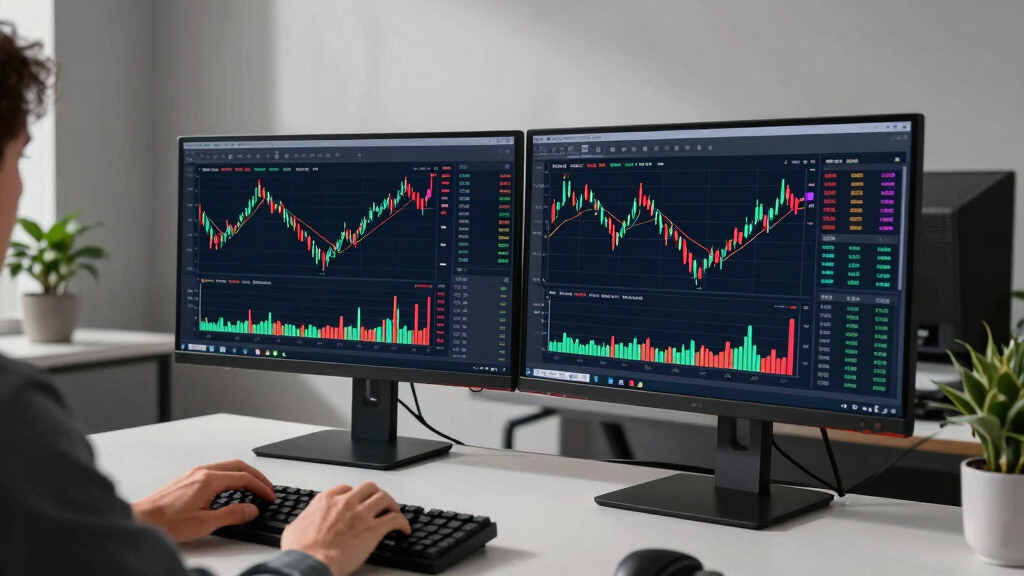

📊 Full opportunity report: Building an AI Trading Bot — Week One: Why a 90 % Win Rate Can Still Lose Money on ThorstenMeyerAI.com — validation score, market gap, and execution plan.
TL;DR
An experimental AI trading bot tested on simulated markets shows that high win rates alone do not indicate profitability. One promising strategy hints at genuine edge, but results are preliminary and context-dependent.
A researcher testing an AI-driven trading bot in simulated short-term markets reports that a high win rate does not necessarily translate into profitability. The findings challenge common assumptions and underscore the importance of understanding market pricing and trade asymmetries.
The experiment involves running 21 strategy variants across multiple assets in a simulated environment, with some strategies achieving over 90% win rates. However, these high win rates are often due to taking late-stage bets when the market has already heavily favored one outcome, which skews the perception of edge.
When adjusting for the market’s implied probabilities—rather than naive 50% assumptions—the apparent advantage of many strategies diminishes or reverses. For instance, strategies showing 98% wins on one asset are actually slightly negative when considering the market’s own pricing, highlighting that winning more than half the time is not enough if the wins are small and the losses are large.
Among the strategies tested, one approach—using a fair-value model on a liquid asset—has shown a consistent, modest profit despite a win rate below 50%. Its larger average wins relative to losses suggest genuine predictive edge, but the sample size remains too small to confirm this with certainty.
Week one.
Why a 90% win rate
can still lose money.
21 strategies running in parallel · 700+ settled paper trades · 18 of 21 with reasonable win rates · 2 variants at 100% wins. And almost none of it means what it looks like.
An experimental AI-driven trading bot running 21 strategy variants against 5-minute binary prediction markets on major crypto assets. Every trade is paper — simulated funds only. Headline numbers look extraordinary: 18 of 21 variants with reasonable win rates · entire fleet on one underlying with >90% wins · two specific variants at 100% wins over 38-44 settled trades. The data is telling a very different story than the leaderboard suggests. Most of the "winning" strategies are buying when the market has already priced one side at 90-95 cents on the dollar — the right baseline isn't 50%, it's the market-implied probability, and below 95% wins on that math is a slow bleed. One strategy — and only one — has the opposite signature: below-50% win rate, 2.5× average winning trade vs losing trade, meaningfully positive net P&L over several hundred settled positions. The right signature. The smoking-gun negative result: same code running on different assets is statistically significantly losing money. Same model, same parameters, different markets, different results — that's data you'd pay for.
90% wins. Still net negative.
Most of the "winning" strategies in the fleet are buying when the market has already decided one side is going to win. They wait until one outcome is priced around 90-95 cents on the dollar, then take the favorite. If the favorite holds, the trade pays a few cents. If it doesn't, the trade loses almost the entire bet. The asymmetry makes the high win rate structurally meaningless.
One candidate. Right signature.
After dismissing the high-win-rate experiments as mechanical illusions, the search shifted to the opposite signature — a strategy that loses more often than it wins but still makes money. That's the mathematical fingerprint of a real prediction signal: bigger wins than losses, willing to be wrong frequently in service of being right with conviction.
Same code. Different markets.
The strongest evidence that the candidate strategy might be real comes from an unexpected place: running the exact same code on different assets produces statistically significant losses. Same model, same parameters, same code path, different volatility regime, different microstructure, different result.
Five lessons. Plain language.
What week one actually taught. The lessons are not novel to anyone who has spent serious time on systematic trading — but you don't internalize them until you watch them happen on your own paper bankroll. Out of 21 variants, one candidate worth more investigation. The ratio is roughly what was expected going in.
Win rate lies. Sample sizes lie. Most things that look like alpha are not. A high win rate, by itself, tells you almost nothing about whether a strategy has edge — it tells you about the kind of trades being taken, not the quality of the decisions. One strategy in the fleet has the right signature — <50% wins, 2.5× win:loss, meaningfully positive net P&L on the most liquid underlying. That's the candidate worth watching. Same code on different markets produces statistically significant losses — informative in a way "everything's green" never is. If you take this article as a reason to put money into anything, you have misread it.
Implications of Win Rate vs. Actual Trading Edge
The findings emphasize that a high win rate alone is not an indicator of profitable strategy development. Many strategies appear successful because they exploit market conditions where the odds are heavily skewed, not because they have genuine predictive skill. Recognizing the difference is critical for developing sustainable trading systems and avoiding false signals.
The only promising approach identified so far relies on a model that accepts frequent losses but aims for larger, more profitable wins. This aligns with the core principle that real edge involves asymmetric payoffs, not just frequent small wins. However, the limited data means this conclusion remains provisional.
Python for Algorithmic Trading Cookbook: Recipes for designing, building, and deploying algorithmic trading strategies with Python
As an affiliate, we earn on qualifying purchases.
As an affiliate, we earn on qualifying purchases.
Market Dynamics and the Pitfalls of Win Rate Metrics
The experiment is set against the backdrop of short-term binary prediction markets for crypto assets, where rapid trades and high volatility create complex microstructure conditions. Prior to this, many traders and algorithms have relied on high win rates as a proxy for success, often overlooking the importance of trade size and market pricing.
This testing builds on ongoing research into AI-based trading systems, emphasizing that understanding market-implied probabilities is crucial. The experiment also highlights the risk of overfitting or mistaking luck for skill, especially in small samples.
"A high win rate, by itself, tells you almost nothing about whether a strategy has edge. It’s about the quality of the trades, not just the frequency."
— Thorsten Meyer

AI Crypto Trading Bot: Build AI-Powered Crypto Trading Systems With Binance, Bybit & 24/7 Automation (AI Trading Systems Series)
As an affiliate, we earn on qualifying purchases.
As an affiliate, we earn on qualifying purchases.
Limitations of Current Data and Future Validation
The main uncertainty is whether the promising strategy will maintain its edge over a larger number of trades. The current sample size—several hundred trades—is insufficient to confidently confirm persistent profitability. Variance and market regime changes could easily distort the results as more data accumulates.
Additionally, the experiment's reliance on simulated data means real-world trading might produce different outcomes, especially considering factors like slippage, transaction costs, and market impact, which are not fully modeled here.

AI + Prediction Markets: The New Edge: How to Use Artificial Intelligence Tools to Research, Scan, and Win in Prediction Markets (Markets Intelligence Series)
As an affiliate, we earn on qualifying purchases.
As an affiliate, we earn on qualifying purchases.
Next Steps for Confirming Strategy Viability
Research will continue with significantly more trades—by at least an order of magnitude—to test whether the identified strategy can sustain profitability. Further, the researcher plans to explore different market conditions and assets to evaluate the robustness of the approach.
Meanwhile, efforts will be made to refine the models and understand the underlying features that contribute to the observed edge. Results from these extended tests will inform whether the strategy warrants further development or remains a statistical anomaly.

Excel Data Analysis For Dummies (For Dummies (Computer/Tech))
As an affiliate, we earn on qualifying purchases.
As an affiliate, we earn on qualifying purchases.
Key Questions
Does a high win rate guarantee profitability?
No. A high win rate can be misleading if the wins are small and losses are large. Genuine edge depends on asymmetric payoffs and market understanding, not just frequency of wins.
Why is market-implied probability important in evaluating strategies?
Because it provides a realistic baseline for assessing whether a strategy truly has an advantage, rather than relying on naive assumptions like a 50% chance for all trades.
Can a strategy with less than 50% win rate still be profitable?
Yes. If its average wins are significantly larger than its losses, it can generate positive returns despite losing more often than winning.
What are the risks of relying on simulated trading experiments?
Simulations may not capture all real-world factors like slippage, transaction costs, and market impact, so results might not translate directly to live trading.
Source: ThorstenMeyerAI.com