
Climate modeling uses sophisticated computer simulations to predict what the future holds for our planet. By analyzing the complex interactions among Earth’s atmosphere, oceans, and land, these models help you understand how human activities like burning fossil fuels and deforestation impact climate change. They incorporate the carbon cycle and feedback mechanisms that can accelerate warming, revealing possible scenarios based on different policies. Keep exploring to uncover how scientists refine these models and what actions could shape tomorrow’s climate.
Key Takeaways
- Climate models simulate Earth’s systems to forecast future climate changes and assess potential impacts.
- They incorporate the carbon cycle and human activities, like fossil fuel use and deforestation, influencing climate predictions.
- Different emission scenarios help evaluate how policy choices affect future climate outcomes.
- Feedback mechanisms, such as ice melt reducing albedo, can accelerate warming and identify potential tipping points.
- Integration of satellite data and historical records refines models, improving accuracy and informing mitigation strategies.
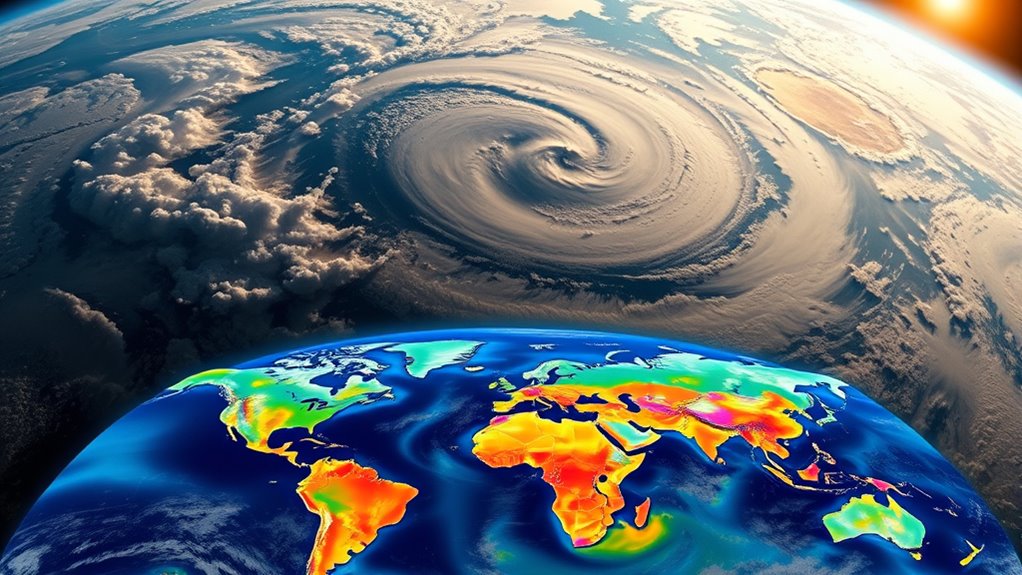
Climate modeling involves using computer-based simulations to understand and predict how Earth’s climate systems behave over time. These models help scientists analyze complex interactions within the atmosphere, oceans, land, and ice, providing a detailed picture of how our climate might change. As you delve into the world of climate models, you’ll see how they incorporate key processes like the carbon cycle, which plays a crucial role in regulating greenhouse gases. The carbon cycle involves the movement of carbon among the atmosphere, biosphere, oceans, and geosphere. Climate models simulate how human activities, especially fossil fuel burning and deforestation, disrupt this cycle, leading to increased carbon dioxide levels in the atmosphere. Understanding these processes allows scientists to predict how future emission scenarios could impact global temperatures and weather patterns. Additionally, advances in battery technologies are enabling better integration of renewable energy sources into climate mitigation efforts, further influencing climate projections.
Emission scenarios are central to climate modeling because they represent different possible futures based on human behavior. For instance, some models explore a world where emissions continue to rise unchecked, while others assume aggressive efforts to reduce greenhouse gases. By comparing these scenarios, you can see how different policy choices might influence climate outcomes. This helps policymakers and stakeholders make informed decisions about mitigation strategies and adaptation plans. Climate models also account for feedback mechanisms, such as the melting of polar ice reducing Earth’s reflectivity (albedo), which can accelerate warming. These interactions are complex, but models help untangle them, offering insights into potential tipping points and long-term climate stability.
When you work with climate models, you’re engaging with a tool that synthesizes vast amounts of data, from satellite observations to historical climate records. This integration enables more accurate predictions and helps identify uncertainties in future climate projections. Models are constantly refined as new data and scientific understanding emerge, making them increasingly reliable for decision-making. They also allow you to test the effects of different emission scenarios, providing a glimpse into possible futures based on current trajectories and policy interventions. This capacity to simulate various pathways makes climate modeling an essential component of climate science, offering a foundation for global efforts to curb climate change and prepare for its impacts. Fundamentally, you’re looking at a dynamic, evolving process that helps humanity understand and navigate the uncertain future of Earth’s climate system.
Frequently Asked Questions
How Do Climate Models Account for Future Technological Advancements?
You can think of climate models as incorporating future technological advancements through technological integration and innovation forecasting. Modelers include potential improvements, like cleaner energy tech or carbon capture, by creating scenarios based on current trends and expected breakthroughs. This helps you understand possible future climate outcomes. While predictions aren’t perfect, these methods allow you to see how technological progress might influence climate change, guiding policy and innovation efforts effectively.
What Are the Limitations of Current Climate Modeling Techniques?
You face limitations from model uncertainty and data resolution. These models might misjudge future climates because they can’t perfectly predict complex systems or capture small-scale details. Incomplete data and simplified assumptions can skew results, making predictions less precise. Despite advances, you should recognize that uncertainty persists, and refining data quality and resolution remains essential for improving climate model accuracy and reliability.
How Accurate Are Climate Predictions Over Long Time Scales?
You should know that climate predictions over long time scales have significant model uncertainty, which affects their accuracy. While models can forecast broad trends, data resolution limitations mean small-scale details remain uncertain. As a result, long-term climate predictions are helpful for understanding general patterns but aren’t pinpoint precise. You need to take these factors into account when interpreting projections, recognizing that they provide estimates rather than exact outcomes.
Can Climate Models Predict Regional Climate Changes Precisely?
Climate models are like a detailed map, but they struggle with pinpointing exact regions due to regional variability. While they can predict broad trends, their precision depends on model resolution, which limits fine-scale accuracy. You might see general climate patterns, but expecting pinpoint predictions for specific areas isn’t realistic yet. Improving model resolution and understanding regional variability will boost the accuracy of regional climate change forecasts in the future.
How Do Climate Models Incorporate Human Behavioral Changes?
You might wonder how climate models include human behavioral changes. They incorporate behavioral feedbacks by adjusting scenarios based on how people respond to policies and climate impacts. For example, if policies encourage renewable energy, models predict reduced emissions. You can see policy impacts shaping future climate outcomes directly in the models, which simulate how shifts in behavior—like conservation efforts—affect greenhouse gas levels and overall climate change trajectories.
Conclusion
As you explore climate modeling, you might realize how these predictions shape our future. Coincidentally, many of today’s innovations in technology and policy stem directly from understanding climate patterns. By staying informed and involved, you become part of the solution, influencing the planet’s trajectory. Remember, the choices we make now aren’t just about data—they’re about the future you’ll share with generations to come. Your actions truly have the power to change the climate’s story.