Metal-Organic Frameworks (MOFs) are highly effective for carbon capture because they have a large surface area and tunable pores, allowing you to trap CO₂ efficiently even at low concentrations. They outperform traditional materials like zeolites and activated carbon, making them ideal for industrial emissions. Regeneration methods like pressure, temperature, and vacuum swing adsorption help reuse MOFs, but choosing the right approach impacts their durability and cost. To understand how these factors influence practical applications, keep exploring further.
Key Takeaways
- MOFs exhibit high surface area and tunable pore structures, enabling efficient CO₂ adsorption and storage.
- Regeneration methods like PSA, TSA, and VSA are essential for MOF reuse, influencing energy use and durability.
- MOF stability under high temperature and moisture is critical for maintaining long-term carbon capture performance.
- Ongoing research aims to develop energy-efficient, cost-effective regeneration techniques to enhance practical applications.
- MOFs offer a promising, scalable solution for industrial CO₂ capture, contributing to sustainable emission reduction strategies.
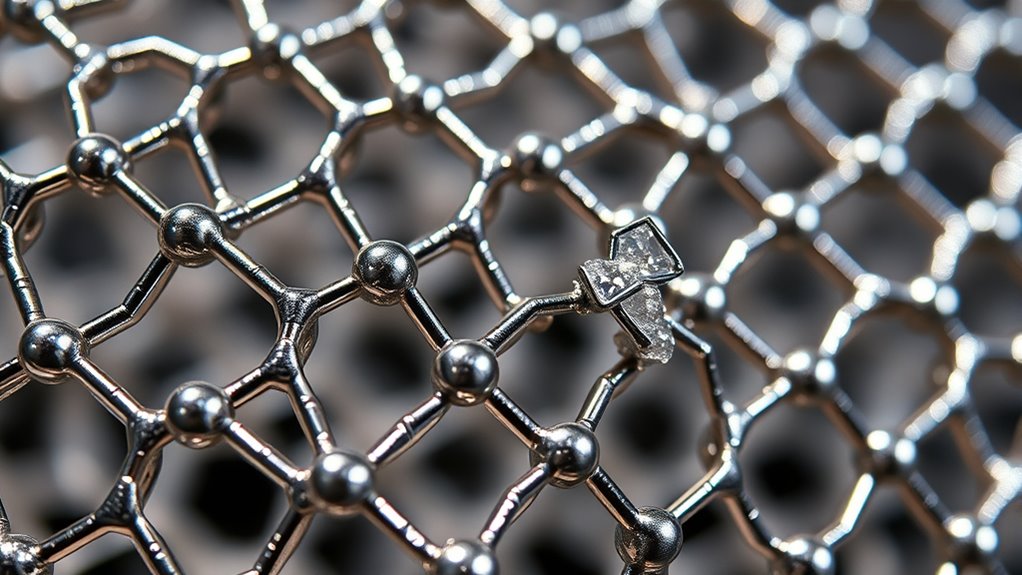
Metal-Organic Frameworks (MOFs) are emerging as a promising solution for carbon capture because of their exceptional ability to adsorb and store CO₂ efficiently. When you consider their high surface area and tunable pore structures, it’s clear that MOFs can outperform traditional materials like zeolites or activated carbon. Their adsorption efficiency is remarkable, allowing them to trap significant amounts of CO₂ even at low concentrations. This capability makes MOFs especially attractive for capturing emissions from industrial processes and power plants. But to make these materials practical, you need to understand how to regenerate them effectively. Regeneration methods are vital because they determine how many times you can reuse a MOF without losing performance.
MOFs excel at capturing CO₂ efficiently, outperforming traditional materials like zeolites and activated carbon.
There are several regeneration techniques, each with its advantages and limitations. Pressure swing adsorption (PSA) and temperature swing adsorption (TSA) are the most common. PSA involves reducing pressure to release the captured CO₂, which is energy-efficient but may require robust equipment to handle pressure cycles. TSA, on the other hand, uses heat to desorb CO₂ from the MOF. This method can be more selective and gentle on the framework, but it consumes more energy due to the heating process. You might also consider vacuum swing adsorption (VSA), which combines aspects of PSA and TSA by applying a vacuum to facilitate desorption. VSA is often more energy-efficient than TSA and can be tailored to specific MOF materials.
The regeneration process impacts not only the operational costs but also the lifespan of your MOF-based system. A good MOF should maintain its adsorption efficiency over many cycles, which depends on choosing the right regeneration method. For instance, some MOFs are sensitive to high temperatures or moisture, so you’ll need to select regeneration techniques that minimize degradation. Researchers are actively exploring more energy-efficient and less invasive regeneration methods, including chemical washing or mild heating, to extend MOF durability and reduce costs. Enhancing regeneration techniques is a key area of ongoing research to improve MOF longevity and cost-effectiveness.
In practice, your choice of regeneration method depends on the specific MOF structure and the CO₂ source. You want a process that maximizes adsorption efficiency while minimizing energy consumption and framework degradation. Advances in regeneration techniques are making MOFs more viable for large-scale carbon capture, bringing you closer to a sustainable and cost-effective solution. By carefully balancing these factors, you can guarantee that MOFs deliver high performance over many cycles, making them a key part of your carbon mitigation strategy.

Metal-Organic Frameworks for Carbon Capture and Energy (ACS SYMPOSIUM SERIES)
As an affiliate, we earn on qualifying purchases.
As an affiliate, we earn on qualifying purchases.
Frequently Asked Questions
How Do MOFS Compare to Traditional Carbon Capture Methods?
You’ll find MOFs often outperform traditional methods in efficiency comparison, capturing more CO₂ with less energy. They’re also more versatile, allowing you to tailor their structures for specific needs. Plus, their material durability means they last longer under harsh conditions, reducing replacement costs. Overall, MOFs offer a promising alternative, combining high efficiency with durability, making your carbon capture process more effective and sustainable.
What Are the Environmental Impacts of Synthesizing MOFS?
You might be surprised to learn that MOF synthesis can generate an environmental footprint comparable to that of traditional materials. During synthesis, toxicity concerns arise due to chemicals used, like solvents and metal precursors. These substances can pose risks if not handled properly, impacting local ecosystems. So, while MOFs offer great potential, you should consider their environmental impacts, especially synthesis toxicity, to ensure sustainable development and minimize ecological harm.
Can MOFS Be Reused After Carbon Capture?
Yes, MOFs can be reused after carbon capture through MOF regeneration. You simply need to remove the captured CO₂, often by applying heat or a vacuum, which restores the material’s pore structure. Material durability plays a key role here, as it determines how many times you can regenerate the MOF without losing efficiency. Proper regeneration techniques ensure you maximize the lifespan and effectiveness of your MOF for ongoing carbon capture.
What Are the Economic Costs of Implementing Mof-Based Systems?
You’ll find that the economic costs of implementing MOF-based systems depend largely on market adoption and policy incentives. As adoption increases and governments offer incentives, costs tend to decrease, making these systems more feasible. However, initial investment, manufacturing expenses, and scaling challenges can still be significant. Strategic policy support and technological advancements are key to reducing costs and encouraging widespread use of MOFs for carbon capture.
How Scalable Are MOF Technologies for Industrial Applications?
You might think MOF technologies are just a sci-fi fantasy, but they’re surprisingly scalable for industry. Sure, industrial scalability faces manufacturing challenges like mass production and cost efficiency, but advancements are happening fast. With ongoing research, you can expect MOFs to become more practical, helping industries reduce emissions. So, don’t underestimate their potential—what seemed impossible is now closer to mainstream, thanks to innovative solutions overcoming manufacturing hurdles.
As an affiliate, we earn on qualifying purchases.
Conclusion
As you explore metal-organic frameworks for carbon capture, you realize they’re like a modern-day Aladdin’s lamp, holding the power to transform our future. With their exceptional porosity and tunability, these materials could revolutionize how we address climate change. Just as the printing press changed the world, MOFs can redefine environmental solutions. Embrace this cutting-edge technology, and you’re stepping into a future where cleaner air isn’t just a dream but a reality—faster than you might think.
As an affiliate, we earn on qualifying purchases.

Pressure Swing Adsorption
- Condition: Used Book in Good Condition
As an affiliate, we earn on qualifying purchases.
As an affiliate, we earn on qualifying purchases.