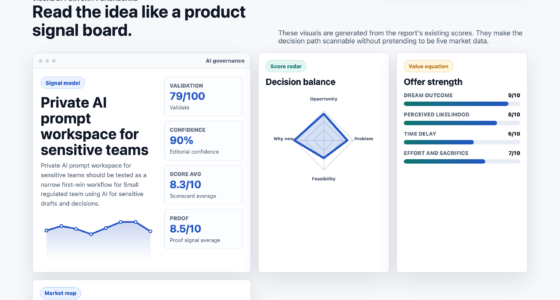
📊 Full opportunity report: Balancing Innovation And Sovereignty: Mistral’s AI Strategy on ThorstenMeyerAI.com — validation score, market gap, and execution plan.

TL;DR

Mistral, a European AI startup valued at over €11.7B, is pursuing rapid growth with a focus on sovereignty. However, it faces technical, financial, and competitive hurdles that could impact its strategic ambitions.

Mistral, the European AI startup valued at over €11.7 billion, is aggressively pursuing growth targets while claiming to uphold European sovereignty in AI development. The company has seen a remarkable increase in annual recurring revenue from around $20 million at the start of 2025 to over $400 million in early 2026, and aims for over $1 billion by the end of 2026, despite significant technical and financial challenges.

Founded with a strategic emphasis on European data privacy and open weights models, Mistral’s sovereignty has attracted notable clients such as HSBC, Airbus, and the European Patent Office. Its recent funding rounds, including a €1.7 billion Series C led by ASML, have propelled its valuation beyond €11.7 billion. However, the company’s model performance lags behind US and Chinese competitors, with its best model reportedly losing head-to-head against earlier releases from rivals. Mistral’s open approach is increasingly challenged as American and Chinese labs adopt and improve upon open models, narrowing its supposed competitive moat.

Financial transparency remains limited; Mistral has raised between $3 billion and $5.5 billion without disclosing losses, and its capital-to-revenue ratio is among the highest in AI. The company’s ambitious goal of exceeding $1 billion in revenue by the end of 2026 is seen as a critical benchmark, with recent growth driven largely by enterprise contracts. Meanwhile, its efforts to develop AI chips are viewed skeptically given the current scale and competition from established chipmakers like Nvidia and SiPearl.

At a glance
reportWhen: ongoing, with recent developments in 20…
The developmentMistral is scaling its AI operations and revenue rapidly while navigating tensions between European sovereignty and global competition.
Mistral’s Sovereignty Paradox — Reality Check
AI Dispatch · Reality Check · 16 July 2026

Mistral’s sovereignty paradox: a critical look at Europe’s AI champion

The growth is real and rare — $16M → $400M+ ARR in a year. But the moat is narrower than the story, the open-weight advantage is gone, and the company selling purity has a purity problem. When your product is sovereignty, every impurity costs more than it would for anyone else.

40%
of Mistral’s revenue comes from the US and other non-European clients — Mensch’s own figure. The company built on not being American also runs a Palo Alto office, distributes via Azure/AWS/GCP, trains partly on US infrastructure, and buys ~all its silicon from Nvidia.
Palo Alto + London offices US capital: a16z · General Catalyst · Lightspeed · Nvidia · Cisco · IBM · Salesforce Microsoft €15M stake + Azure distribution Nvidia 90%+ GPU share
The honest scorecard
▼ Falling short
  • The open moat is gone — GLM-5.2, DeepSeek V4, Qwen, Kimi are open and better; now Inkling too
  • Large 3 below median on AA index for peer open models; ~38 tok/s
  • Vibe/Le Chat badly behind ChatGPT & Claude — even at Station F, Paris
  • No loss figures ever disclosed; ~$3–5.5B raised vs $400M ARR
  • Own-chip ambition = distraction at this scale
– Merely average
  • Great API pricing — but price is the most copyable moat
  • The “default second model” in multi-provider stacks = commodity position
  • Voxtral trails ElevenLabs; Devstral behind coding agents
  • Studio / Workflows / Agents undifferentiated vs Foundry, Bedrock, LangChain
  • Ministral fine at the edge
▲ The opportunity
  • SecNumCloud — US hyperscalers structurally cannot hold it
  • Defence: French armed forces framework deal; Helsing
  • Industrial/physical AI — Emmi, Airbus, BMW: Europe’s real home turf
  • Non-compute-bound wins: OCR 4 (170 langs, self-host), Leanstral (SOTA, ~1/75th cost)
  • “The rest of the world” — states wanting neither DC nor Beijing
◆ The strategy behind the product sprawl

It looks like chaos — 18+ products for 350 people. Two things are true: it’s consolidating (Small 4 merged Magistral+Pixtral+Devstral; Le Chat → Vibe), and the real plan is vertical integration of the whole sovereign stack. Mensch at VivaTech: moving “from an AI company doing software to a cloud company.”

chips? €4B datacentres cloud (Koyeb) models Forge agents apps forward-deployed engineers
The logic is correct: if you sell sovereignty you must own every layer — a dependency anywhere is a sovereignty hole. And that’s also how it dies: six fronts, each against a better-capitalized incumbent (Nvidia · AWS/Azure · OpenAI/Anthropic · ElevenLabs · Palantir · now Cohere+Aleph Alpha), with 350 people and ~3% of a US lab’s capital. Vertical integration is what you do from ahead.
⚑ Mistral USA — precision, not a gotcha
Narrative problem
“Not American” is the brand. Purity products get held to purity standards SAP never faces.
Incentive problem
At 40% non-EU revenue and growing, the roadmap follows the money. Easy at 100%, negotiable at 50/50.
✕ The real one
US cloud distribution + total Nvidia dependency. One export-control turn and French incorporation won’t save it.
The tell that cuts the other way: the $830M data-centre debt syndicate — BNP Paribas, Crédit Agricole, Bpifrance, La Banque Postale, Natixis, HSBC Continental Europe, MUFG. Six European banks, one Japanese. No US bank. That’s not coincidence; it’s who underwrites European AI. (Jurisdiction turns on “possession, custody, or control” of specific data — get counsel, not a blog post.)
The take

Mistral is the most important test running on whether European AI sovereignty is a business or a subsidy. The demand is real, the legal wedge is durable in 3–4 verticals, the growth is extraordinary. But the open-weight moat is gone, the vertical integration is being attempted from behind on six fronts, and April’s Cohere–Aleph Alpha merger killed the “only credible European option” claim. Stop trying to be Europe’s OpenAI. Finish being Europe’s Palantir. Own the narrowness — it’s a better business than the one being marketed. And watch the $1B ARR number in December: that’s the honest scoreboard.

Sources: Forbes (40% figure, model gap); TechCrunch, Sacra, TIME100, Bismarck, Klover, Penchan (financials — unaudited, estimates conflict); TechTimes (AA index); Futurum; Raconteur + Gartner (vertical concentration); CISPE 72%; Nagel/SoftwareSeni/DATASOLUTION (CLOUD Act, SecNumCloud); Mistral docs. Not investment or legal advice.
thorstenmeyerai.com

Implications of Mistral’s Growth and Strategic Risks

This story highlights the tension between European AI sovereignty and the realities of global competition. While Mistral’s rapid revenue growth signals strong market demand, its technical lag and financial opacity pose risks to its long-term sustainability. The company’s ability to meet its aggressive 2026 revenue target will influence the perception of European AI independence and competitiveness in a landscape dominated by US giants like OpenAI and Anthropic.

Amazon

European privacy-focused AI development tools

As an affiliate, we earn on qualifying purchases.

As an affiliate, we earn on qualifying purchases.

European AI Ambitions and Global Competition

Mistral emerged as a challenger emphasizing European data privacy and open weights models, aiming to differentiate from US and Chinese labs. Despite its European roots, nearly 40% of its revenue comes from non-European clients, including the US. Its valuation soared after a €1.7 billion Series C led by ASML, with plans for a potential $3.5 billion raise in 2026. The company’s growth coincides with a broader European push for AI independence, but technical shortcomings and financial opacity threaten its ambitions.

Historically, European AI companies have struggled against dominant US and Chinese players, who benefit from larger markets, more advanced models, and greater investment. Mistral’s open model approach was seen as a strategic advantage, but recent developments suggest that American labs are reclaiming ground by adopting open models and improving performance, challenging Mistral’s core differentiation.

“roughly 40% of Mistral’s revenue comes from the United States and other non-European clients”

— Arthur Mensch, Forbes

Hands-On AI Engineering: Code First Guide to Building Production Grade LLM Systems with Python | Accompanied with GitHub Tutorials | Learn about Transformers Foundation Models & ML Pipelines

Hands-On AI Engineering: Code First Guide to Building Production Grade LLM Systems with Python | Accompanied with GitHub Tutorials | Learn about Transformers Foundation Models & ML Pipelines

As an affiliate, we earn on qualifying purchases.

As an affiliate, we earn on qualifying purchases.

Unresolved Challenges in Model Performance and Financial Transparency

It remains unclear whether Mistral can close its technical gap with US and Chinese models within the year, or if its financial situation will come under scrutiny as it approaches potential IPO or debt covenant thresholds. The exact trajectory of its funding rounds and profitability is also uncertain, given the lack of disclosed loss figures and detailed financial statements.

AI INFRASTRUCTURE AND MACHINE LEARNING OPERATIONS ENGINEERING: Scalable AI Deployment Systems Model Lifecycle Management and Enterprise Automation Frameworks

AI INFRASTRUCTURE AND MACHINE LEARNING OPERATIONS ENGINEERING: Scalable AI Deployment Systems Model Lifecycle Management and Enterprise Automation Frameworks

As an affiliate, we earn on qualifying purchases.

As an affiliate, we earn on qualifying purchases.

Upcoming Milestones and Strategic Focus Areas

Next steps include Mistral’s efforts to improve model performance and expand its client base, aiming to reach >$1 billion revenue by late 2026. The company’s planned development of custom AI chips and potential IPO are also key milestones. Monitoring its ability to deliver on technical promises and financial transparency will determine whether it can sustain its growth and strategic positioning.

Meshnology LoRa ESP32-S3 Board - 915MHz W10 AIOT Dev Kit with GPS Blue Tooth WiFi AI Meshtastic LoRaWAN Ar duino Compatible Perfect for Starter Maker Smart City Industrial Control Application

Meshnology LoRa ESP32-S3 Board – 915MHz W10 AIOT Dev Kit with GPS Blue Tooth WiFi AI Meshtastic LoRaWAN Ar duino Compatible Perfect for Starter Maker Smart City Industrial Control Application

Ultra-Powerful Processing: The W10 Development Board Kit is powered by the 32-bit LX7 dual-core processor with a clock…

As an affiliate, we earn on qualifying purchases.

As an affiliate, we earn on qualifying purchases.

Key Questions

Can Mistral compete with US and Chinese AI leaders?

Currently, Mistral trails in model performance and ecosystem maturity. Its open approach offers some differentiation, but technical gaps pose significant challenges for competing at the highest levels.

What risks does Mistral face with its funding and financial opacity?

Limited transparency raises governance concerns, and high capital-to-revenue ratios suggest substantial losses. Future disclosures or an IPO could clarify its financial health.

Does Mistral’s focus on European sovereignty limit its competitiveness?

While sovereignty aligns with strategic goals, it may restrict access to global infrastructure and talent, potentially hampering performance and market share.

What is the significance of Mistral’s chip ambitions?

Developing AI chips could be a long-term strategic move, but at current scale, it appears more like a distraction than a viable immediate plan given the competition from Nvidia and SiPearl.

Will Mistral’s growth targets be achievable?

The company aims for over $1 billion in revenue by late 2026, a highly ambitious goal that depends on technical improvements, client expansion, and financial transparency.

Source: ThorstenMeyerAI.com

You May Also Like

Inclusive Design: Making Products for Everyone

Inclusive design transforms products for all users, ensuring accessibility and independence—discover how to create truly universal solutions.

The European Bet: How Mistral, Aleph Alpha, and Black Forest Labs Are Playing a Different Game

European AI vendors Mistral, Aleph Alpha, and Black Forest Labs are aligning their strategies with the EU AI Act, emphasizing compliance and sovereignty over frontier capabilities.

Europe’s AI Market: Diversification And The Quest To Exit Palantir

European countries are moving from rhetoric to procurement in developing alternatives to Palantir, with contracts and testing underway across multiple nations.