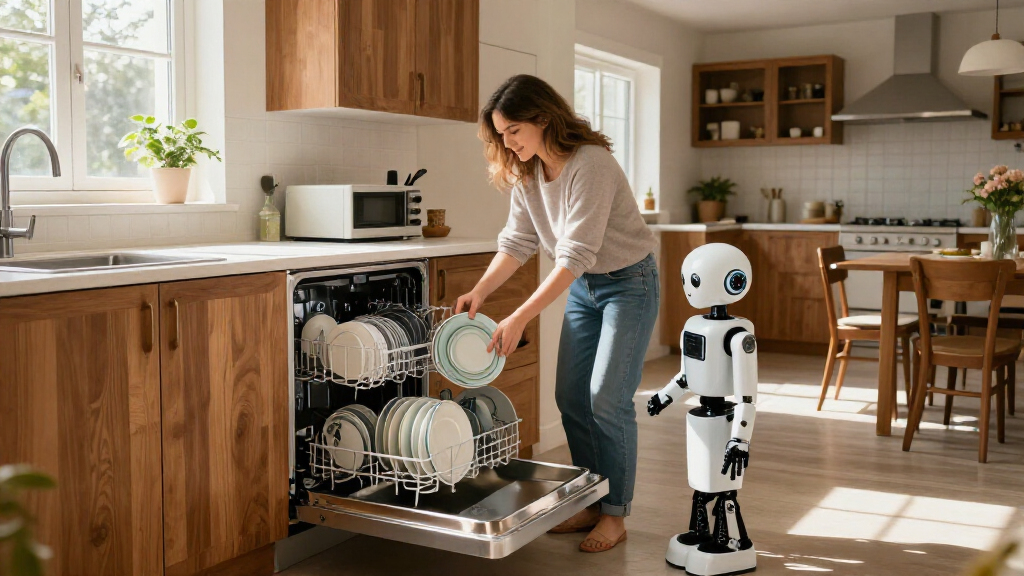

🔍 Read the full analysis: Meet Max, Meta's Reported Humanoid Robot, And Consider Who Will Do The Chores on ThorstenMeyerAI.com

Turn your quiet moments into listening time
- Thousands of audiobooks, podcasts and originals
- Listen on your phone, tablet or Echo — also offline
- Cancel anytime
TL;DR
The Information reported on Oct. 31 that Meta and Shanghai-based robot maker Fourier built a humanoid prototype called Max in about three months. Meta has not announced the robot; according to the report, the company described the work as internal research and said it has no plans to sell the units. Max’s reported home-care ambitions raise questions about how far robots are from household use and how automation could affect paid and unpaid domestic work.
Meta and Shanghai-based robot maker Fourier reportedly built a humanoid prototype called Max in about three months, according to a report published by The Information on Oct. 31. Meta has not announced the robot, and the report says the company characterized the work as internal research and experimentation, with no plans to sell the units.
Details reported by The Information and repeated by outlets including Engadget, The Next Web and Investing.com describe Max as roughly five feet tall and 106 pounds. It reportedly has a screen that can display facial expressions, speakers, five-fingered hands designed for handling small objects, and Nvidia’s Jetson Thor robotics computer. Reuters said it could not immediately verify the report. The Information’s original article is behind a paywall; the account here relies on details reported by other outlets.
The robot was reportedly shown to some Meta employees at an internal robotics summit in late August. Work on a follow-up, called Max 2, reportedly began in September. The next version is said to have a redesigned torso, improved hands, a projector and additional sensors intended to help it handle stairs. These details have not been confirmed in a public announcement by Meta.
The reported aim is to explore humanoid robots as a possible way for Meta’s AI systems to assist with household tasks in the future. That is not the same as evidence that Max can reliably do chores now. The source material says Meta has no plans to sell the units, and it provides no launch date or public demonstration of Max completing household work.
Infographic 01 · Meta’s humanoid, on paper
Max: a humanoid built in about three months
What multiple outlets reported from The Information’s story, and what is not confirmed.
What the report says Max is
From The Information (31 Oct 2026), as carried by Engadget, The Next Web and Investing.com
- Built by Meta with Fourier, a Shanghai robot maker
- Runs on Nvidia Jetson Thor, a computer for robots
- A screen that shows facial expressions, built-in speakers
- Five-fingered hands designed for small objects
- Shown to some Meta staff at an internal summit in late August
- Max 2: new torso, better hands, a projector, sensors for stairs
What you should not take from the headlines
- No Meta announcement. Reuters “could not immediately verify the report.”
- Not for sale. Meta told The Information the work is internal research, with no plans to sell units.
- No chores shown. “Can do household chores” is a goal, not a reported demonstration.
- Dropped: “lifts bottles and toys” and a Muse quote, found only on aggregator sites.
Jetson Thor, per Nvidia: up to 2,070 FP4 teraflops of AI compute, 128 GB memory, 130-watt power envelope; developer kit from $3,499 at launch in August 2025. Meta was named an early adopter.
Sources: The Information (paywalled), reported by Engadget, The Next Web, Investing.com and Reuters, all 31 Oct 2026 · Nvidia, 25 Aug 2025.
Powered by Thorsten Meyer AI
A Prototype, Not a Household Helper
Max matters as a sign of Meta’s reported interest in combining AI software with a physical robot, not as proof that a useful home assistant is ready. A machine that can move around a house and handle objects would have to operate safely around people, furniture, pets and changing conditions. The available reporting offers no performance results showing how Max manages those challenges.
The chores at stake are substantial, but the labor figures do not show that humanoids can replace that work. The International Labour Organization estimates that people perform 16.4 billion hours of unpaid care work each day, about three-quarters of it by women. The ILO also counts 80 million people employed in paid domestic work worldwide, with 83% working informally. Those figures describe existing care and domestic labor, not jobs that Max or similar robots are currently able to do.
If home robots eventually take on routine tasks, the effects could reach households, care workers and employers. Whether they reduce unpaid workloads, change demand for paid labor, or create new costs and responsibilities will depend on what the machines can actually do and who can afford them. Those outcomes remain open questions; the Max report supplies no evidence that a household is using the prototype for chores.
Products Worth Considering

Oral-B iO5 Rechargeable Electric Toothbrush with Visual Pressure Sensor, Travel Case, and 3 Brush Heads (Black)

Levoit Core 600S-P Smart Air Purifier for Large Rooms
Garmin Venu 3S GPS Fitness Smartwatch, 41 mm, French Gray
As an affiliate, we earn on qualifying purchases.
Why Meta Partnered With Fourier
The reported three-month build does not mean Meta developed every part of a humanoid from scratch. Fourier already makes robots. In August 2025, it introduced the GR-3, a larger machine the company described as a care robot for settings such as nursing homes and rehabilitation centres. The reported partnership gives Meta access to a robotics manufacturer’s existing experience and production capabilities.
The computing hardware is also commercially available. Nvidia made its Jetson Thor platform generally available on Aug. 25, 2025. Nvidia has said the system is designed for robotics and can run AI workloads on board. The same chip reportedly powers 1X’s NEO home robot, according to German technology outlet heise. Using an existing robotics computer and Fourier’s hardware helps explain how a prototype could be assembled quickly; it does not establish that the robot can perform domestic tasks reliably.
Other companies are testing home robots, though the examples cited in the source material also show the distance between trials and independent household use. 1X sells its NEO for $20,000 and says the robot relies on remote human “experts” for tasks it does not know. Figure has said its robot completed whole chores in 56% of trials across 30 homes it had not previously seen. That is Figure’s reported result, not an independent assessment or a measure of Max’s capabilities.
“The work with Fourier is for internal research and experimentation, and Meta has no plans to sell the units.”
— Meta, as quoted in The Information
What Max Can Actually Do
Meta has not publicly confirmed Max’s specifications, shown it performing chores, or provided data on its capabilities. The reported description of hands designed for small objects does not establish that the robot can pick up particular items or complete household tasks. Claims circulating on aggregator sites about specific objects were excluded from the source account because they were not supported by multiple outlets.
It is also unclear how much of Max’s operation is autonomous, whether it needs remote human assistance, how safely it can work around people, and what it costs to build. The report gives no delivery schedule for Max 2, no product plans and no independent testing results. The Information’s account was not directly reviewed in the supplied source material, and Reuters said it could not immediately verify the report.
Watch for a Public Demonstration
The clearest next milestone would be a statement from Meta or Fourier confirming the project and explaining what Max can do. A public demonstration or independent test would help distinguish a research prototype from a robot capable of useful household work. For now, the reported development of Max 2 is the only indication of continued work, and no date has been announced for a reveal, sale or household trial.
Until more evidence appears, readers should treat Max as a reported research prototype rather than a product that can take over chores. The broader question—who benefits if robots eventually perform some domestic tasks—will depend on their real-world capabilities, cost, availability and the way households and care workers use them.
Key Questions
Has Meta officially announced Max?
No. The account comes from The Information’s Oct. 31 report and coverage by other outlets. Meta has not publicly announced the robot in the source material.
Can Max do household chores now?
The reporting describes a prototype intended to help in homes in the future. It provides no demonstration or test results showing Max completing chores.
What are Max’s reported features?
Max is described as roughly five feet tall and 106 pounds, with a screen face, speakers, five-fingered hands and Nvidia’s Jetson Thor computer. These specifications have not been confirmed in a public Meta announcement.
Will Meta sell Max?
According to The Information’s account of Meta’s position, the work is for internal research and experimentation and the company has no plans to sell the units. No launch date has been reported.
What does Max mean for domestic workers?
It is too early to know. The report does not show that Max can replace paid or unpaid domestic labor. Any effect would depend on future robots’ capabilities, price, safety and how they are used.
Source: ThorstenMeyerAI.com