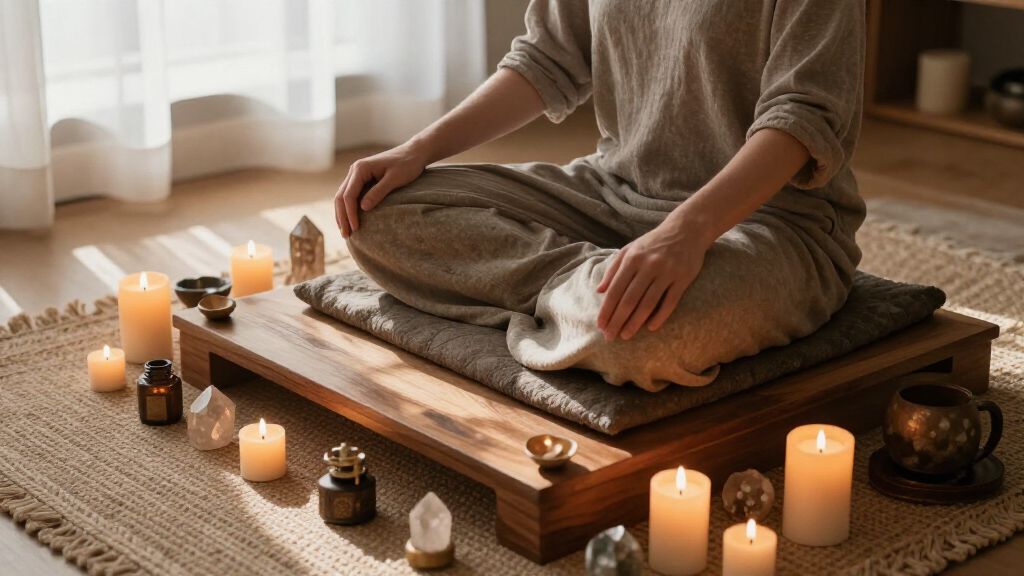

Spirituality, faith and metaphysics meet at some of humanity’s oldest questions: What gives life meaning? Is reality larger than what can be measured? How should we live with uncertainty, suffering and change? People approach these questions through religion, meditation, philosophy, divination, art, community or quiet personal reflection. There is no single path that fits everyone, but a thoughtful orientation can help you explore without losing your curiosity, judgment or connection to everyday life.

Turn your quiet moments into listening time
- Thousands of audiobooks, podcasts and originals
- Listen on your phone, tablet or Echo — also offline
- Cancel anytime
This guide maps the territory. It explains how spirituality, faith and metaphysics overlap, where they differ and how to build practices that feel grounded rather than performative. It also points toward practical resources for meditation, mindfulness, symbolic exploration and reflective rituals.
Understanding the Spiritual Landscape
Spirituality as a Search for Connection
Spirituality is the broadest of the three ideas. It often describes a felt relationship with something beyond the isolated self: God, nature, consciousness, humanity, ancestors, the cosmos or an underlying unity. For some people, spirituality is inseparable from organized religion. For others, it is an individual practice shaped by meditation, creativity, service or time outdoors.
A spiritual life does not require constant serenity or certainty. Doubt, grief, wonder and contradiction can all belong within it. What matters is the orientation: a willingness to ask deeper questions and to let those questions influence attention, values and behavior.
Faith as Trust and Commitment
Faith can mean belief in religious teachings, but it is more than intellectual agreement. It may involve trust, devotion, participation in a tradition and commitment to a way of living. Faith communities provide stories, ethical frameworks, ceremonies and relationships that can carry people through major transitions.
Faith is also dynamic. Some people inherit it, some discover it later and others reconstruct it after disappointment or change. A mature faith can make room for inquiry instead of treating every question as a threat. If you belong to a tradition, learning from its teachers, texts and history can add depth that isolated spiritual experimentation may lack.
Metaphysics as Inquiry Into Reality
Metaphysics is a branch of philosophy concerned with the fundamental nature of reality. It asks what exists, what a person is, how time and causation work and whether mind can be reduced to matter. In popular spirituality, the word is also used for ideas involving energy, manifestation, synchronicity, reincarnation or nonphysical dimensions.
These uses should not be confused. A philosophical argument, a religious doctrine, a personal experience and a scientific finding carry different kinds of evidence. You can remain open to mystery while distinguishing what is known, what is believed and what is interpreted. That distinction protects exploration from becoming credulity.
Products Worth Considering

LEVOIT Vital 200S-P Smart Air Purifier for Large Rooms, White

Withings ScanWatch Light Hybrid Smartwatch, Black

Oura Ring 5 Smart Ring, Silver, Size 10
As an affiliate, we earn on qualifying purchases.
Choosing a Path Without Forcing a Label
You do not need to settle your entire worldview before beginning. Start with the need that brings you here. You may be seeking peace, belonging, moral direction, healing after loss, a language for unusual experiences or a clearer philosophy of life. Naming that need makes it easier to choose practices and recognize when an approach is not serving you.
- If you want inner steadiness, begin with meditation, prayer or mindful breathing.
- If you want belonging, explore communities whose values and conduct match their teachings.
- If you want intellectual clarity, study philosophy, comparative religion and the history of ideas.
- If you want ritual, create simple repeated actions that connect intention with daily life.
- If you want symbolic insight, approach tarot, runes or similar systems as prompts for reflection rather than infallible authorities.
Labels can be useful shorthand, but they need not become cages. “Religious,” “spiritual,” “skeptical,” “mystical” and “secular” can describe tendencies without capturing a whole person. Let your understanding develop through study, experience and honest self-examination.
Building a Grounded Spiritual Practice
Create a Repeatable Rhythm
A sustainable practice is usually modest enough to repeat. Five attentive minutes each morning may shape a life more than an elaborate ritual performed twice and abandoned. Choose a regular time, a clear purpose and a simple action. You might sit in silence, recite a prayer, read a short passage, write three lines in a journal or walk without your phone.
Physical comfort can reduce avoidable distraction. A cushion, chair or folded blanket may be enough; those developing a seated or restorative routine can also compare meditation blankets designed for comfort and calm. The object is supportive, not sacred by default. Its value comes from how it helps you return to the practice.
Use Objects With Intention
Beads, candles, icons and stones can focus attention by giving an invisible intention a physical form. Mala beads, for example, are traditionally associated with repeated mantras or prayers in several contemplative contexts. If that method appeals to you, this guide to mala beads for meditation practice can help you consider practical options.
Learn the background of any object you adopt, especially when it comes from a living religious culture. Respect involves more than liking an aesthetic. It means understanding the item’s purpose, avoiding exaggerated promises and recognizing that ownership does not substitute for practice or relationship with a tradition.
Make Mindfulness Relational
Mindfulness is often presented as solitary, but attention can be cultivated with family and friends. Reflective prompts and cooperative activities may make abstract ideas easier to discuss. Explore these mindfulness card games for presence and relaxation if you want a structured way to begin conversations or pauses together.
The deeper aim is not to remain calm at all times. Mindfulness helps you notice sensations, thoughts and reactions before acting automatically. That space can support patience, honesty and wiser choices—qualities that matter beyond the meditation session.
Working With Symbols, Divination and Intuition
Symbolic systems invite the mind to form associations. A rune, archetype, dream image or chance pattern can prompt questions that ordinary analysis overlooks. The benefit may lie less in predicting events than in revealing assumptions, fears and possibilities already active within you.
Rune traditions have specific historical and cultural contexts, while modern games and fantasy settings often reinterpret them freely. Readers interested in their gaming use can consult this comparison of rune sets for gamers. Keep entertainment, contemporary spiritual practice and historical scholarship distinct; each may be worthwhile, but they are not interchangeable.
When using any divination method, ask open questions such as “What perspective am I missing?” rather than surrendering decisions to an object or reader. Avoid using divination as the sole basis for medical, legal, financial or safety choices. A reflective tool should expand agency, not weaken it.
Energy, Auras and Extraordinary Claims
Many spiritual traditions describe subtle energy, life force or luminous fields around living beings. People may interpret sensations, colors or images through those frameworks. Others understand the same experiences psychologically, artistically or technologically. It is reasonable to explore while remaining clear about which interpretation you are applying.
So-called aura photography can be approached as a creative or reflective experience. The resulting colors should not automatically be treated as objective measurements of health, personality or spiritual development. If you are curious about the equipment category, review these aura cameras for home energy insights alongside an understanding of how each device produces its images.
A useful discipline is to separate observation from interpretation. “I saw a blue area in the image” is an observation. “Blue proves that my energy is healed” is an interpretation. Keeping that gap visible lets wonder and critical thinking coexist.
Ritual, Memory and the Sacred Everyday
Spirituality does not have to happen only in designated spaces. Cooking for someone, tending a garden, making music or keeping photographs can become contemplative when performed with attention and gratitude. Everyday rituals help translate large beliefs into embodied habits.
Photography can support a practice of noticing. An instant photograph placed in a journal or on a small remembrance shelf may mark a meaningful encounter, season or place. Those drawn to a tactile format can browse Polaroid cameras for capturing vintage-style memories. The camera itself does not make an experience sacred; the attention and meaning you bring to the image do.
You might create a weekly ritual of choosing one photograph and writing what it evokes. Over time, the collection can reveal what repeatedly draws your gratitude, grief or awe. This turns memory-keeping into inquiry rather than mere accumulation.
Caring for the Body During Inner Work
Spiritual practice takes place through a body. Sleep, nourishment, movement and medical care are not distractions from inner life. They help create the conditions in which reflection is possible. Discomfort can sometimes be observed with patience, but it should not automatically be romanticized as a spiritual lesson.
If migraines or light sensitivity interrupt rest or meditation, environmental adjustments may offer comfort alongside appropriate professional care. This overview of eye masks considered for migraine relief may help you compare options. An eye mask is a comfort aid, not a diagnosis or a replacement for medical guidance, especially when symptoms are new, severe or changing.
Finding Trustworthy Teachers and Communities
A healthy teacher does not demand that you abandon judgment. Look for transparency about training, money, boundaries and the limits of what they can provide. Good communities allow questions, respect consent and do not isolate members from outside relationships or professional help.
- Be cautious of guaranteed healing, enlightenment or supernatural results.
- Notice whether disagreement is welcomed or punished.
- Ask how leaders are held accountable.
- Watch for pressure to spend beyond your means.
- Leave spaces that use fear, shame or secrecy to control participation.
Trust develops through patterns, not charisma. A compelling experience may be meaningful, but time reveals whether a path encourages humility, responsibility and care for others.
Bringing Belief and Discernment Together
Discernment is the practice of evaluating an idea without dismissing it merely because it is unfamiliar or accepting it merely because it feels powerful. Ask where a claim originated, whether alternative explanations exist and what consequences follow from believing it. Personal experience can matter deeply without becoming universal proof.
Keep a journal that separates events, emotions and conclusions. Revisit entries after days or months. Patterns that remain meaningful may deserve further exploration; impressions that fade still teach you how expectation and mood shape perception.
Your Next Step
Begin with one practice connected to a real need. Sit quietly for five minutes, attend a service, read a foundational text, discuss a mindfulness prompt with someone you trust or record a moment of wonder. Continue long enough to observe its effects on your attention, choices and relationships.
The most reliable sign of spiritual growth is not a collection of objects, unusual experiences or perfect answers. It is the gradual integration of insight into life: greater honesty, steadier compassion, deeper responsibility and an expanding capacity to meet mystery without pretending certainty. Spirituality, faith and metaphysics can open immense questions. A grounded practice helps you live those questions with both wonder and wisdom.