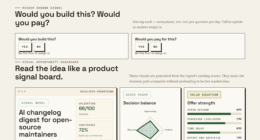

📊 Full opportunity report: Évian and the Fallout: What Europe Actually Wants From Amodei, Hassabis, and Altman on ThorstenMeyerAI.com — validation score, market gap, and execution plan.
TL;DR
European officials and AI industry leaders gathered at the G7 summit in Évian to address concerns over AI access, sovereignty, and safety. Europe seeks guarantees on reliable access, control over infrastructure, and child protection, amid US export restrictions.
At the G7 summit in Évian-les-Bains, France, on June 17, European leaders and top AI executives, including Dario Amodei, Demis Hassabis, and Sam Altman, engaged in a high-level discussion regarding the future of artificial intelligence. The summit occurred shortly after the US implemented export controls on certain AI models, raising concerns over reliable access and technological sovereignty for Europe. This gathering underscores Europe’s efforts to establish a strategic position amid geopolitical considerations and US restrictions.
The summit brought together leaders from the US, Europe, and Japan, alongside major AI firms, to discuss the implications of recent US export controls that resulted in Anthropic’s inability to provide access to its top models for foreign users. European representatives expressed concerns over dependence on US-controlled infrastructure and the potential risk of being cut off by executive decisions. Europe outlined six key demands: reliable, durable access to AI models; assurances against future ‘kill switches’; a trusted partners scheme for non-US collaborations; increased focus on technological sovereignty; control over AI infrastructure placement; and protections for children and youth from AI-related harms. European officials emphasized that these issues are connected to broader considerations of security, economic independence, and public safety.
Évian and the fallout: what Europe actually wants
For the first time, Amodei, Hassabis, and Altman sat with heads of state — five days after Washington switched Anthropic’s models off worldwide. Europe’s question: can you rely on models a foreign cabinet can shut down by decree?
The dilemma: what Europe wants from the three CEOs, the three can’t deliver — because they don’t hold the switch, Washington does. Macron’s platform is the right answer, but no fix for a decade-old infrastructure gap. The only answer that doesn’t depend on someone else’s goodwill: your own models, your own compute, open weights you can self-host.
Why Europe’s AI Demands Are a Turning Point
This summit indicates a shift in Europe’s approach to AI development and regulation. Europe’s emphasis on technological sovereignty and infrastructure control reflects a desire to reduce reliance on US and Asian providers, particularly in light of recent restrictions that exposed vulnerabilities. The demands for assured access, oversight of infrastructure, and child safety measures demonstrate Europe’s intent to influence AI governance and prioritize public safety while maintaining economic competitiveness. The outcomes of these discussions could impact global AI standards and influence international cooperation in this domain.

Amazon Fire TV Stick 4K Max (newest model), streaming device, with AI-powered Fire TV Search, supports Wi-Fi 6E, free & live TV without cable or satellite, find shows faster with Alexa+
The new Fire TV experience (2026 release) – Our biggest update to Fire TV has a new, modern…
As an affiliate, we earn on qualifying purchases.
As an affiliate, we earn on qualifying purchases.
Background of US-Europe AI Tensions and Summit Preparations
Earlier in 2026, the US government introduced export controls targeting advanced AI models, including Anthropic’s Fable 5 and Mythos 5, which effectively restricted access for foreign users. This development prompted concerns across Europe regarding dependence on US-controlled AI infrastructure and raised questions about sovereignty and security. The Évian summit was convened in response to these tensions, with European leaders seeking to assert their interests. The European Commission’s recent €420 billion Technological Sovereignty Package underscores their commitment to reducing reliance on non-European providers and establishing control over AI infrastructure and data. Prior to the summit, European officials indicated a desire for greater influence over AI deployment and regulation, especially concerning child safety and infrastructure siting.
“It is important that European citizens and companies have access to reliable AI models, and we need to ensure consistent access.”
— Ursula von der Leyen
AI infrastructure security hardware
As an affiliate, we earn on qualifying purchases.
As an affiliate, we earn on qualifying purchases.
Unresolved Issues and Future Disputes
It remains uncertain whether the European demands will be fully accepted or implemented by the US and major AI firms. Details regarding how guarantees against future ‘kill switches’ will be enforced, and the structure of trusted partner schemes, are still under discussion. Additionally, it is unclear how the US might modify its export control policies in response to Europe’s positions. The long-term effects on AI innovation and international cooperation are yet to be determined.
child protection AI software
As an affiliate, we earn on qualifying purchases.
As an affiliate, we earn on qualifying purchases.
Next Steps in European-US AI Cooperation
European leaders plan to establish a cooperation platform among Western democracies within a month, with a follow-up summit scheduled for September. Discussions will focus on formalizing agreements related to AI access, infrastructure siting, and safety standards. European institutions will also assess the progress of the €420 billion Sovereignty Package, aimed at strengthening local AI development and infrastructure. The US and European governments will continue negotiations on export controls and international governance frameworks, seeking to balance innovation, security, and sovereignty considerations.
trusted AI collaboration platforms
As an affiliate, we earn on qualifying purchases.
As an affiliate, we earn on qualifying purchases.
Key Questions
What are Europe’s main demands from AI leaders after the Évian summit?
Europe seeks reliable and durable access to AI models, assurances against future ‘kill switches’, a trusted partners scheme for non-US collaborations, increased technological sovereignty, control over infrastructure placement, and protections for children and youth.
How did US export controls impact European AI access?
The US introduced restrictions that led to Anthropic’s inability to provide access to its top models for foreign users, raising concerns about dependence on US-controlled infrastructure and potential disruptions to European AI applications.
Will Europe achieve its goal of technological sovereignty?
European policymakers are actively working on the €420 billion Sovereignty Package to reduce reliance on non-European providers, but full sovereignty will depend on successful implementation and international cooperation.
What are the implications for global AI governance?
The summit indicates a move toward more structured international cooperation and standards, which could influence global AI regulation and the distribution of influence among nations and corporations.
What happens if US and European demands conflict?
It remains uncertain how disagreements over access, sovereignty, and safety will be resolved, but ongoing negotiations and upcoming summits are expected to shape the future landscape of AI governance.
Source: ThorstenMeyerAI.com