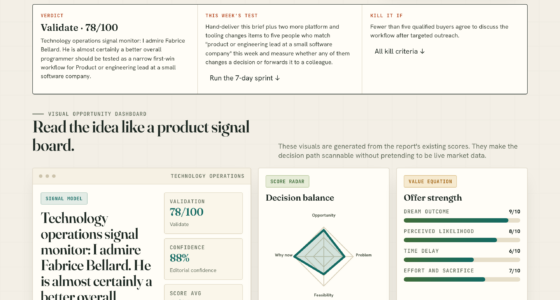

📊 Full opportunity report: QAtrial: Compliance That Shows Its Work on ThorstenMeyerAI.com — validation score, market gap, and execution plan.

Turn your quiet moments into listening time
- Thousands of audiobooks, podcasts and originals
- Listen on your phone, tablet or Echo — also offline
- Cancel anytime
TL;DR
QAtrial has released a new platform that integrates AI into regulated quality assurance processes with full provenance tracking. This ensures AI assistance meets strict compliance requirements, supporting validation and auditability.
QAtrial has introduced a new platform designed to embed provenance tracking into AI-assisted quality assurance processes for regulated life sciences. This development aims to address longstanding compliance challenges by ensuring every AI-generated record is attributable, signed, and auditable, aligning with regulations like 21 CFR Part 11 and EU Annex 11. The platform is intended to support, not replace, human judgment, providing a transparent audit trail for AI outputs.
QAtrial’s platform records detailed provenance data for each AI-assisted action, including which model, version, and purpose produced the output. Human reviewers must electronically sign these outputs, ensuring traceability and accountability in line with regulated QA standards. The system is self-hostable, designed to integrate seamlessly with existing compliance workflows.
While the platform supports models compatible with OpenAI and Anthropic, it does not validate or certify compliance itself. Instead, it provides tools to support organizations’ validation efforts, emphasizing that ultimate responsibility remains with the users. The focus is on traceability, attribution, and auditability, turning AI’s potential risks into managed, controlled processes.
QAtrial — compliance that shows its work
You can’t put an unaccountable black box into a regulated process. So every AI-assisted output records which model produced it — reviewed, e-signed, and traceable.
no validation risk
Independent commentary, produced with AI assistance under human editorial oversight. The views are the author’s own and may change. QAtrial is developed privately and is not publicly available. It is designed to align with frameworks including 21 CFR Part 11 and EU Annex 11 but is not validated, certified, or a guarantee of regulatory compliance, and is not legal or regulatory advice — computer-system validation and all regulatory obligations remain the user’s responsibility. AI-assisted outputs may contain errors and require qualified human review. Product and company names are trademarks of their respective owners; mention does not imply endorsement.
How Provenance-First AI Changes Regulated QA
This development matters because it offers a practical solution to the challenge of integrating AI tools into highly regulated environments. By ensuring every AI output is attributable and signed, QAtrial addresses key regulatory concerns about trustworthiness and auditability. This could enable broader adoption of AI in life sciences, improving efficiency while maintaining compliance. However, it does not guarantee validation or certification; organizations must still validate their systems per regulatory standards.
AI compliance management software for life sciences
As an affiliate, we earn on qualifying purchases.
As an affiliate, we earn on qualifying purchases.
Regulated QA’s Longstanding Challenges with AI Integration
In life sciences, regulated QA relies on validated systems, detailed audit trails, and signatures to demonstrate compliance. Traditional processes involve extensive manual work—drafting, cross-referencing, and building matrices—creating bottlenecks and errors. AI offers potential to automate and streamline these tasks, but regulators demand full traceability and attribution to prevent unaccountable outputs. This tension has limited AI’s adoption in regulated environments until now. QAtrial’s provenance-first approach is a response to this challenge, aiming to reconcile AI’s capabilities with compliance requirements.
“Our platform is designed to make AI assistance compliant by capturing its provenance at every step, ensuring regulators can verify how each record was produced.”
— Thorsten Meyer, CEO of QAtrial
regulated quality assurance software with provenance tracking
As an affiliate, we earn on qualifying purchases.
As an affiliate, we earn on qualifying purchases.
Uncertainties About Validation and Industry Adoption
It is not yet clear whether regulators will accept provenance-tracking as sufficient for validation purposes. The platform itself is not validated or certified; organizations must perform their own validation. Additionally, industry adoption may be slow until best practices and standards evolve around provenance-based AI in regulated QA environments. The long-term impact on compliance processes remains to be seen.
21 CFR Part 11 compliant audit trail tools
As an affiliate, we earn on qualifying purchases.
As an affiliate, we earn on qualifying purchases.
Next Steps for Implementation and Regulatory Engagement
Organizations interested in using QAtrial should begin pilot projects to assess integration with existing workflows. Regulatory bodies may evaluate the platform’s approach in upcoming audits or guidance updates. QAtrial plans to engage with industry stakeholders and regulators to demonstrate its capabilities and gather feedback. Further validation efforts and case studies are expected in the coming months to support broader acceptance.
AI-assisted validation tools for regulated industries
As an affiliate, we earn on qualifying purchases.
As an affiliate, we earn on qualifying purchases.
Key Questions
Can QAtrial replace existing validation processes?
No. QAtrial provides tools to support validation efforts but does not itself validate or certify compliance. Users must validate their systems according to applicable standards.
Does the platform guarantee regulatory approval?
No. The platform supports compliance but does not guarantee approval. Regulatory acceptance depends on how organizations implement and validate the system.
Is the platform compatible with all AI models?
QAtrial supports models compatible with OpenAI and Anthropic, with provider-agnostic provenance tracking. It is designed to be adaptable but may require customization for other models.
Will this platform reduce manual work in QA processes?
Yes. It automates the capture of provenance data and reduces the drudgery involved in drafting and cross-referencing, while keeping human oversight and signatures central.
When will broader industry adoption occur?
It depends on validation efforts, regulatory feedback, and demonstration of effectiveness in real-world settings. Pilot projects are expected in the near future.
Source: ThorstenMeyerAI.com
Halloween Picks
halloween
As an affiliate, we earn on qualifying purchases.