
Solid-state batteries are poised to revolutionize energy storage by offering safer, more durable, and higher-capacity options than current lithium-ion tech. They use solid electrolytes, reducing risks of leaks, thermal runaway, and dendrite formation. While manufacturing challenges and material limitations remain, ongoing advances aim to overcome these hurdles and unveil their full potential. As this technology continues to develop, understanding its future impact could change your view of energy solutions—keep exploring to learn more.
Key Takeaways
- Solid-state batteries offer higher energy density and improved safety over traditional liquid electrolyte batteries.
- Manufacturing challenges include scaling precise processes and ensuring consistent quality across production batches.
- Material limitations, such as brittleness of ceramics and moisture sensitivity of sulfides, hinder commercial scalability.
- Advances in materials and fabrication techniques are critical for overcoming current technical and economic barriers.
- Successful development could revolutionize energy storage for electric vehicles, portable electronics, and renewable systems.
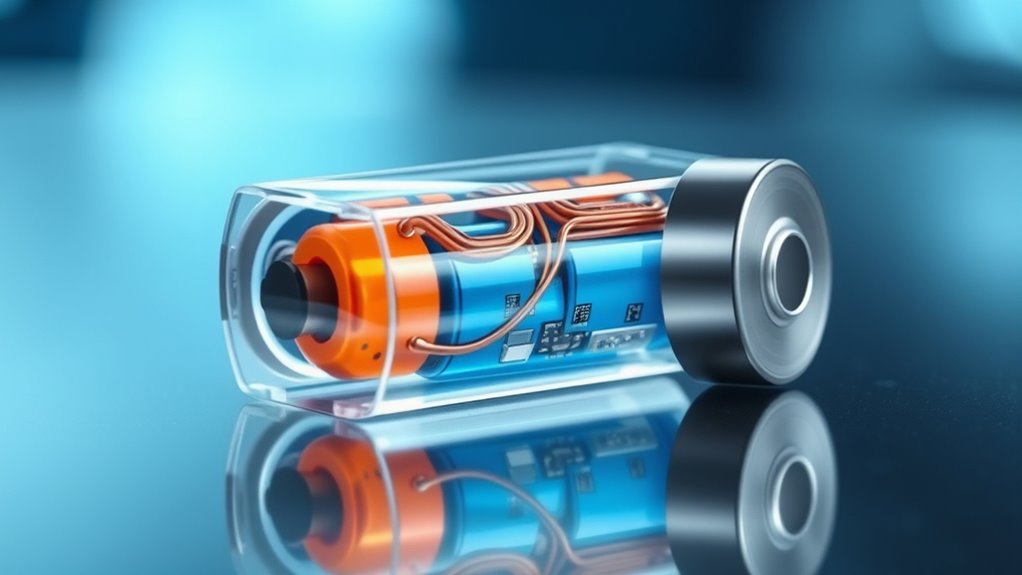
Are solid-state batteries the future of energy storage? It’s a question many are asking as technology advances and the demand for safer, more efficient power sources increases. Unlike traditional lithium-ion batteries that rely on liquid electrolytes, solid-state batteries use a solid electrolyte, which promises numerous benefits. The key advantage lies in electrolyte stability. Solid electrolytes are less prone to leakage, degradation, or thermal runaway, making them inherently safer. They resist the formation of dendrites—tiny needle-like structures that can pierce through liquid electrolytes and cause short circuits. This stability allows for the potential of higher energy densities, longer battery life, and improved safety, which are compelling reasons to consider solid-state options for everything from electric vehicles to portable electronics.
Solid-state batteries offer safer, more stable energy storage with higher potential for longevity and efficiency.
However, embracing this technology isn’t without hurdles. Manufacturing challenges play a significant role in slowing down widespread adoption. Producing solid-state batteries requires precise, scalable techniques to create uniform, defect-free solid electrolytes. These materials often involve complex processes, such as high-temperature sintering or delicate thin-film deposition, which can be costly and difficult to control at an industrial scale. Achieving consistent quality across large batches remains a significant obstacle. Furthermore, integrating solid electrolytes with electrodes demands advanced engineering to guarantee good contact and minimize resistance. Any imperfections can impair performance, reduce lifespan, or increase manufacturing costs. Manufacturing challenges are a critical barrier to large-scale deployment.
You also need to think about that current materials used as solid electrolytes—like ceramics or sulfides—have their own issues. Ceramics, while stable, are brittle and challenging to process into thin, flexible layers. Sulfides, on the other hand, tend to be sensitive to moisture and require careful handling, adding complexity to manufacturing lines. Overcoming these material-specific challenges is vital to making solid-state batteries commercially viable. Researchers are actively exploring new materials and fabrication techniques that could simplify production and improve electrolyte stability. But until these innovations mature, scaling up production remains a significant bottleneck.
Despite these hurdles, the potential benefits keep pushing the industry forward. If manufacturers can solve the electrolyte stability issues and streamline production challenges, solid-state batteries could revolutionize energy storage. They promise safer, more durable, and energy-dense solutions that can power the next generation of electric vehicles, portable devices, and renewable energy systems. While the road to commercial viability is still under construction, the progress made suggests that solid-state batteries could indeed shape the future of energy storage, provided these manufacturing challenges are addressed effectively.

KU XIU 2025 Solid-State Magnetic Portable Charger 5000mAh, Qi2-Certified 15W Wireless Power Bank, High Energy Density & Safety, Travel Magnetic Battery Pack for iPhone 17/16/15/14/13/12-Titanium
[Advanced Solid-State Battery – Safer, Smarter Charging] The KUXIU S2 brings world-leading solid-state battery technology to portable power…
As an affiliate, we earn on qualifying purchases.
As an affiliate, we earn on qualifying purchases.
Frequently Asked Questions
What Are the Main Challenges in Commercializing Solid-State Batteries?
You’ll face main challenges in commercializing solid-state batteries, mainly manufacturing hurdles and material compatibility issues. Manufacturing hurdles include scaling up production processes while maintaining quality and safety standards. Material compatibility remains tricky because some electrolytes don’t work well with electrodes, risking degradation or failure. Overcoming these obstacles requires innovative engineering and reliable materials, but doing so is essential to make solid-state batteries practical and widely available for various applications.
How Long Do Solid-State Batteries Typically Last Compared to Lithium-Ion?
You’ll find that solid-state batteries typically last longer than lithium-ion ones, often around 10-15 years or more. Their increased battery lifespan results from reduced degradation factors like dendrite formation and electrolyte breakdown. Since solid electrolytes are more stable, they resist wear and tear better, extending their durability. However, actual lifespan can vary depending on usage, temperature, and how well the battery is maintained.
Are Solid-State Batteries Environmentally Sustainable and Recyclable?
Think of solid-state batteries as a garden that’s more sustainable than a traditional one. They offer a lower environmental impact because their materials are less toxic and more stable. Recycling processes are improving, making it easier to reclaim valuable components. While they’re not perfect, they’re a step toward greener energy storage, reducing waste and environmental harm, and helping you contribute to a healthier planet.
When Will Solid-State Batteries Become Widely Available?
Solid-state batteries are expected to become widely available within the next 5 to 10 years. You’ll see market adoption increase as manufacturers improve manufacturing scalability, making production more cost-effective. Advances in materials and technology are accelerating this timeline, so expect these batteries to start replacing traditional lithium-ion cells in electric vehicles and electronics soon. Keep an eye on industry developments, as breakthroughs could shorten this timeframe even further.
How Do Solid-State Batteries Perform in Extreme Temperatures?
Imagine a winter landscape, where resilience is key. Solid-state batteries excel in extreme temperatures, offering remarkable thermal resilience and improved cold weather performance. Unlike traditional batteries, they resist freezing and overheating, maintaining stable energy output. This means you can rely on them during harsh conditions, ensuring your devices and vehicles keep functioning smoothly regardless of the weather. Their robustness makes them a promising solution for energy storage in any climate.

Fire Power Non-Sealed Battery Electrolyte Pack 570Cc 570CC CONV
Easy to use single use container
As an affiliate, we earn on qualifying purchases.
As an affiliate, we earn on qualifying purchases.
Conclusion
As you explore solid-state batteries, you’ll find they’re a game-changer—offering safety and higher energy density. Yet, they still face challenges like manufacturing complexities. Like a promising sunrise overshadowed by clouds, their potential shines bright, but hurdles remain. Embrace this technology’s promise, knowing that, just as dawn follows night, innovation will eventually illuminate the path to a sustainable energy future. The future is bright, even amidst current obstacles.

RENOGY REGO Lithium Battery 12V 104Ah LiFePO4 Solid State Battery 60+ BMS, 6000+ Cycles Life, 80% DOD, Super Slim 22.8×11.4×2.4", Lightweight, IP67 for RV, Marine, Off-Grid. Home Backup Energy
【Ultra-Slim Solid-State Design for Space Efficiency】At just 61mm thick and 12.8kg, this semi-solid-state battery is 50% slimmer than…
As an affiliate, we earn on qualifying purchases.
As an affiliate, we earn on qualifying purchases.

Electric Vehicle Batteries: From Sourcing to Second Life and Recycling
As an affiliate, we earn on qualifying purchases.
As an affiliate, we earn on qualifying purchases.