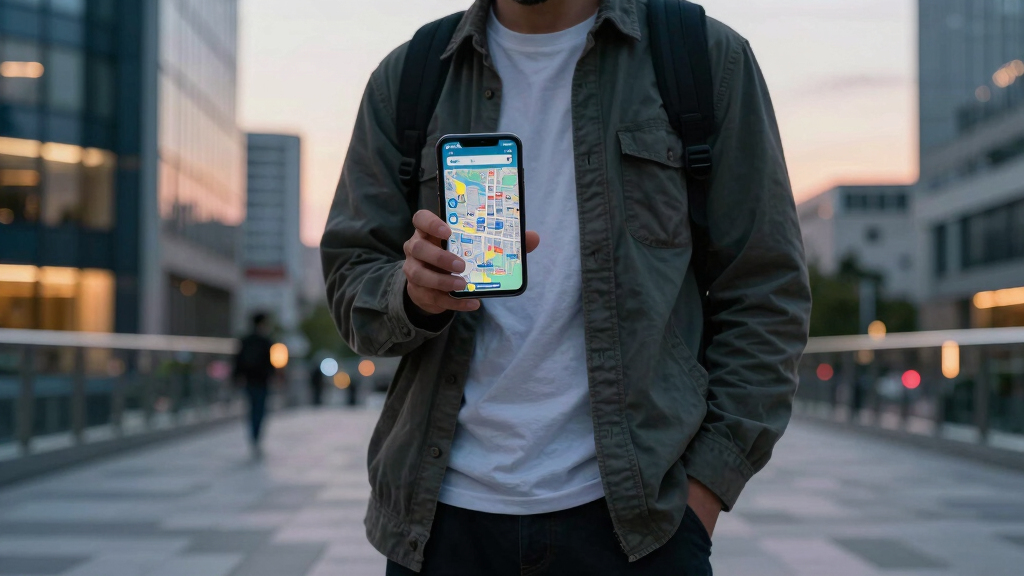

📊 Full opportunity report: The City That Watches Itself: The Living Digital Twin, And The God’s-Eye View We’re Building on ThorstenMeyerAI.com — validation score, market gap, and execution plan.

Turn your quiet moments into listening time
- Thousands of audiobooks, podcasts and originals
- Listen on your phone, tablet or Echo — also offline
- Cancel anytime
TL;DR
Urban digital twins are evolving into live, AI-driven models that monitor cities in real-time. This development enhances planning but also raises significant surveillance and sovereignty issues.
Cities are increasingly deploying dynamic digital twins that replicate urban environments in real-time, powered by advanced sensors and artificial intelligence. These models can answer complex questions about city operations, offering significant benefits for urban planning and management, but also raising concerns over privacy and sovereignty.
Recent technological convergence has enabled the creation of living digital twins—virtual replicas of cities that update second by second via data from sensors, satellite imagery, and AI processing. Notable examples include Singapore’s Virtual Singapore, which models every building and utility in three dimensions, and other cities like Helsinki and Las Vegas that are integrating similar systems for operational use.
These digital twins are now being enhanced with Wide-Area Motion Imagery (WAMI) sensors, which track every vehicle and pedestrian in real time, creating a detailed, rewindable record of city life. When combined with all-weather radar and AI capable of understanding complex data, these models can simulate scenarios, optimize urban infrastructure, and support decision-making at unprecedented levels.
However, the same technology also transforms the city into a surveillance apparatus. Experts warn that such comprehensive monitoring blurs the line between urban management and mass surveillance, raising questions about data sovereignty and privacy.
The city that watches itself: the living digital twin, and the god’s-eye view we’re building
Soon most cities will exist twice — once in concrete, once as a live data model you can rewind, simulate, and question in plain language. Persistent sensing + frontier AI turn the planner’s digital twin into an oracle. The most useful thing we’ve built — and the most powerful surveillance instrument. Both at once.
- Plan better — cities & rural: traffic, zoning, energy, land use
- Emergency response — route crews, one live picture, ~50% faster
- Disaster resilience — simulate, track live, assess damage in hours
- Mass surveillance — track everyone, retroactively, forever
- Pattern-of-life — AI links movements, infers associations
- Social control — no warrant, no suspicion (cf. Baltimore, 2021 ruling)
We’re building a city that watches itself, remembers everything, and can be asked anything. The technology won’t choose between saving lives and ending privacy — we will, through the rules we write now, while the twin is still under construction and the defaults haven’t yet hardened into permanence. WAMI and the living twin open our lives to a view from the heavens that, from the dawn of civilization until a heartbeat ago, was reserved for gods and stars. The question is no longer whether we can see everything — it’s who gets to look, and who watches the watchers.
Implications for Urban Governance and Privacy
The development of live, AI-powered digital twins has the potential to influence urban governance by enabling predictive planning and resource management, which could improve efficiency and urban quality of life. Nonetheless, these systems also introduce risks related to mass surveillance and questions about data sovereignty, especially if control over the twin’s AI is held by external entities. The dual-use nature of this technology makes it a significant consideration in discussions about urban oversight.
As an affiliate, we earn on qualifying purchases.
Rapid Advances in Sensor and AI Technologies Drive Growth
Over the past decade, urban digital twins have transitioned from static 3D models to dynamic, real-time systems. Singapore launched its Virtual Singapore following flooding incidents in 2012, and many cities now incorporate live data feeds into their planning processes. The recent integration of WAMI sensors and advanced AI models capable of understanding and querying complex data streams represent a notable progression, allowing cities to monitor and simulate their environments with increased accuracy.
While sensor and storage technologies have been available for some time, recent advances in AI comprehension have significantly expanded capabilities. Modern AI models like GPT-5.6 can interpret diverse data streams, identify patterns, and respond to natural language queries about city operations, transforming digital twins from static maps into interactive, interrogable systems.
“The convergence of sensors, AI, and data is enabling cities to develop digital twins that can be monitored and analyzed in real time.”
— Thorsten Meyer, AI researcher
AI-powered city monitoring devices
As an affiliate, we earn on qualifying purchases.
As an affiliate, we earn on qualifying purchases.
Unresolved Concerns Over Data Control and Privacy
The extent to which cities will retain sovereignty over their digital twins remains uncertain, especially as some systems rely on external AI providers. Discussions continue regarding potential misuse and the development of regulatory frameworks to address privacy and data control issues. The long-term impacts on residents and visitors are still under evaluation.
real-time city surveillance cameras
As an affiliate, we earn on qualifying purchases.
As an affiliate, we earn on qualifying purchases.
Future Developments in City Digital Twin Technology
Future advancements are expected to include AI models with enhanced reasoning and natural language capabilities, facilitating more proactive city management. Regulatory efforts are likely to focus on privacy protections and data sovereignty, with pilot programs expanding across various urban and rural settings. Monitoring the effects of these systems on governance and civil liberties will be an important area of ongoing research.
As an affiliate, we earn on qualifying purchases.
Key Questions
What is a digital twin in a city context?
A digital twin is a virtual, real-time replica of a city that integrates data from sensors, satellite imagery, and other sources to monitor, simulate, and analyze urban environments.
How do digital twins improve city planning?
They enable planners to test scenarios like new transit routes or zoning changes virtually, reducing errors, costs, and planning cycles.
What are the privacy risks associated with digital twins?
Because they can track individual vehicles and pedestrians continuously, digital twins pose mass surveillance risks, especially if control over the data and AI is foreign or unregulated.
Are all cities using this technology now?
While some cities like Singapore, Helsinki, and Las Vegas are actively deploying digital twins, widespread adoption is still in progress, with many regions testing or planning pilot programs.
What regulations are in place to protect privacy?
Regulations are emerging but vary by jurisdiction. Many experts call for stronger data sovereignty laws and oversight to prevent misuse of surveillance data.
Source: ThorstenMeyerAI.com
Fall Picks
fall essentials
As an affiliate, we earn on qualifying purchases.